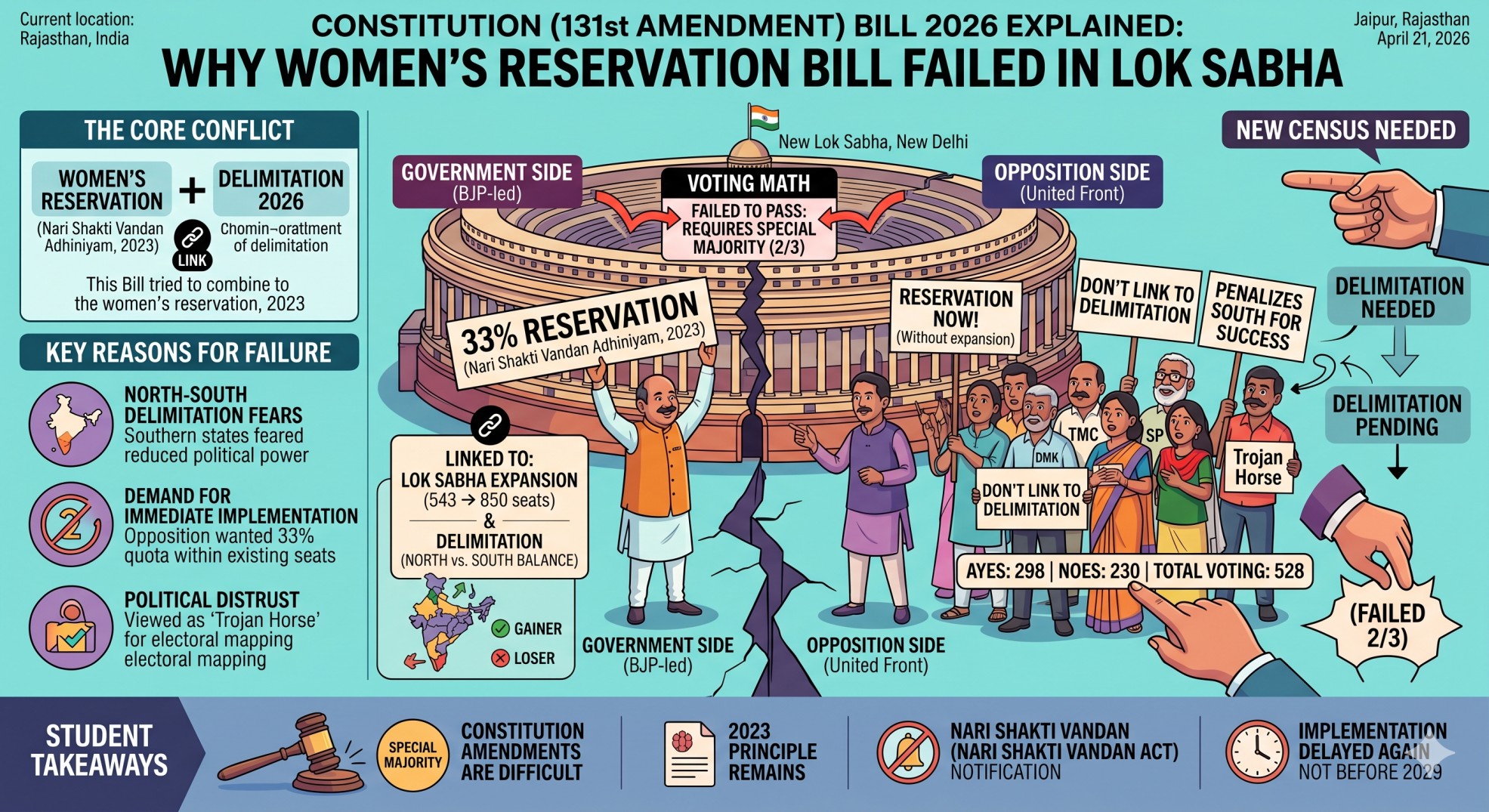
Constitution (131st Amendment) Bill 2026 Explained: Why Women’s Reservation Bill Failed in Lok Sabha
Constitution (131st Amendment) Bill, 2026: Women’s Reservation Bill Failure in Lok Sabha — Complete Constitutional Analysis, Timeline, Political Debate, Delimitation Impact, and Future of Women’s Representation in India
The Constitution (131st Amendment) Bill, 2026 aimed to implement 33% reservation for women in Lok Sabha and State Assemblies through earlier delimitation based on the 2011 Census. However, the bill failed in Lok Sabha after receiving 298 votes, falling short of the required two-thirds majority (352 votes).
Table of Contents
- Introduction
- Background of Women’s Reservation in India
- What Is the Constitution (131st Amendment) Bill, 2026?
- Key Objectives of the Bill
- Voting Results in Lok Sabha: Detailed Breakdown
- Why the Bill Failed Despite Majority Support
- Constitutional Amendment Procedure Under Article 368
- Special Majority Explained Simply
- Expansion of Lok Sabha Seats Proposal (543 → 850)
- Delimitation Reform and Its Role in Reservation
- Relationship With Nari Shakti Vandan Adhiniyam, 2023
- Why Women’s Reservation Was Not Immediately Implemented After 2023 Law
- Historical Timeline of Women’s Reservation Bill (1996–2026)
Introduction
Women’s representation in legislative institutions has been one of the most debated democratic reform issues in India over the last three decades. Although women constitute nearly half of India’s population, their participation in law-making bodies such as the Lok Sabha and State Legislative Assemblies has historically remained limited.
To address this imbalance, the Government of India introduced the Constitution (131st Amendment) Bill, 2026, which aimed to accelerate implementation of 33% reservation for women in Parliament and State Assemblies through delimitation based on the 2011 Census instead of waiting for the next census cycle.
However, despite widespread expectations and strong parliamentary debate, the bill failed to secure the constitutionally required two-thirds majority in the Lok Sabha.
This failure raised important constitutional, political, and federal questions regarding:
- representation reforms
- delimitation policy
- gender equality in politics
- parliamentary consensus
- implementation timeline of women’s reservation
Understanding this amendment requires examining India’s constitutional framework, electoral structure, demographic distribution, political history, and gender representation challenges.
This article provides a comprehensive explanation of the amendment proposal, its objectives, parliamentary voting results, historical background, constitutional implications, and future prospects of women’s reservation in India.
Background of Women’s Reservation in India
India adopted universal adult franchise immediately after independence in 1950. Women received equal voting rights from the beginning, unlike many Western democracies where women gained voting rights much later.
However, equal voting rights did not automatically translate into equal political representation.
Even after decades of democratic functioning:
women’s representation in Lok Sabha remains around 14–15%
representation in State Assemblies averages below 10%
These figures highlight the structural imbalance that continues to exist within legislative institutions.
Recognizing this gap, policymakers began discussing reservation mechanisms during the 1990s.
The goal was not symbolic inclusion but structural representation reform.
Women’s reservation aims to:
increase participation in policymaking
improve gender-sensitive legislation
strengthen democratic inclusiveness
encourage leadership among women
reduce institutional barriers
The 2026 amendment attempt must be understood within this long reform journey.
What Is the Constitution (131st Amendment) Bill, 2026?
The Constitution (131st Amendment) Bill, 2026 proposed to operationalize one-third reservation for women in legislative institutions earlier than previously planned under the 2023 constitutional amendment framework.
The bill included provisions to implement reservation in:
Lok Sabha
State Legislative Assemblies
Union Territory legislatures with elected assemblies
Its central objective was to remove the implementation delay caused by the requirement of future census-based delimitation.
Instead, it proposed using 2011 Census data as the basis for redrawing constituencies and applying reservation.
This proposal made the amendment politically significant because delimitation has long-term consequences for representation balance among Indian states.
Key Objectives of the 131st Amendment Bill
The amendment proposal had multiple strategic objectives.
These included:
accelerating women’s reservation implementation
reducing dependence on future census timelines
restructuring parliamentary representation
expanding Lok Sabha seat capacity
ensuring equitable demographic distribution
strengthening inclusive democracy
Each objective contributed to the broader goal of increasing women’s participation in legislative governance.
Voting Results in Lok Sabha: Detailed Breakdown
Because the proposal involved a constitutional amendment, it required a special majority under Article 368 of the Constitution.
Voting statistics were as follows:
Members present and voting: 528
Votes in favour: 298
Votes against: 230
Required votes: 352
Shortfall: 54 votes
Despite receiving majority support, the amendment failed because it did not reach the constitutionally mandated threshold.
This outcome demonstrates an important constitutional principle:
majority support alone is insufficient for constitutional amendments
special majority consensus is mandatory.
Why the Bill Failed Despite Majority Support
At first glance, receiving 298 supportive votes appears politically strong.
However, constitutional amendments follow stricter approval procedures than ordinary legislation.
Several reasons contributed to the bill’s failure.
These include:
delimitation-linked implementation concerns
regional representation imbalance fears
seat expansion debate
federal structure sensitivities
timing disagreements
political strategy differences
Together, these factors prevented the amendment from securing cross-party consensus.
Constitutional Amendment Procedure Under Article 368
Article 368 defines how the Constitution of India can be amended.
There are three types of amendment procedures:
simple majority amendments
special majority amendments
special majority plus state ratification amendments
Women’s reservation reforms fall within the category requiring special majority approval.
This requirement ensures constitutional stability while allowing necessary reforms.
Special Majority Explained Simply
A special majority means two conditions must be satisfied:
majority of total membership of the House
two-thirds of members present and voting
In this case:
528 members participated
two-thirds equals 352 votes
support reached only 298
Therefore, the amendment could not pass.
Expansion of Lok Sabha Seats Proposal (543 → 850)
One of the most important provisions in the amendment proposal involved expanding the size of Lok Sabha representation.
Current Lok Sabha strength:
543 elected members
Proposed strength:
up to 850 members
This expansion aimed to:
accommodate women’s reservation without reducing existing representation
adjust representation according to population growth
improve accessibility between MPs and citizens
strengthen proportional democracy
Seat expansion has been debated for decades due to demographic changes across states.
Why Seat Expansion Became Controversial
Increasing Lok Sabha seats affects representation balance among states.
States with higher population growth gain additional seats.
States with lower growth experience relative decline in representation share.
Southern states expressed concern regarding this issue.
They argued that population control efforts should not result in reduced parliamentary influence.
Therefore, linking reservation with seat expansion created political disagreement.
What Is Delimitation and Why It Matters
Delimitation refers to the process of redrawing boundaries of electoral constituencies.
Its objectives include:
ensuring equal representation
adjusting seat distribution according to population
strengthening democratic fairness
maintaining electoral balance
India completed its last delimitation exercise in 2008 using 2001 Census data.
Future delimitation is expected after post-2026 census updates.
This explains why delimitation became central to the amendment debate.
Why Delimitation Was Linked to Women’s Reservation
Reservation implementation requires identification of constituencies where seats will be reserved.
This cannot occur without updated constituency boundaries.
Therefore:
reservation implementation depends on delimitation
The 2026 amendment attempted to use older census data to speed up this process.
This proposal created disagreement among political parties.
Relationship With Nari Shakti Vandan Adhiniyam, 2023
The Nari Shakti Vandan Adhiniyam, 2023 already guarantees:
33% reservation in Lok Sabha
33% reservation in State Assemblies
reservation within SC/ST categories
rotation of reserved constituencies
However, implementation depends on:
future census
fresh delimitation exercise
The 2026 amendment attempted to accelerate implementation by bypassing waiting requirements.
Why Women’s Reservation Was Not Immediately Implemented After 2023 Law
Many citizens assumed reservation would begin immediately after the 2023 constitutional amendment.
However, constitutional provisions clearly state implementation must follow:
completion of next census
fresh delimitation process
Without these steps, constituency restructuring cannot occur.
Therefore implementation remains pending.
Historical Timeline of Women’s Reservation Bill (1996–2026)
Women’s reservation has a long legislative history.
Major milestones include:
1996 – first Women’s Reservation Bill introduced
1998 – reintroduced in Parliament
1999 – another attempt made
2003 – parliamentary debate continues
2008 – bill introduced again
2010 – passed in Rajya Sabha but not Lok Sabha
2014–2019 – issue remained pending
2023 – Nari Shakti Vandan Adhiniyam passed
2026 – Constitution (131st Amendment) Bill introduced to accelerate implementation
This timeline demonstrates the complexity of representation reforms in India.
Why Women’s Reservation Bills Faced Repeated Delays
Several structural and political reasons explain delays.
These include:
party-level disagreements
regional representation concerns
rotation system debates
quota within quota demands
delimitation dependency
constitutional complexity
Because reservation affects electoral competition structure, consensus takes time.
Understanding “Quota Within Quota” Debate
Some political groups demanded reservation within women’s quota for:
Other Backward Classes women
Minority women
They argued general reservation alone would not ensure inclusive representation.
This debate influenced legislative discussions across multiple attempts.
Women’s Reservation in Local Governance: A Successful Example
India already implemented women’s reservation successfully in:
Panchayati Raj Institutions
Urban Local Bodies
Through the 73rd and 74th Constitutional Amendments, at least 33% seats were reserved for women.
Several states increased reservation to:
50%
This produced significant improvements in grassroots leadership participation.
The success of local reservation strengthened arguments for national-level implementation.
Impact of Local-Level Reservation on Women’s Leadership
Studies show women representatives at local level contributed to improvements in:
sanitation infrastructure
education access
water supply
nutrition programs
health services
These results support the argument that legislative-level reservation can strengthen governance outcomes.
Global Comparison: Women’s Political Representation Worldwide
Several countries implemented reservation policies successfully.
Examples include:
Rwanda – highest women representation globally
Mexico – near equal gender representation
France – strong parity laws
United Kingdom – steady improvement
Nepal – constitutionally mandated inclusion
India’s progress remains slower compared to many developing democracies.
Why Women’s Representation Matters in Parliament
Representation influences policy outcomes.
Higher women participation improves attention toward:
maternal health
education reforms
gender safety
nutrition policy
social welfare programs
Inclusive legislatures create balanced governance structures.