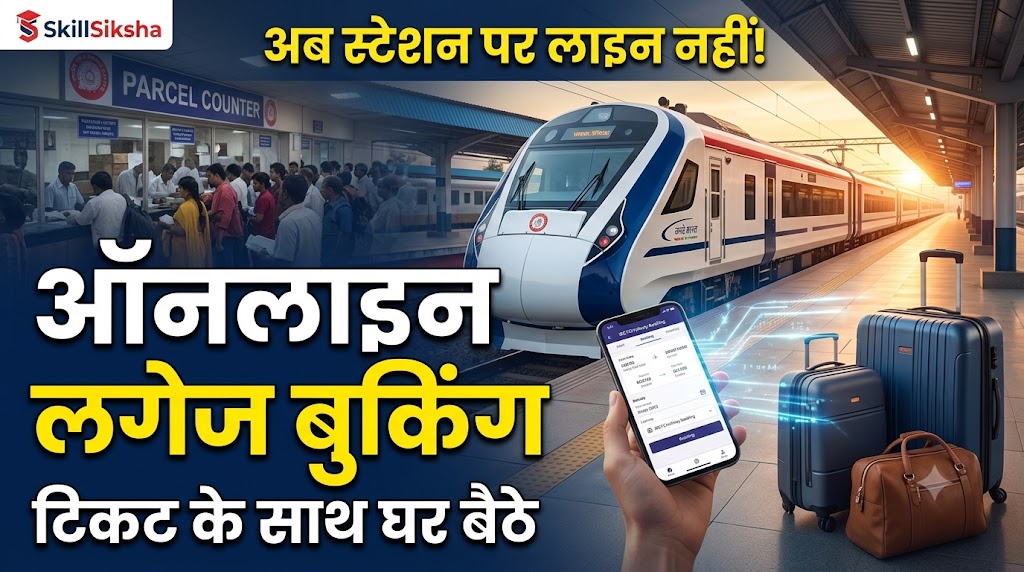
Indian Railways luggage rules update
Indian Railways Introduces Online Excess Luggage Booking with Ticket Reservations: A Major Step Toward Digital and Hassle-Free Travel
Indian Railways has introduced a new digital facility that allows passengers to declare and pre-book excess luggage online while reserving or managing their train tickets. The initiative, launched through the Railway Board and integrated with the Indian Railways Parcel Portal and the IRCTC ecosystem, is aimed at reducing queues at parcel offices, improving transparency in luggage charges, and making long-distance train travel more convenient for passengers.
For years, passengers carrying baggage beyond the free permissible limit had to visit the parcel counter at the station, fill out paper forms, get their luggage weighed, and pay additional charges before boarding. The new online process brings a significant part of this procedure into the digital domain and is being seen as an important modernization step in passenger services.
Why This New Facility Matters
India has one of the largest railway networks in the world, carrying millions of passengers every day. At major stations such as New Delhi, Mumbai, Chennai, Kolkata, Bengaluru, and other busy junctions, parcel and luggage counters often witness heavy congestion, especially during festive seasons, vacations, and long-distance travel periods.
Passengers traveling with extra baggage—such as students shifting to hostels, families relocating temporarily, tourists carrying large suitcases, or people transporting household items—frequently face time pressure before departure. The online declaration system is intended to reduce this last-minute rush and provide a more organized process.
The facility reflects Indian Railways’ broader push toward digital-first passenger services, similar to earlier initiatives such as online ticket booking, e-catering, live train tracking, digital refunds, and online parcel management.
What Exactly Is the Online Excess Luggage Booking Facility?
Under the new arrangement, a passenger holding a confirmed train ticket can declare luggage that exceeds the free allowance through the official parcel portal.
The service is available through:
-
Indian Railways Parcel Portal: parcel.indianrail.gov.in
-
Related luggage options integrated with the IRCTC platform
After entering journey details and luggage information, the system generates an estimated freight charge. The passenger can then submit an electronic forwarding note (e-forwarding note) before reaching the station.
It is important to note that the process is not fully paperless yet. The luggage still has to be physically presented at the originating station for weighing and verification, and the final charge is confirmed by railway staff.
How the Earlier Process Worked
Before this digital facility, the typical procedure involved:
-
Reaching the station well in advance.
-
Finding the parcel or luggage office.
-
Filling out a manual forwarding form.
-
Getting the baggage weighed.
-
Calculating charges manually.
-
Making payment at the counter.
-
Collecting the railway receipt.
This often consumed 20–60 minutes or more, depending on crowd levels.
Class-Wise Free Luggage Allowance
Indian Railways has different free luggage limits for different classes of travel. These limits continue to apply under the new system.
| Travel Class | Free Allowance | Maximum Permissible |
|---|---|---|
| AC First Class | 70 kg | 150 kg |
| AC 2-Tier / First Class | 50 kg | 100 kg |
| Sleeper Class | 40 kg | 80 kg |
| Second Class (General) | 35 kg | 70 kg |
| AC 3-Tier / AC Chair Car | 40 kg | 40 kg |
Important clarification
In AC 3-Tier and AC Chair Car, the free allowance is 40 kg and no additional excess baggage is permitted inside the passenger compartment beyond this limit. Oversized or excess items must be handled through the appropriate luggage booking process where applicable.
Standard Size Limits for Baggage
Indian Railways also prescribes dimension limits for items carried inside passenger coaches.
Maximum size for baggage inside passenger compartments
Length
100 cm
Width
60 cm
Height
25 cm
Oversized trunks, cartons, appliances, furniture, or bulky goods must be booked in the luggage or brake van rather than carried inside the passenger coach.
Step-by-Step: How to Book Excess Luggage Online
Here is the practical process a passenger needs to follow.
1. Visit the official portal
Open parcel.indianrail.gov.in or use the luggage option available through IRCTC.
2. Enter reservation details
Provide:
-
PNR number
-
Train number
-
Source station
-
Destination station
-
Date of journey
3. Declare luggage details
Enter:
-
Weight
-
Number of packages
-
Dimensions
-
Description of items
4. Submit the e-forwarding note
The portal calculates an estimated luggage charge based on the declared details and journey.
5. Present luggage at the station
Before departure, take the baggage to the parcel/luggage counter at the originating station for:
-
Physical weighing
-
Verification
-
Final charge confirmation
6. Make payment and collect receipt
After payment, the passenger receives a Railway Receipt (RR), which serves as the official document for the booked luggage.
Real-Time Tracking of Luggage
One of the useful additions is the Track & Trace feature.
Passengers can monitor the movement of their booked luggage through the parcel portal. The system is designed to provide status updates during transit and after arrival at the destination station.
In many cases, automated SMS alerts are also sent to the registered mobile number.
This is particularly helpful for:
-
Long-distance journeys
-
Connecting travel plans
-
Families traveling separately from their luggage
-
Passengers sending luggage ahead of their arrival
Penalty for Carrying Unbooked Excess Luggage
Indian Railways has also reiterated the rules regarding unbooked excess baggage.
If a passenger is found carrying luggage beyond the permissible free limit without proper booking, a penalty is charged.
Penalty rule
1.5 × the normal luggage rate
Calculated in 10 kg slabs
Minimum charge: ₹30
Traveling with undeclared excess baggage can therefore become significantly more expensive than pre-booking it through the official system.
A Real-World Example
Suppose a passenger is traveling from Delhi to Mumbai in Sleeper Class.
-
Free allowance: 40 kg
-
Actual luggage: 58 kg
Excess luggage = 18 kg
Under the new system, the passenger can declare the additional weight online, obtain an estimated charge, and complete verification at the station instead of discovering the issue during checking or at the last minute.
How This Helps Different Types of Passengers
Students
Students moving to colleges or hostels often carry books, clothes, and household items. Pre-booking reduces stress on the day of travel.
Families
Families traveling with children usually have multiple bags. Transparent charges help in planning.
Senior citizens
Less time spent standing in queues is a major advantage.
Tourists
Tourists carrying large suitcases or sports equipment can manage baggage more efficiently.
Temporary relocation
People traveling for jobs, training, or medical treatment often carry extra luggage and benefit from advance declaration.
Impact on Railway Stations
From an operational perspective, the facility can help railways in several ways:
Reduced crowding
Fewer passengers completing paperwork at the counter.
Faster processing
Advance data entry shortens counter transactions.
Better record keeping
Digital declarations improve data availability.
Improved accountability
Structured tracking reduces disputes and missing-item complaints.
Is This Similar to Airline Baggage Pre-Booking?
In some ways, yes.


5
Like airlines, Indian Railways is moving toward:
-
Advance declaration
-
Transparent pricing
-
Digital records
-
Tracking facilities
However, there are important differences:
| Airlines | Indian Railways |
|---|---|
| Fully online payment | Final verification at station |
| Automated baggage drop | Manual parcel/luggage handling |
| Strict weight enforcement | Class-based allowance system |
| Barcode-based tracking | Parcel portal tracking |
The railway system is therefore a hybrid model rather than a fully automated baggage system.
Important Things Passengers Should Remember
Before using the facility, keep these points in mind:
-
The ticket should be confirmed.
-
Reach the station well before departure for physical verification.
-
Declare the correct weight and dimensions.
-
Carry a copy or screenshot of the e-forwarding note.
-
Keep the Railway Receipt (RR) safely until the journey is completed.
-
Avoid carrying prohibited or hazardous items.
What Cannot Be Carried as Ordinary Luggage?
Railway rules restrict or prohibit items such as:
-
Inflammable substances
-
Explosives
-
Acids and corrosive chemicals
-
Gas cylinders (except permitted categories under rules)
-
Firearms without proper authorization
-
Dangerous goods
Such items cannot be booked as normal passenger luggage.
Digital Transformation of Indian Railways
The excess luggage facility is part of a larger digital transformation program that includes:
-
Online ticketing
-
UTS mobile ticketing
-
E-catering
-
Rail Madad grievance system
-
Live train status
-
Freight and parcel digitization
-
AI-based operational tools
-
Paperless communication in many departments
While the luggage system is still evolving, it represents another step toward integrating passenger services with digital workflows.
Challenges That May Remain
Despite the benefits, some practical challenges may continue in the initial phase:
Digital awareness
Many passengers may not know about the facility initially.
Internet access
Rural and elderly users may face difficulties.
Counter capacity
Physical weighing is still required.
Scalability
Implementation across all stations may take time.
The success of the initiative will depend on awareness campaigns, staff training, and smooth integration with existing parcel operations.
Conclusion
The introduction of online excess luggage booking with ticket reservations is a meaningful and practical reform by Indian Railways. It does not completely eliminate the need to visit the parcel counter, but it significantly simplifies the process by allowing passengers to declare baggage in advance, view estimated charges, and maintain a digital record of their booking.
For millions of passengers who travel with luggage beyond the free allowance, the new system offers greater transparency, reduced uncertainty, better tracking, and less time spent in queues. From the railway administration’s perspective, it can improve crowd management, record keeping, and operational efficiency.
As Indian Railways continues its journey toward a more modern and passenger-friendly network, this initiative may appear small compared with high-speed trains or new corridors, but for ordinary travelers carrying extra baggage, it has the potential to make a noticeable difference in the overall travel experience.