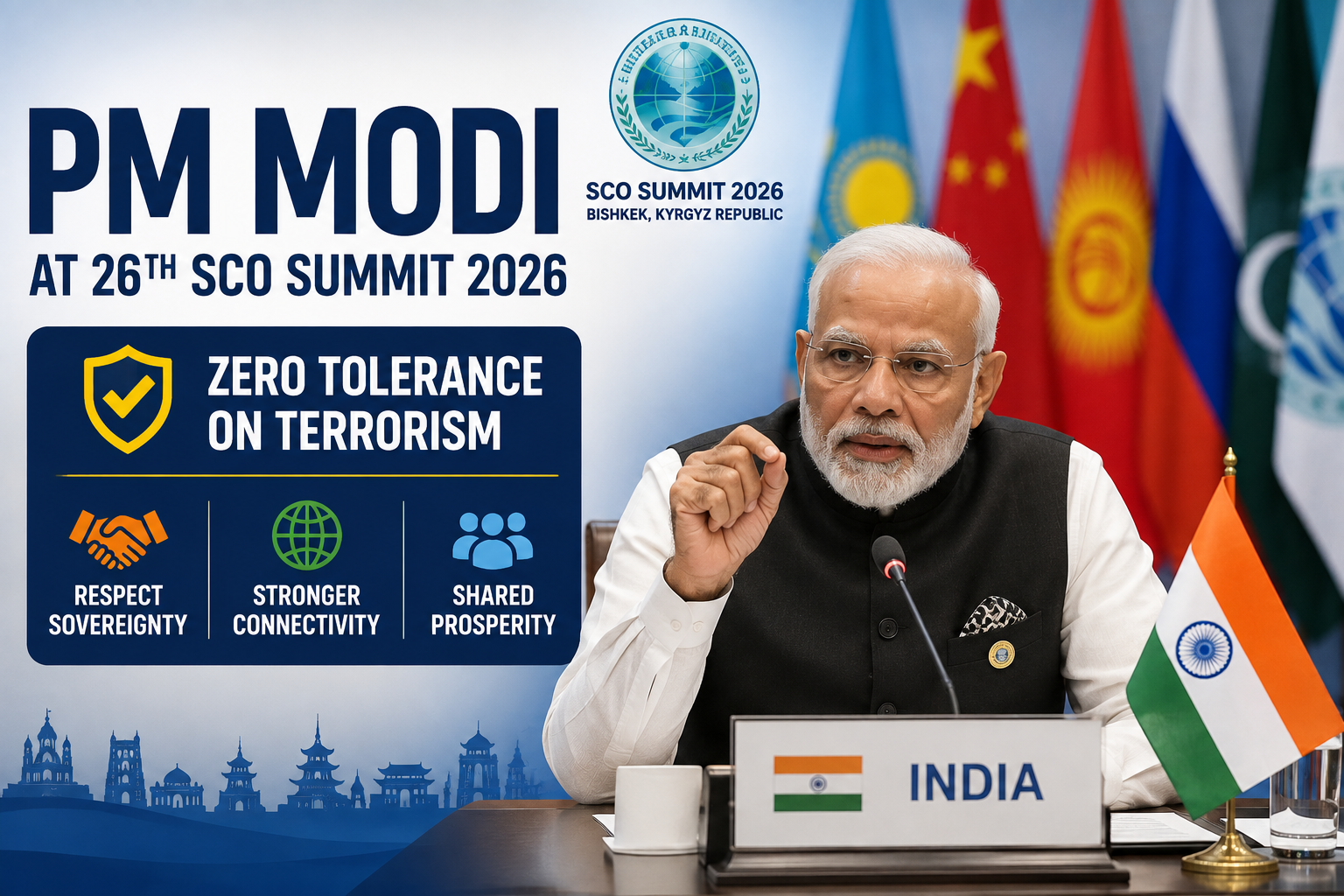
PM Modi at 26th SCO Summit 2026: Terrorism Message
PM Modi at 26th SCO Summit 2026: India Pushes for Zero Double Standards on Terrorism
PM Modi at 26th SCO Summit 2026 delivered a strong message on terrorism, regional security, connectivity and diplomacy as the Prime Minister addressed the Council of Heads of State of the Shanghai Cooperation Organisation (SCO) in Bishkek, Kyrgyz Republic.
The 26th SCO Summit was held from 31 August to 1 September 2026 and coincided with the organisation's 25th anniversary. PM Narendra Modi called for a long-term roadmap for the SCO and highlighted India's priorities of Security, Connectivity and Opportunity. (Press Information Bureau)
The strongest part of his address focused on terrorism. Modi said that the fight against terrorism cannot remain limited to an action-reaction approach. Instead, countries need to dismantle the entire ecosystem supporting terrorism, including terror financing, recruitment, radicalisation and safe havens. (Press Information Bureau)


26th SCO Summit 2026: What Happened in Bishkek?
The 26th Meeting of the Council of Heads of State of the SCO was organised in Bishkek, Kyrgyz Republic, on August 31 and September 1, 2026.
The summit came at an important moment for the organisation as the SCO marked its 25th anniversary. PM Modi said this milestone should be used to create a roadmap for the next 25 years while building on the organisation's tradition of dialogue and cooperation. (Press Information Bureau)
India's approach at the summit centred around three broad pillars:
-
Security
-
Connectivity
-
Opportunity
These priorities build on India's earlier SCO vision and seek to translate regional cooperation into concrete outcomes. (Press Information Bureau)
PM Modi's Strong Message on Terrorism
The central theme of PM Modi's address was the need for a united and consistent global approach against terrorism.
He argued that the international community cannot apply different standards depending on who commits or supports terrorism.
According to the Prime Minister, the SCO should speak with one voice on the issue and reject double standards. (Press Information Bureau)
His message focused on four interconnected components:
1. Terrorist Financing
Terrorist organisations require financial networks to operate, recruit members and maintain infrastructure.
PM Modi called for the dismantling of the ecosystem that enables terrorist financing.
2. Recruitment
Stopping terrorism also requires disrupting recruitment pipelines that bring new people into extremist organisations.
3. Radicalisation
The Prime Minister highlighted radicalisation as another part of the wider ecosystem that needs to be addressed.
4. Safe Havens
According to Modi, terrorist groups and their supporters should not be allowed to operate from safe havens.
The overall message was that counter-terrorism efforts should address the complete ecosystem, rather than responding only after attacks take place. (Press Information Bureau)
"Terrorism Can Never Be a Strategic Asset"
One of the strongest messages from PM Modi's speech was directed at countries that use terrorism as an instrument of policy.
He said that countries providing safe haven and support to terrorists must receive a clear message that terrorism can never become a strategic asset. (Press Information Bureau)
This represents a broader Indian position that terrorism should not be treated differently based on political considerations.
For India, the issue is particularly significant because cross-border terrorism has remained a major national-security concern.
India Calls for an End to Double Standards
India has repeatedly argued in international forums that terrorism should be condemned regardless of its origin, motivation or political context.
At the SCO Summit, PM Modi again stressed that there should be no double standards on such a serious issue. (Press Information Bureau)
The emphasis is not simply on condemning attacks after they happen. Instead, India is advocating stronger action against:
-
Terror financing networks
-
Recruitment mechanisms
-
Radicalisation channels
-
Terrorist safe havens
-
Organisations and individuals supporting terrorism
This approach aims to move international counter-terrorism policy from reaction to prevention.


Afghanistan and Security in Eurasia
PM Modi also connected regional security with developments in Afghanistan.
He noted that India's vision for a peaceful and secure Eurasia is closely linked with peace and stability in Afghanistan.
India has continued to provide humanitarian assistance to the Afghan people and has said it will continue contributing to humanitarian efforts. (Press Information Bureau)
Afghanistan is strategically important for the SCO because instability there can have consequences for:
-
Regional security
-
Terrorism
-
Extremism
-
Drug trafficking
-
Cross-border movement
-
Economic connectivity
For India, preventing Afghan territory from becoming a source of regional instability remains an important security objective.
Connectivity Must Respect Sovereignty
Another major issue raised by PM Modi was connectivity.
India supports stronger regional connectivity because transport corridors, ports and trade routes can increase commerce and economic opportunities.
However, Modi stressed that connectivity projects must respect the sovereignty and territorial integrity of SCO member states. (Press Information Bureau)
This is an important part of India's connectivity policy.
India's position is that infrastructure and trade corridors should not undermine the territorial rights or strategic interests of participating countries.
Why Connectivity Matters
Better connectivity can contribute to:
-
Faster movement of goods
-
Greater regional trade
-
Investment opportunities
-
Tourism
-
People-to-people contacts
-
Stronger economic relationships
But India believes these benefits should come through projects based on respect for sovereignty and territorial integrity.
India's Three Priorities: Security, Connectivity and Opportunity
PM Modi's broader SCO vision can be understood through three interconnected priorities.
| Priority | India's Focus |
|---|---|
| Security | Counter-terrorism, regional stability and cooperation |
| Connectivity | Trade corridors while respecting sovereignty |
| Opportunity | Economic cooperation, innovation and people-to-people ties |
The Prime Minister said India had shared this vision at the previous summit and that the SCO should now work toward achieving concrete outcomes in these areas. (Press Information Bureau)
West Asia Conflict and Global Economic Impact
PM Modi also addressed the wider consequences of conflicts, particularly the crisis in West Asia.
He pointed out that in today's interconnected world, a conflict in one region does not remain limited to that region.
Its effects can spread through:
-
Energy markets
-
Maritime trade
-
Shipping
-
Supply chains
-
Global economic activity
The Prime Minister emphasised dialogue and diplomacy as the way forward in addressing conflicts. (Press Information Bureau)
India's position is that regional conflicts should be resolved through peaceful diplomatic engagement while protecting civilians, commercial shipping and international trade routes.
PM Modi's Meetings on the Sidelines of the SCO Summit
The SCO Summit also provided an opportunity for India to engage bilaterally with important countries.
Meeting with Vladimir Putin
PM Modi met Russian President Vladimir Putin in Bishkek on the sidelines of the 26th SCO Summit.
The two leaders reviewed cooperation covering areas including:
-
Political relations
-
Economy
-
Defence
-
Energy
-
Space
-
Mobility
-
People-to-people relations
They also discussed global and regional developments, including the situations in West Asia and the Black Sea region. PM Modi reiterated that dialogue and diplomacy should guide efforts to resolve conflicts. (Press Information Bureau)
Meeting with Iran's President
PM Modi also met Iranian President Masoud Pezeshkian during the summit.
The two leaders discussed bilateral relations and developments in West Asia. Modi reiterated India's position that regional issues should be addressed through dialogue and diplomacy.
He also emphasised the importance of protecting freedom of navigation and commerce and ensuring that civilians, civilian infrastructure, commercial shipping and seafarers are not harmed. (Press Information Bureau)


SCO Civilisation Dialogue: India's Cultural Push
India also placed emphasis on the SCO's shared cultural and civilisational connections.
The Prime Minister highlighted the importance of the region's shared heritage and people-to-people relationships.
India has proposed strengthening cultural cooperation through a Civilisation Dialogue Forum under the SCO framework.
Such initiatives can create another layer of cooperation beyond security and economics by encouraging:
-
Cultural exchanges
-
Academic cooperation
-
Historical research
-
Youth interaction
-
Tourism
-
People-to-people connections
This is particularly relevant for an organisation covering a large and historically interconnected part of Eurasia.
Why the SCO Matters for India
The Shanghai Cooperation Organisation provides India with a platform to engage with major Eurasian countries on security, trade and regional issues.
India became a full member of the SCO in 2017. (Press Information Bureau)
The organisation is important for India because its discussions cover areas directly connected with Indian interests, including:
Regional Security
Terrorism, extremism and organised crime remain major security challenges.
Central Asian Connectivity
Central Asia provides opportunities for India's trade, energy, transportation and diplomatic engagement.
Afghanistan
Developments in Afghanistan have implications for India's security and regional interests.
Energy Security
Instability in major energy-producing regions can influence India's energy security and economy.
Trade Routes
Stable transportation and maritime routes are essential for India's international trade.
What India's Position Means for the SCO
PM Modi's address essentially called for the SCO to become more effective in addressing security and economic challenges.
India's message can be summarised in five points:
1. No double standards on terrorism.
All forms of terrorism should be dealt with consistently.
2. Dismantle the complete terror ecosystem.
Counter-terrorism must address financing, recruitment, radicalisation and safe havens.
3. Do not treat terrorism as a strategic tool.
Countries supporting terrorism should understand that terrorism cannot be used as a legitimate instrument of policy.
4. Connectivity must respect sovereignty.
Economic corridors should strengthen cooperation without compromising territorial integrity.
5. Dialogue should remain central to conflict resolution.
Regional and global conflicts require diplomacy rather than continued escalation. (Press Information Bureau)
26th SCO Summit 2026: Key Takeaways
| Issue | PM Modi's Position |
|---|---|
| Terrorism | Strong collective action |
| Double standards | Must end |
| Terror financing | Ecosystem must be dismantled |
| Recruitment | Terror recruitment networks must be disrupted |
| Radicalisation | Requires preventive action |
| Safe havens | Should not be tolerated |
| State support for terrorism | Must face an unambiguous message |
| Connectivity | Must respect sovereignty and territorial integrity |
| Afghanistan | Peace and stability are important for Eurasian security |
| West Asia | Dialogue and diplomacy should guide resolution |
| Cultural cooperation | Greater people-to-people and civilisational engagement |
| SCO's future | Focus on Security, Connectivity and Opportunity |
What Happens Next?
The significance of the 26th SCO Summit will ultimately depend on how far member states can translate political commitments into practical cooperation.
For India, the priorities are particularly clear: stronger counter-terrorism cooperation, secure connectivity, regional stability, economic opportunities and greater diplomatic engagement.
The call for eliminating double standards is also likely to remain an important part of India's international counter-terrorism diplomacy.
At the same time, India's emphasis on dialogue and diplomacy in relation to Afghanistan, West Asia and other conflicts demonstrates that New Delhi is seeking to combine firm security positions with diplomatic engagement.
Conclusion
The PM Modi at 26th SCO Summit 2026 address placed terrorism and regional security at the centre of India's message in Bishkek.
The Prime Minister called for an approach that goes beyond responding to individual terrorist attacks and instead targets the complete ecosystem of financing, recruitment, radicalisation and safe havens. He also urged SCO members to reject double standards and send a clear message that terrorism cannot become a strategic asset. (Press Information Bureau)
Beyond counter-terrorism, India highlighted Security, Connectivity and Opportunity as the three pillars for deeper SCO cooperation. Modi also stressed that connectivity must respect sovereignty and territorial integrity, while conflicts in regions such as West Asia should be addressed through dialogue and diplomacy. (Press Information Bureau)
With the SCO completing 25 years, India's message at Bishkek was therefore not limited to today's security challenges. It also focused on how the organisation can shape a more secure, connected and prosperous Eurasian region over the next 25 years.