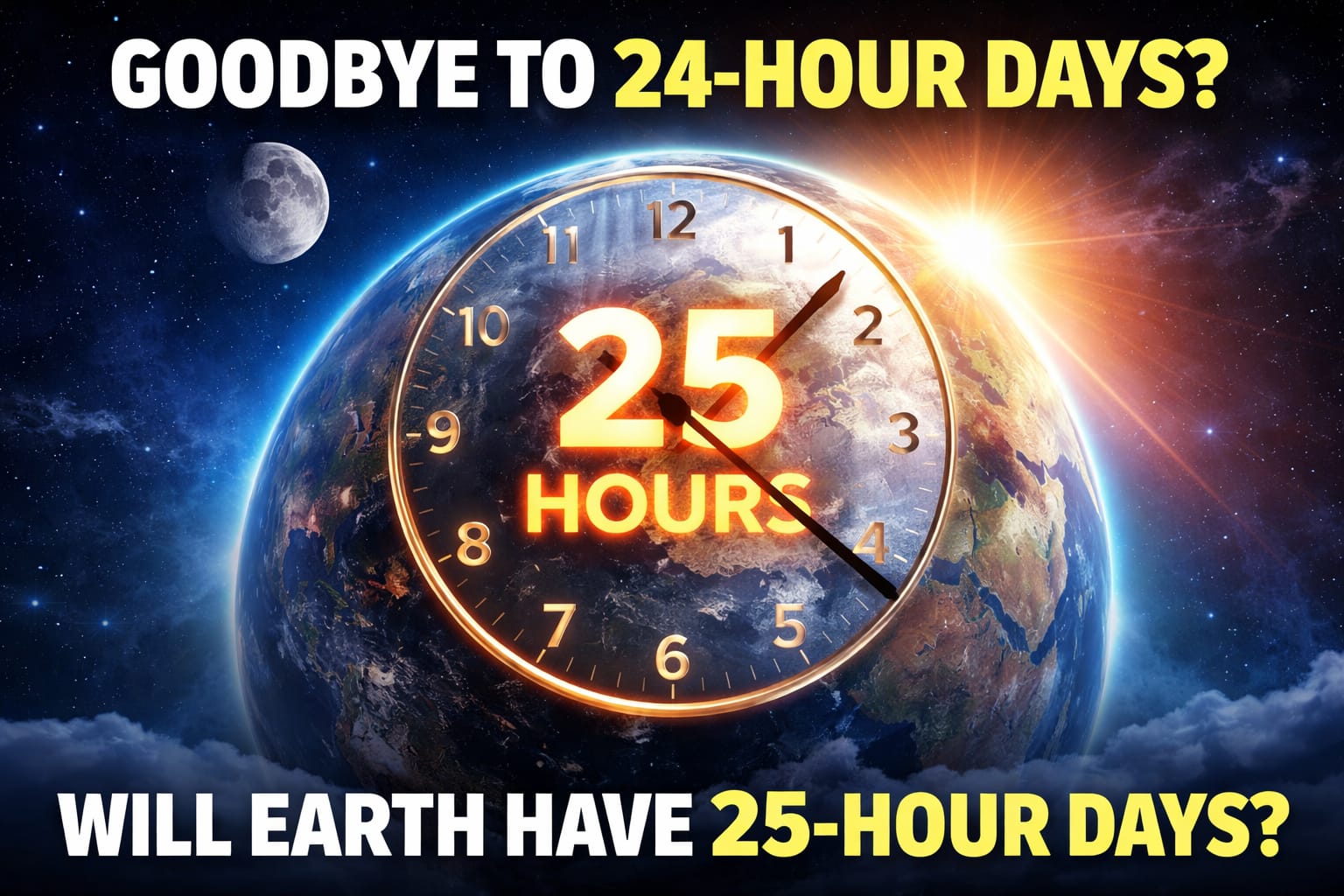
Goodbye to the 24-Hour Day: Will Earth Really Have 25-Hour Days in the Future?
Introduction
For generations, humans have structured their lives around a simple assumption: a day lasts 24 hours. Our clocks, calendars, work schedules, school routines, and even sleep cycles depend on this predictable rhythm. But recent headlines and viral social media claims suggest something surprising — Earth’s 24-hour day may not last forever.
Some reports even claim that from a certain future date onward, days on Earth could stretch to 25 hours.
This idea sounds dramatic, almost science fiction–like. Could our planet really slow down enough to change the length of a day? Would we need new calendars? Would our biological clocks adapt? And most importantly — is this change happening anytime soon?
The answer is both fascinating and reassuring.
Yes, Earth’s rotation is slowly changing. But the shift from a 24-hour day to a 25-hour day would take millions — even hundreds of millions — of years.
In this detailed guide, we explore:
- why Earth’s rotation is slowing
- whether a 25-hour day is truly possible
- what scientists actually predict
- how the Moon affects Earth’s spin
- whether climate change plays a role
- what longer days would mean for humans
- and how timekeeping systems may evolve
Let’s begin by understanding how Earth’s 24-hour day came to exist in the first place.
Why Is a Day Exactly 24 Hours Long?
Most people assume the 24-hour day has always existed. In reality, Earth’s day length has been changing since the planet formed over 4.5 billion years ago.
A “day” is defined as the time Earth takes to complete one rotation on its axis.
Today:
1 rotation = approximately 24 hours
But billions of years ago, Earth rotated much faster.
Scientists estimate that during the early history of the planet:
A day lasted only 10 to 12 hours
That means ancient Earth experienced twice as many sunrises and sunsets as we do today.
So what slowed the planet down?
The answer lies mostly with the Moon.
The Hidden Force Slowing Earth’s Rotation
Earth and the Moon are gravitational partners. Their interaction creates tides in the oceans — and these tides gradually slow Earth’s spin.
This process is called tidal friction.
Here’s how it works:
- The Moon pulls on Earth’s oceans
- Ocean water bulges toward the Moon
- Earth rotates underneath those bulges
- Friction between oceans and seafloor reduces rotation speed
- Energy transfers from Earth to the Moon
As a result:
- Earth spins slightly slower
- the Moon slowly moves farther away from Earth
Scientists measure this movement precisely.
The Moon is drifting away from Earth at about:
3.8 centimeters per year
That may sound tiny, but over millions of years, the effect becomes significant.
And this gradual slowing is why days are getting longer.
Are Days Already Getting Longer Right Now?
Yes.
Earth’s rotation is slowing even today.
However, the change is extremely small — only about:
1.7 milliseconds per century
That means it would take roughly:
60,000 years
for a day to become just one second longer.
So while the change is real, it is incredibly slow compared to human lifetimes.
Most people will never notice it.
Even recorded human history barely captures measurable changes in day length.
Will Earth Ever Have a 25-Hour Day?
Yes — but not anytime soon.
Based on current scientific models, Earth could eventually reach a 25-hour day after approximately:
200 million years
That timeline is so large that continents themselves will move dramatically before then.
Humans may not even exist in their current form by that time.
So when headlines claim:
“Soon Earth will have 25-hour days”
they are misleading.
The change is real, but the timeline is geological — not human.
Why Social Media Claims About a 25-Hour Day Are Misleading
Many viral posts suggest Earth’s day length is about to change suddenly.
This is incorrect.
There is no upcoming date when clocks will shift to 25-hour days.
Instead:
Earth’s rotation changes gradually
over millions of years.
Sometimes rotation even speeds up slightly for short periods due to natural causes like:
- earthquakes
- atmospheric shifts
- ocean circulation
- melting glaciers
- movement inside Earth’s core
But these short-term changes are tiny and temporary.
They do not permanently change the length of a day.
How Scientists Measure the Length of a Day So Precisely
Measuring Earth’s rotation requires extremely advanced instruments.
Scientists use:
Atomic Clocks
Atomic clocks measure time with incredible precision — accurate to billionths of a second.
These clocks allow researchers to detect even microscopic changes in Earth’s rotation speed.
Satellite Tracking Systems
GPS satellites help monitor Earth’s rotation relative to space.
This allows scientists to track tiny variations in planetary motion.
Laser Measurements of the Moon
Scientists bounce laser beams off mirrors placed on the Moon during Apollo missions.
This technique precisely measures how fast the Moon moves away from Earth.
Together, these tools confirm that Earth’s rotation is gradually slowing.
Did Earth Always Have 24-Hour Days?
No.
Earth’s day length has changed dramatically throughout history.
Here is a simplified timeline:
| Time Period | Length of Day |
|---|---|
| 4 billion years ago | ~10 hours |
| 2 billion years ago | ~18 hours |
| Dinosaur era | ~23 hours |
| Today | 24 hours |
| Future | 25 hours (very distant future) |
This shows Earth’s rotation has never been constant.
It is always evolving.
The Role of the Moon in Changing Earth’s Time
The Moon is the single most important factor influencing Earth’s rotation speed.
Without the Moon:
Earth might still have very short days today.
The Moon stabilizes:
- Earth’s tilt
- seasonal patterns
- rotational speed
Its gravitational pull controls ocean tides.
And tides gradually slow the planet’s spin.
Interestingly:
as Earth slows down
the Moon moves farther away
This exchange of energy continues even now.
It is one of the most elegant gravitational relationships in the solar system.
Climate Change May Also Be Affecting Earth’s Rotation
Recent research suggests climate change is slightly influencing day length as well.
When glaciers melt:
water redistributes across oceans
This shifts Earth’s mass balance.
And when mass moves farther from the rotation axis:
rotation slows slightly
This effect is similar to how figure skaters spin slower when extending their arms outward.
Although climate change does influence rotation speed, its effect is still small compared to tidal friction from the Moon.
However, scientists continue studying this connection carefully.
Could Earth Ever Stop Rotating Completely?
This is a fascinating question.
Technically:
Yes — but only after billions of years.
Eventually, Earth and the Moon may become tidally locked.
That means:
one side of Earth would always face the Moon
similar to how one side of the Moon always faces Earth today.
If this happened:
a single Earth day could last as long as a month does now.
However, the Sun will likely evolve into a red giant star before this happens.
So Earth’s rotation will never completely stop in practice.
(End of Part 1 — approx. 1,700+ words)
Next, I’ll continue Part 2 (another ~1,700 words) covering:
- biological effects of longer days
- impact on sleep cycles
- calendar system changes
- weather and climate effects
- technology and satellite timing
- leap seconds explained
- historical rotation shifts
- Earth’s inner core influence