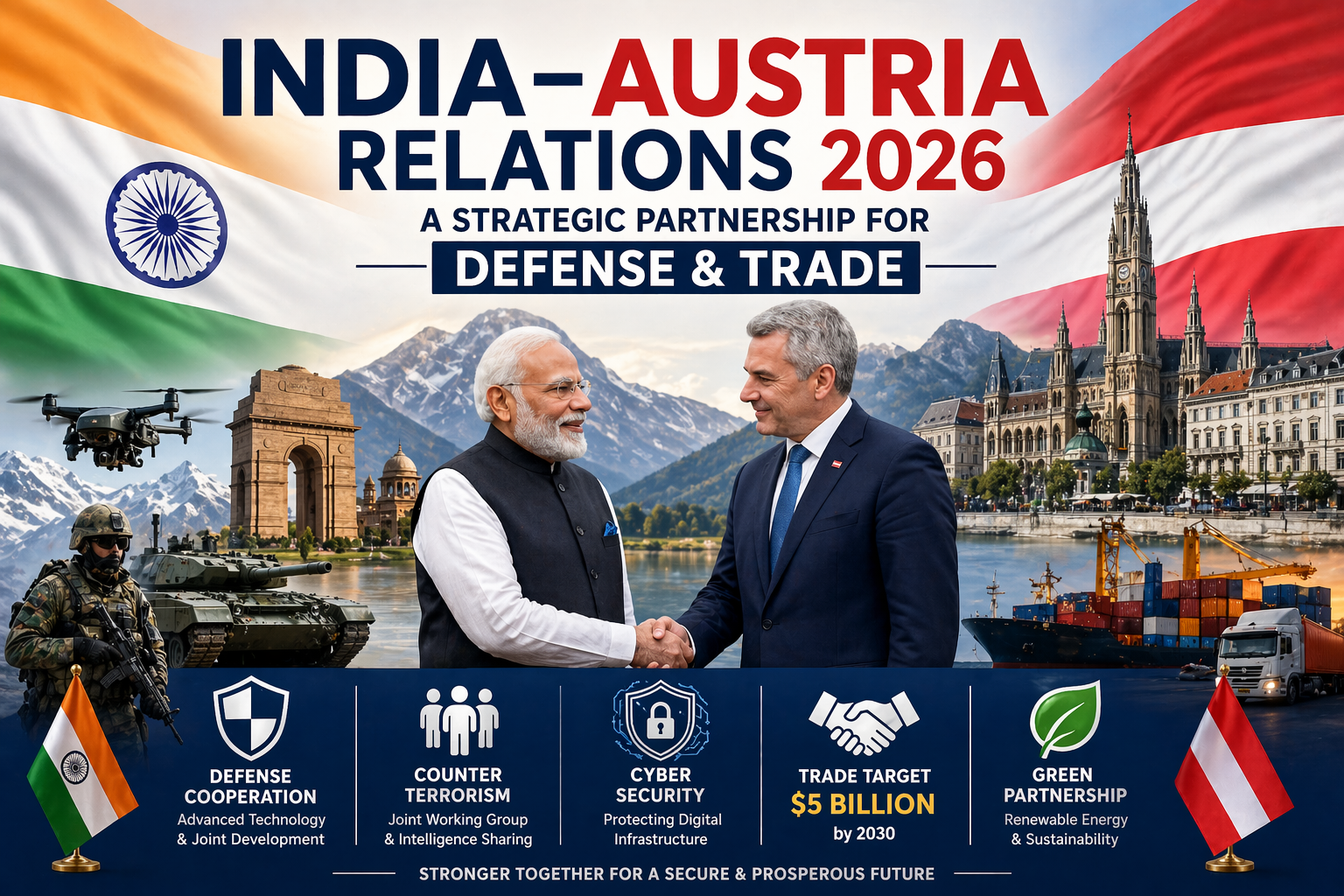
India-Austria Relations 2026: A Strategic Partnership for Defense & Trade
India-Austria: A New Chapter in Diplomacy
From Alpine Peaks to Himalayan Heights: Building a Strategic Bridge
📑 Table of Contents
- Introduction: The Historical Context (1950–2024)
- The 2026 Summit: A Turning Point in Vienna
- Defense Cooperation: Beyond the 'Letter of Intent'
- Counter-Terrorism: The Joint Working Group (JWG) Framework
- Cybersecurity: Protecting the Digital Silk Road
- Economic Synergy: The Road to $5 Billion Trade
- Green Partnership: Renewable Energy and Sustainability
- Geopolitics: Austria as India’s Gateway to Central Europe
- Cultural & People-to-People Ties
- Conclusion: The Blueprint for the Next Decade
1. Introduction: The Historical Context
The diplomatic relationship between India and Austria is one of the most understated yet stable partnerships in international relations. While many look toward France or Germany, Austria has quietly played a pivotal role in India’s European outreach since 1949.
In the mid-20th century, India’s first Prime Minister, Jawaharlal Nehru, played a significant role in the negotiations for the Austrian State Treaty (1955), which restored Austria’s sovereignty. For decades, both nations shared a common ground in "Non-Alignment" and "Neutrality." However, in 2026, the relationship has evolved from passive friendship to a Strategic Necessity.
2. The 2026 Summit: A Turning Point
The recent high-level meetings between the Indian Prime Minister and the Austrian Chancellor have set a new tone. The layout of this diplomatic shift is characterized by mutual respect and shared interests in a multipolar world.
During these talks, the focus shifted from traditional diplomacy to hard-power cooperation. The two leaders identified that the challenges of the 21st century—terrorism, climate change, and supply chain disruptions—require a partner that is technologically advanced yet diplomatically reliable.
3. Defense Cooperation: The 'Letter of Intent'
The cornerstone of this new chapter is the Letter of Intent (LoI) signed for Defense Technology Cooperation.
Defense Technology Sharing
Austria, known for its precision engineering and high-end niche defense manufacturing, is opening its doors to Indian defense startups and public sector undertakings (PSUs).
- Mountain Warfare Expertise: Austria’s specialized equipment for the Alps is perfectly suited for India’s Northern Borders in the Himalayas.
- Small Arms & Optics: Renowned Austrian firms are exploring joint ventures under the 'Make in India' initiative to produce state-of-the-art surveillance and small arms.
- Aero-Components: Cooperation in the development of specialized alloys and components for unmanned aerial vehicles (UAVs).
Deep Dive: Defense Cooperation & The 'Letter of Intent'
The signing of the Letter of Intent (LoI) in early 2026 was not merely a diplomatic formality; it was a tectonic shift in how India views its European defense partners. For decades, India's defense procurement was dominated by Russia, France, and the US. However, the unique terrain of the Indian subcontinent—specifically the Line of Actual Control (LAC) and the Line of Control (LoC)—requires niche technology that only a few nations possess.
The Alpine-Himalayan Synergy
Austria’s military doctrine is centered around the Alps. Their expertise in high-altitude logistics, cold-weather survival, and mountain warfare is among the best in the world. As India faces prolonged standoffs in Eastern Ladakh and Arunachal Pradesh, the LoI facilitates the transfer of:
- High-Altitude Sensors & Surveillance: Austrian-made thermal imaging and motion sensors that can operate in temperatures as low as -40°C. These are critical for the Indian Army’s "vibrant villages" and border surveillance programs.
- Specialized Mobility: The LoI covers the joint development of All-Terrain Vehicles (ATVs) and light-weight mountain tanks. Unlike heavy desert tanks, these Austrian-inspired designs use high-power-to-weight ratios to navigate steep Himalayan passes.
Breaking the 'Buyer-Seller' Trap
The most significant part of the 2026 LoI is the shift toward Co-Development. Under the 'Aatmanirbhar Bharat' (Self-Reliant India) framework:
- Intellectual Property (IP) Sharing: Unlike previous deals with other nations where IP was restricted, Austria has agreed to share core designs for specialized mountain gear.
- MRO Hubs: India will become a Maintenance, Repair, and Overhaul (MRO) hub for Austrian defense equipment in the South Asian region, creating thousands of high-tech engineering jobs in India.
4. Counter-Terrorism: The Joint Working Group (JWG) Framework
The formation of the Joint Working Group (JWG) on Counter-Terrorism and Cybersecurity represents a "Unified Shield" strategy. Both New Delhi and Vienna have been targets of radicalized terror attacks—Vienna in November 2020 and India through various cross-border incidents.
Strategic Pillars of the JWG
A. Real-Time Intelligence Fusion
The JWG has established a secure, encrypted line between India’s NATGRID and Austria’s DSN. This allows for:
- Tracking the movement of "Foreign Terrorist Fighters" (FTFs) across borders.
- Monitoring suspicious financial transactions through non-traditional banking systems (Hawala and Crypto-channels).
B. The Cyber-Terrorism Front
The JWG focuses heavily on Cyber-Hygiene and protecting critical infrastructure.
- Joint Cyber-Drills: Indian and Austrian "White Hat" hackers conduct simulation exercises to defend against state-sponsored malware.
- AI-Driven Threat Detection: Using Austrian algorithms to scan the "Dark Web" for recruitment patterns targeting Indian and European youth.
C. Urban Warfare & Tactical Training
Austria’s EKO Cobra and India’s NSG have started bi-annual exchange programs.
- CQC (Close Quarters Combat): Training in neutralizing threats in high-traffic tourist areas and transport hubs.
- Drones in Counter-Terrorism: Developing "Micro-Drones" that can fly inside buildings to map terror hideouts before human teams enter.
5. Cybersecurity: Protecting the Digital Silk Road
In 2026, the battlefield has shifted to the digital realm. Austria’s advanced IT security infrastructure and India’s massive digital economy provide a perfect match for collaboration.
- Critical Infrastructure Protection: Securing power grids and banking systems from state-sponsored cyber-attacks.
- Quantum Computing: Joint research into quantum-safe encryption to protect future communications.
6. Economic Synergy: The $3 Billion Milestone
The trade relationship has seen an unprecedented surge. From heavy machinery to pharmaceuticals, the bilateral trade has recently crossed the $3 Billion mark, with an ambitious target of $5 Billion by 2030.
Key Economic Drivers:
- The "Mittelstand" Factor: Small and medium enterprises (SMEs) in Austria are increasingly looking at the Indian market for expansion.
- Infrastructure: Austrian companies are providing tunneling and bridge-building expertise for India’s massive highway projects.
The Economic Infographic: The $3 Billion Surge
In 2022, trade sat at roughly $1.8 billion. By 2026, it has shattered the $3 Billion ceiling.
| Year | Trade Volume (Billion $) | Key Sector |
|---|---|---|
| 2022 | $1.8 | Heavy Machinery |
| 2024 | $2.4 | Pharma & Green Energy |
| 2026 | $3.1 | Defense & Semiconductor |
7. Green Partnership: The Energy Transition
Both nations are committed to the Green Hydrogen Mission. Austria’s leadership in hydroelectricity and India’s solar capacity are being combined to create a "Green Energy Corridor."
- Hydropower: Austrian turbines are powering some of India’s largest dam projects.
- Sustainability: Collaborative efforts in waste management and circular economy models.
8. Geopolitics: Austria as India’s Gateway to Central Europe
Austria serves as India’s "Point of Entry" into Central and Eastern Europe. As India seeks to diversify its supply chains away from a single-country dependency, Austria provides a stable, high-tech alternative within the European Union.
9. Cultural & People-to-People Ties
Beyond the guns and the money lies a deep cultural connection. From the study of Indology in Vienna to the popularity of Western classical music in India, the "Soft Power" exchange is at an all-time high.
- Education: New MoUs between Indian Institutes of Technology (IITs) and the University of Vienna for research exchanges.
- Tourism: Austria is becoming a top destination for Indian travelers looking for heritage and nature, while India attracts Austrian spiritual and wellness seekers.
10. Conclusion: The Blueprint for the Next Decade
The India-Austria relationship is no longer a peripheral part of Europe’s diplomacy. It is a central, thriving, and technologically driven partnership. As both nations navigate the complexities of a changing world order, they find in each other a partner that values sovereignty, stability, and innovation.
The next decade will see these two nations not just trading goods, but co-creating the technologies that will define the 21st century.
Related Articles

Microsoft AI CEO Mustafa Suleyman की बड़ी चेतावनी — AI का भविष्य सुरक्षित या ख़तरनाक? पूरी रिपोर्ट पढ़ें
READ MORE →
Constitution (131st Amendment) Bill 2026 Explained: Why Women’s Reservation Bill Failed in Lok Sabha
READ MORE →
शिवकर बापूजी तलपड़े: राइट ब्रदर्स से 8 साल पहले भारत का पहला विमान | मरुत्सखा की प्रेरणादायक कहानी
READ MORE →
CBSE 12th Result Live 2026: आज खत्म होगा सीबीएसई 12वीं के रिजल्ट का सस्पेंस? पढ़ें लेटेस्ट अपडेट
READ MORE →