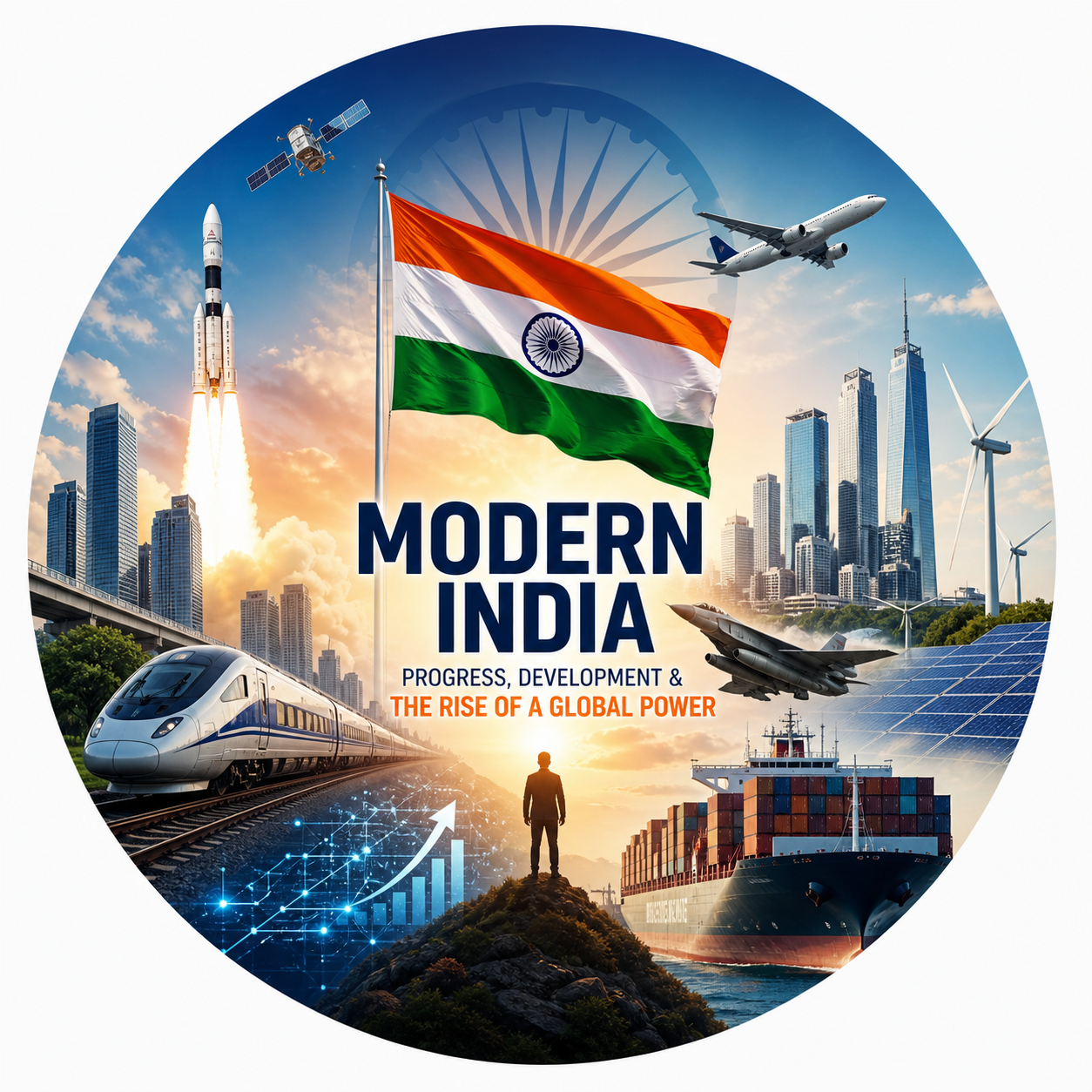
Modern India: A Nation Reimagined
Progress, Power, and the Promise of the 21st Century
An In-Depth Analysis for the Professional & Academic Reader
1. Introduction: Waking the Sleeping Giant
For most of recorded history, India stood at the very centre of the world economy. Ancient trade routes — from the Silk Road to the spice lanes of the Indian Ocean — converged on the subcontinent, and for millennia it contributed anywhere between a quarter and a third of global GDP. Then came two centuries of colonial extraction, partition, and the long reconstruction of independence. Yet today, in the third decade of the twenty-first century, India is once again ascending — not merely as an emerging market but as a civilisational power reshaping the international order.
The numbers, taken alone, are staggering. India is now the world's most populous nation, having surpassed China in 2023 with a population exceeding 1.44 billion. It is the fifth-largest economy by nominal GDP and the third-largest by purchasing power parity. Its technology sector generates nearly a quarter of a trillion dollars in annual revenue and employs over five million engineers. Its space agency, ISRO, soft-landed a rover near the lunar south pole in August 2023 — a first for any nation on Earth. Its middle class, depending on the threshold used, numbers between three and four hundred million people, making it larger than the entire population of the United States.
Yet these aggregates can obscure as much as they illuminate. India remains a country of staggering contrasts: gleaming metro systems and dusty bullock-cart roads; world-class cancer hospitals and villages without a single doctor; Nobel laureates and a workforce where hundreds of millions are still engaged in informal, subsistence-level agriculture. To understand modern India is to hold both realities simultaneously — the soaring aspiration and the grinding constraint, the inclusive constitution and the persistent inequality, the open democratic tradition and the anxieties about its durability.
This essay is an attempt to do exactly that: to survey modern India across its most consequential dimensions — economic transformation, technological rise, geopolitical assertion, social evolution, environmental challenge, and democratic health — with the rigour that a subject of this complexity demands. It draws on data, historical context, and analytical frameworks to offer a picture that is neither triumphalist nor defeatist, but as clear-eyed as the evidence allows.
India is not just a country. It is a civilisation that has survived every disruption known to history — invasion, plague, partition, and poverty — and each time reconstituted itself with extraordinary resilience. What is different today is the pace of transformation.
2. The Economic Transformation: From Licence Raj to Global Powerhouse
2.1 The Long Shadow of Dirigisme
To understand where India's economy is today, one must first appreciate where it came from. In 1947, the newly independent nation inherited an economy shaped by colonial underdevelopment: de-industrialised textile towns, infrastructure designed to extract resources rather than generate value, and near-total rural poverty. The founding leadership, influenced by Fabian socialism and the Soviet planning model, constructed an elaborate system of state controls — the so-called Licence Raj — under which virtually every significant business decision required government approval.
The results were not entirely without merit. India built a diversified industrial base, created world-class institutions of higher learning such as the IITs and IIMs, and laid the foundations of a scientific establishment. But the costs were severe: chronic capital misallocation, rampant rent-seeking, and an economy that by 1991 was teetering on the edge of default. With foreign exchange reserves sufficient to cover barely two weeks of imports, the government of Narasimha Rao — flanked by Finance Minister Manmohan Singh — flew to the International Monetary Fund, pledged gold as collateral, and initiated one of the most consequential packages of economic reforms in post-war history.
2.2 The Reforms of 1991 and Their Aftermath
The liberalisation of 1991 was not a wholesale adoption of the Washington Consensus; it was a pragmatic, sequenced opening that dismantled the worst excesses of control while preserving a large public sector. Import licences were abolished, industrial licensing requirements were gutted, and foreign investment restrictions were relaxed. The rupee was devalued and then made partially convertible. Tariffs were progressively lowered. The stock market was reformed and modernised.
The response was dramatic. GDP growth, which had averaged around 3.5 per cent during the so-called Hindu rate of growth era, accelerated to between 6 and 7 per cent through the 1990s, and then to 8 and even 9 per cent in the boom years of 2003–2008. A new private sector emerged with extraordinary dynamism: Infosys, Wipro, TCS, and dozens of other technology companies transformed Bangalore, Hyderabad, Pune, and Chennai into globally recognised hubs of software services.
The reforms also had significant distributional consequences. Poverty rates fell substantially: by most credible estimates, the share of Indians living in extreme poverty declined from over 45 per cent in 1993 to under 12 per cent by the early 2020s — lifting hundreds of millions out of destitution in what is, by any historical measure, one of the greatest poverty-reduction achievements ever recorded. Yet inequality also rose. The gains were unevenly distributed across sectors, regions, and social groups, producing a new class of ultra-wealthy industrialists alongside a missing middle of small and medium enterprises struggling to compete.
2.3 The Structure of Today's Economy
India today is an unusual economy in structural terms. In most successful development stories — South Korea, China, Taiwan — the transition from agriculture to industry preceded the rise of services. India, by contrast, has seen services become the dominant sector while manufacturing remains underdeveloped relative to the country's income level. Services account for roughly 55 per cent of GDP; industry, including manufacturing, for about 28 per cent; and agriculture for the remainder. Yet agriculture still employs close to 45 per cent of the workforce, creating an enormous productivity gap between sectors.
The consequences are profound. India's labour force adds approximately 12 million new workers every year — people leaving subsistence farming or completing their education and seeking employment. The formal manufacturing sector, which could absorb millions in medium-skill, decent-wage jobs, has never grown large enough to meet this demand. Make in India, the flagship manufacturing initiative launched in 2014, achieved some success in electronics assembly — India became a significant manufacturer of smartphones — but the broader goal of replicating China's industrial trajectory has proved elusive, constrained by land acquisition laws, rigid labour regulations, inadequate logistics infrastructure, and inconsistent power supply.
The IT and business process outsourcing sector, by contrast, has been a genuine miracle. India commands roughly 55 per cent of the global market for offshore IT services, generating revenues of approximately $245 billion in fiscal year 2024. More significantly, the sector has spawned an ecosystem of startups, venture capital, and product companies — from Flipkart and Zomato to Razorpay and Zepto — that mark India's evolution from a services factory for Western corporations into an innovation economy in its own right.
2.4 The Digital Financial Revolution
Perhaps the most underappreciated transformation in India's recent economic history is the digitalisation of its financial architecture. The Aadhaar biometric identity system, rolled out from 2009 onwards, now covers over 1.3 billion Indians. Built on this foundation, the Unified Payments Interface — UPI — has become the world's most remarkable real-time payments network. In 2023 alone, UPI processed over 100 billion transactions worth approximately $2 trillion. On some metrics, India now accounts for nearly half of all real-time digital payment transactions globally.
The implications reach far beyond convenience. Hundreds of millions of previously unbanked or underbanked Indians — migrant workers, small farmers, women in rural areas — now have access to formal financial services through their smartphones. Direct benefit transfers, which channel government subsidies electronically straight to beneficiaries, have dramatically reduced leakage and corruption in welfare programmes. Jan Dhan Yojana, the financial inclusion initiative, had opened over 500 million bank accounts by 2024. The combination of Aadhaar, UPI, and mobile banking has effectively created a new financial infrastructure that leapfrogs the brick-and-mortar banking model of earlier development eras.
3. Technology and Innovation: The New India Stack
3.1 From Back Office to Innovation Hub
For two decades, India's technology story was primarily a story of arbitrage: Western companies outsourcing software development, data entry, and call centres to a skilled, English-speaking, lower-cost workforce. That model remains important, but it no longer captures the full picture. India has become a genuine technology producer, and the India Stack — the layered digital public infrastructure of Aadhaar, UPI, DigiLocker, and an open-source health records system — has become an export model that dozens of countries are seeking to replicate.
The startup ecosystem reflects this shift. By 2024, India had produced over 100 unicorns — private companies valued at over $1 billion — across sectors ranging from fintech and edtech to logistics and agritech. Bengaluru routinely features among the world's top five startup cities by funding raised. Crucially, a new generation of product companies is building for global markets from day one, not merely servicing them as contractors. Freshworks became the first SaaS company founded in India to list on a US stock exchange; InMobi pioneered mobile advertising; Zerodha democratised retail stock investing.
3.2 Artificial Intelligence and the Emerging Frontier
India's engagement with artificial intelligence is both a source of enormous opportunity and a site of significant policy contestation. On the opportunity side, India has the world's largest reservoir of STEM graduates, producing over 1.5 million engineers annually. Its data advantage is formidable: more than 800 million internet users generate linguistic, behavioural, and transactional data at a scale matched only by China. Several Indian firms — including Sarvam AI, Krutrim, and divisions of TCS and Infosys — are developing large language models trained on Indian languages, attempting to build AI systems that are culturally and linguistically grounded in the subcontinent rather than translations of Western-centric models.
The government has committed substantial resources to AI through the IndiaAI Mission, with a focus on compute infrastructure, dataset development, and startup support. There is genuine ambition — and some scepticism — about whether India can develop frontier AI rather than simply applying technologies developed elsewhere. The talent pipeline is strong; the compute infrastructure remains nascent. The policy environment, including data governance frameworks, is still being constructed, and debates about the balance between innovation and privacy are actively unresolved.
3.3 Space: ISRO and the Chandrayaan Moment
India's space programme occupies a unique place in the national imagination and in global perceptions of Indian capability. The Indian Space Research Organisation, founded in 1969, has long been known for cost-efficient mission design — the Mars Orbiter Mission of 2013 cost $74 million, less than the budget of the Hollywood film Gravity. But the Chandrayaan-3 mission of August 2023 was of a different order of significance.
When the Vikram lander touched down near the lunar south pole on 23 August 2023 — just days after Russia's Luna-25 mission had crashed attempting the same feat — India became only the fourth nation to achieve a controlled lunar landing, and the first to do so at the south pole. The mission was not merely a symbolic achievement; it opened scientific territory of potentially enormous importance, as permanently shadowed craters near the lunar poles are believed to contain water ice, a resource critical for any sustained human presence on the Moon.
The Chandrayaan moment crystallised something important about modern India's relationship with science and technology: a willingness to attempt ambitious goals on constrained budgets, to learn from failure (Chandrayaan-2 had crash-landed in 2019), and to invest in capabilities that define a nation's status in the emerging space economy. India's commercial launch vehicle market, dominated by ISRO's PSLV and GSLV but increasingly open to private operators like Skyroot Aerospace and Agnikul Cosmos, is growing rapidly.
4. Geopolitics: India's Strategic Ascent
4.1 Non-Alignment Revisited: Strategic Autonomy in a Multipolar World
India's foreign policy has always been animated by a commitment to strategic autonomy — the preservation of maximum manoeuvre room in a world defined by great power rivalry. During the Cold War, this translated into the Non-Aligned Movement, which Jawaharlal Nehru helped found. Today, it manifests in India's simultaneous membership of QUAD (the security dialogue with the United States, Japan, and Australia), the Shanghai Cooperation Organisation (alongside China and Russia), BRICS (which India helped expand in 2023), and its ongoing role in the United Nations framework.
This multi-vector approach infuriates those who prefer clear alignments. During the Russia-Ukraine war, India refused to vote to condemn the invasion at the UN, continued purchasing discounted Russian oil, and simultaneously deepened defence ties with the United States and acquired significant military platforms from France and Israel. The logic, articulated by External Affairs Minister S. Jaishankar with unusual directness in his book The India Way, is that India's interests are served by maintaining working relationships with all major powers rather than subordinating itself to any bloc.
4.2 The China Challenge
No bilateral relationship is more consequential for India's future than its relationship with China, and none is more troubled. The two countries share the world's longest disputed border, and the June 2020 clashes in the Galwan Valley — in which twenty Indian soldiers and an unknown number of Chinese troops died in hand-to-hand combat — marked the most serious military confrontation between the two nuclear powers in decades. While partial disengagement has occurred at several friction points, the underlying territorial dispute is unresolved, and both sides have engaged in substantial military build-up along the Line of Actual Control.
The economic dimension adds further complexity. Despite political tensions, bilateral trade with China exceeded $120 billion in 2023, with India running a large deficit. India depends on China for critical pharmaceutical ingredients, electronics components, and a range of industrial inputs. Reducing this dependence is a stated policy goal, but supply chain restructuring of this magnitude takes years or decades. The paradox — deep economic interdependence combined with military standoff — defines what Jaishankar has called the most consequential relationship for India in the 21st century.
4.3 India and the Global South
India's G20 presidency in 2023 provided a striking demonstration of its ambitions as a leader of the developing world. The New Delhi Summit was notable for the inclusion of the African Union as a permanent member — a diplomatic coup that India claimed as evidence of its commitment to the Global South. Prime Minister Narendra Modi has consistently framed India as a voice for developing nations in a global economic architecture designed by and for wealthy countries.
This framing serves multiple purposes: it differentiates India from China (which also claims leadership of the developing world), it builds coalitions at international institutions, and it reflects genuine shared interests in reforming institutions like the IMF, World Bank, and WTO that many developing countries view as insufficiently responsive to their needs. India's development assistance programme — through the Indian Technical and Economic Cooperation scheme and bilateral grants — has expanded significantly, particularly in Africa and South Asia.
5. Social Transformation: A Society in Flux
5.1 Demographics: The Dividend and Its Discontents
India's demographic profile is simultaneously its greatest economic asset and its most demanding challenge. With a median age of approximately 28 years — compared to 38 for China, 42 for Europe, and 38 for the United States — India possesses a young and growing workforce at precisely the moment when much of the developed world is ageing. The demographic dividend — the economic boost that occurs when a large working-age population supports a smaller dependent population — is, in theory, India's to harvest over the next two to three decades.
But the dividend is not automatic. It requires the right investments in health, education, and job creation to convert young people from potential consumers into productive workers. India's record here is uneven. Literacy rates have risen dramatically — from under 20 per cent at independence to over 77 per cent today — and school enrolment has expanded enormously. Yet learning outcomes remain alarmingly poor: the Annual Status of Education Report consistently finds that a large fraction of children who have completed primary school cannot read a simple paragraph or perform basic arithmetic.
5.2 Gender and the Incomplete Revolution
India's trajectory on gender equality is a study in contradictions. On one hand, India has had a female Prime Minister, a female President, a female Finance Minister, and millions of elected women representatives at the local panchayat level. Its legal framework — from the Constitution's equality guarantee to the Domestic Violence Act and the Sexual Harassment at the Workplace Act — is among the more progressive in Asia. Women's labour force participation in the formal economy has risen, and female enrolment in higher education now exceeds male enrolment in some states.
On the other hand, India's female labour force participation rate — roughly 24 per cent — is among the lowest in the world, below even several of its South Asian neighbours. Son preference, rooted in patrilineal inheritance systems and dowry practices, has produced a skewed sex ratio in many northern states. Violence against women remains pervasive: the 2012 Delhi gang rape and murder case, which triggered massive nationwide protests, brought global attention to a problem that persists despite tightened laws and increased prosecution.
5.3 Caste: The Unfinished Business of the Republic
No single social fact is more central to understanding India than caste, and none is more contested. The caste system — the hierarchical division of society into hereditary occupational groups, with Brahmins at the top and Dalits (meaning the oppressed) at the bottom — is thousands of years old. The Indian Constitution of 1950 abolished untouchability, created reservations in government jobs and educational institutions for Scheduled Castes and Scheduled Tribes, and mandated non-discrimination. B.R. Ambedkar, the architect of the Constitution and himself a Dalit, understood that formal legal equality would not by itself dismantle social inequality rooted in centuries of structural exclusion.
The results of seven decades of affirmative action are mixed but significant. Dalits and Adivasis have made real gains in access to education and government employment. A Dalit, K.R. Narayanan, became President of India in 1997; another, Ram Nath Kovind, served as President from 2017 to 2022. Dalit political mobilisation has transformed electoral arithmetic in several states. Yet economic data consistently shows that Dalits and Adivasis remain over-represented in the poorest quintiles of the population and subject to social discrimination and violence that laws have not eliminated.
The political salience of caste has, if anything, increased in recent decades. The Mandal Commission's recommendation in 1990 to extend reservations to Other Backward Classes triggered violent protests and reshuffled the political landscape permanently. Today, caste calculations are central to electoral strategy, coalition-building, and policymaking at every level of government.
5.4 Religion, Identity, and the Majoritarian Turn
India was constituted as a secular democratic republic — a nation in which citizens of all religions would enjoy equal rights and the state would maintain neutrality in religious matters. This founding vision was not without tension even from the beginning, given the trauma of Partition and the communal violence that accompanied it. But for most of the republic's history, the secular framework held, with periodic — sometimes severe — ruptures.
The rise to power of the Bharatiya Janata Party under Narendra Modi in 2014, and its decisive re-election in 2019, marked a significant shift in the political culture of the country. The BJP and its ideological parent, the Rashtriya Swayamsevak Sangh, are rooted in Hindutva — a majoritarian ideology that defines Indian nationhood primarily in Hindu cultural terms. Critics argue that under BJP rule, minority communities — particularly Muslims, who constitute approximately 14 per cent of the population — have faced systematic marginalisation through a combination of legislative changes, administrative discrimination, and mob violence.
The Citizenship Amendment Act of 2019, which fast-tracked citizenship for religious minorities from neighbouring countries but excluded Muslims, triggered the largest protests India had seen since independence. The revocation of Article 370, which had given Jammu and Kashmir special status, was accompanied by the detention of thousands of political leaders and an extended communications blackout. Whether these developments represent a temporary electoral realignment or a deeper transformation of India's constitutional character is one of the most consequential — and bitterly contested — questions in contemporary Indian public life.
6. Infrastructure: Building the Bones of a Modern Nation
6.1 The Infrastructure Deficit and the Response
For decades, inadequate infrastructure was one of the most frequently cited constraints on India's growth. Power outages disrupted factories and households. Roads were too few, too narrow, and too poorly maintained to support efficient logistics. Ports were congested and slow. Airports were crowded and outdated. Urban water and sanitation systems were overwhelmed. The infrastructure deficit was estimated by various studies to reduce India's potential GDP growth by 1 to 2 percentage points annually.
From 2014 onwards, and with particular acceleration after 2019, the government launched what is arguably the most ambitious infrastructure investment programme in Indian history. The National Infrastructure Pipeline committed over $1.5 trillion to projects across roads, railways, airports, ports, urban infrastructure, and digital connectivity over a five-year horizon. The results have been substantial. The highway network has expanded dramatically: India built more national highway kilometres in 2022–23 than in any previous year on record. The Delhi-Mumbai Expressway — at over 1,300 kilometres, one of the world's longest — opened in phases from 2023.
6.2 Railways: The World's Largest System Modernising
Indian Railways is not just a transport network; it is a civilisational institution. With over 67,000 kilometres of track, 7,000-plus stations, and 22 million daily passengers, it is the world's fourth-largest railway network and, in many respects, the nervous system of the Indian economy. For decades, it was also celebrated for its democratic character while being notorious for its chronic under-investment and deteriorating safety record.
The Vande Bharat Express, a semi-high-speed train developed indigenously by Rail Coach Factory in Chennai, has become a symbol of railway modernisation. By 2024, over 100 Vande Bharat services were running across the country, dramatically cutting journey times on major corridors. The dedicated freight corridors — running on entirely separate tracks to passenger services — are transforming logistics, enabling faster and more reliable movement of goods between major industrial centres. The Mumbai-Ahmedabad High Speed Rail project, being built with Japanese technology and financing, will bring bullet train travel to India for the first time.
6.3 Cities and Urban Transformation
India is urbanising at an extraordinary rate. Already home to some of the world's largest cities — Mumbai, Delhi, Kolkata, Chennai, Bengaluru — India adds an estimated 30–40 million new urban residents every decade. By 2050, it is projected to be the world's most urbanised nation by absolute numbers. This urbanisation is both an enormous opportunity — cities are the primary engines of economic productivity — and an immense management challenge.
The Smart Cities Mission, launched in 2015, sought to upgrade urban infrastructure and governance in 100 cities through a combination of public investment and technology-enabled management. Results have been uneven. Some cities — Surat, Pune, Indore — have made significant improvements in solid waste management, public transport, and digital services. Others have struggled to translate funding into functional change. The deeper problem is that Indian cities, with their overlapping jurisdictions and chronically underfinanced local governments, lack the institutional capacity to manage rapid urbanisation effectively.
7. Environment and Sustainability: The Tightrope Walk
7.1 The Development-Environment Dilemma
India faces one of the most acute versions of the development-environment dilemma confronting any major nation. It is simultaneously one of the world's most climate-vulnerable countries and one of its largest emitters of greenhouse gases. It has 600 million people in regions highly exposed to climate impacts — extreme heat, erratic monsoons, sea-level rise, glacial retreat — while also having 300 million people still without access to reliable electricity and hundreds of millions more who aspire to the material living standards of the global middle class.
India's argument at international climate negotiations has been consistent: the wealthy nations that caused the climate crisis through their historical emissions must bear the primary burden of addressing it, and developing nations must not be denied the development pathway that was available to Europe and North America. This argument has considerable justice behind it — India's cumulative historical emissions are a fraction of those of the United States, Europe, or China — but it is increasingly difficult to sustain in a world where India's annual emissions are the third-largest globally.
7.2 Renewable Energy: An Unlikely Leader
Whatever the tensions in climate diplomacy, India's domestic record on renewable energy is more impressive than is commonly recognised. India has set — and largely met — ambitious targets for solar and wind capacity addition. By 2024, total renewable capacity (including large hydro) exceeded 180 gigawatts, with solar alone accounting for over 80 GW. India is routinely among the world's top five nations for new solar installations. The International Solar Alliance, co-founded by India and France, has brought together over 120 countries around shared solar energy goals.
Prime Minister Modi pledged at COP26 in Glasgow in 2021 that India would achieve 500 GW of non-fossil electricity capacity and source 50 per cent of its energy from renewables by 2030, and reach net zero by 2070. Analysts assess that the 2030 targets are achievable — indeed, some may be met ahead of schedule — while acknowledging that coal will remain a significant part of India's energy mix for at least another two to three decades.
7.3 Water, Air, and Biodiversity
India's environmental challenges extend well beyond climate change. Air quality in its major cities is a public health catastrophe: Delhi regularly records air quality index figures that classify the air as severe or hazardous, and the annual winter smog season — caused by a combination of vehicle emissions, industrial pollution, and crop stubble burning in Punjab and Haryana — has become a defining feature of life in the capital. Particulate matter pollution is estimated to reduce life expectancy in northern India by an average of five years.
Water stress is another existential concern. India is a water-scarce country by any global standard — per capita water availability has declined by over 70 per cent since independence as the population has grown. Groundwater is being extracted at rates that exceed recharge in much of the Indo-Gangetic Plain, the country's agricultural heartland. The National Green Tribunal, established in 2010, has become an important institutional mechanism for environmental enforcement, but its capacity to address the scale of the challenge remains limited.
8. Democracy: Strength, Stress, and the Question of Resilience
8.1 The Miracle of Indian Democracy
India's democratic achievement is, in historical context, remarkable to the point of improbability. A country that was desperately poor, overwhelmingly illiterate, deeply divided by religion, caste, language, and region, and had no prior democratic tradition was granted universal adult suffrage in 1950. The pessimists predicted rapid collapse into authoritarianism or chaos. They were wrong. India has held free and fair elections, with high levels of participation, for seven decades. Power has changed hands at the state and national level through the ballot box. An independent judiciary, a free press, and a vibrant civil society have functioned as checks on executive power.
The Election Commission of India, established as a constitutional body with genuine independence, has overseen elections of extraordinary logistical complexity — the 2024 general election involved over 970 million eligible voters and 1.5 million polling stations — with a level of competence and credibility that is the envy of many developing nations. The Supreme Court has, over the decades, expanded the justiciable reach of fundamental rights and subjected executive action to judicial scrutiny in ways that have meaningfully constrained government power.
8.2 Stresses on the Democratic Framework
Yet the health of Indian democracy is a matter of genuine scholarly debate. Freedom House downgraded India from Free to Partly Free in 2021, citing concerns about shrinking civic space, the suppression of dissent, and threats to minority rights. The V-Dem Institute has classified India as an electoral autocracy, a categorisation that the Indian government has vigorously disputed. These assessments are contested, and critics of the critics note that India continues to hold competitive elections with genuinely uncertain outcomes.
The concerns are nevertheless real and documented. The Sedition Law — a colonial-era provision used against freedom fighters by the British — has been deployed against journalists, activists, and opposition politicians with greater frequency. Several high-profile journalists and media organisations have faced tax raids, legal cases, or effective government pressure that critics argue amounts to a chilling effect on investigative reporting. The use of the Unlawful Activities (Prevention) Act, which allows detention without bail for extended periods, against activists and academics has drawn criticism from the Supreme Court as well as human rights organisations.
8.3 Federalism and Centre-State Tensions
India's constitutional design is federal in structure but unitary in spirit — the Centre retains extensive powers over states, including the ability to dismiss elected state governments and impose President's Rule. The Goods and Services Tax, introduced in 2017, was a landmark achievement of cooperative federalism, replacing a complex tangle of central and state levies with a unified national market. But implementation generated significant friction, particularly over revenue-sharing arrangements.
Several non-BJP state governments have accused the Centre of discriminating in resource transfers, delaying approval for state-funded schemes, or using the Governor's office to interfere in elected state governments. These tensions are a natural feature of any mature federation, but they have been sharper in recent years than at any point since the 1970s.
9. Culture, Soft Power, and the Indian Imagination
9.1 Cinema, Music, and the Global Reach of Indian Culture
Long before soft power became a term of diplomatic art, India was exercising it through culture. Hindi cinema — Bollywood — has been a cultural export of enormous reach, particularly across Asia, Africa, and the Indian diaspora. Films like Sholay, Dilwale Dulhania Le Jayenge, and more recently the works of Anurag Kashyap or S.S. Rajamouli have found audiences from Cairo to Jakarta to Lagos. The global success of RRR — a Telugu-language epic that won an Academy Award for Best Original Song in 2023 and became a cult phenomenon in Japan and the United States — signals a new phase in which Indian cinema is reaching global audiences not as a niche ethnic product but as mainstream entertainment.
Indian classical music traditions — Hindustani in the north, Carnatic in the south — are among the world's most sophisticated performing arts, with continuous lineages stretching back more than a thousand years. Yoga and Ayurveda, systematised and exported through a combination of traditional institutions and modern marketing, have become global wellness industries worth hundreds of billions of dollars. Indian cuisine, adapted and localised across the world, is among the most widely consumed globally. The Indian diaspora — 32 million strong and among the wealthiest immigrant communities in any country — serves as a cultural bridge and an informal diplomatic network of extraordinary reach.
9.2 Literature, Philosophy, and Intellectual Life
India's literary tradition is ancient and diverse. The Sanskrit corpus — encompassing the Vedas, Upanishads, epics, and a vast body of philosophy, mathematics, and natural science — constitutes one of the great intellectual achievements of human civilisation. The philosophical traditions of Advaita Vedanta, Buddhism, Jainism, and Sufism have profoundly influenced global thought. Modern Indian literature in English — from Rabindranath Tagore, the first non-European Nobel laureate in Literature, to Salman Rushdie, Arundhati Roy, and Jhumpa Lahiri — has earned global recognition while grappling with the specific conditions and contradictions of Indian modernity.
India's intellectual life is vibrant but contested. The relationship between the traditional Sanskrit learning culture and modern Western-inflected university education has always been uneasy. Today, debates about historical narratives — whether school textbooks should emphasise the Hindu civilisational legacy or the plural, syncretic tradition — have become politically charged, with significant implications for how the next generation of Indians understands its own past.
10. India at 2047: Projections and Possibilities
10.1 The Viksit Bharat Vision
India will celebrate the centenary of its independence in 2047. Prime Minister Modi has set the goal of achieving Viksit Bharat — Developed India — by that date: a country in the top tier of global economies, with per capita income comparable to upper-middle income nations, universal access to basic services, and a central role in shaping the global order. This is an ambitious vision, and its achievement is neither guaranteed nor impossible.
The economic pathway is mathematically plausible. If India maintains average GDP growth of 6.5 to 7 per cent per annum over the next 23 years — roughly its historical average since the reforms — it will become the world's third-largest economy in nominal terms by the late 2020s and could approach $20–25 trillion in GDP by 2047. Per capita incomes would rise from around $2,500 today to perhaps $10,000 or above — firmly in the upper-middle income range.
10.2 The Risks and Constraints
The risks to this trajectory are multiple and interacting. Climate change is perhaps the most severe: the IPCC projects that South Asia will experience some of the world's most severe climate impacts, including deadly heat-humidity combinations that could render large parts of the Indo-Gangetic Plain physiologically uninhabitable for outdoor labour during summer months by mid-century. Water stress, crop yield volatility, and more frequent extreme weather events could impose economic costs that dwarf the benefits of growth.
Political risks are also significant. Democratic backsliding — if it continues — risks the institutional quality that makes India a credible destination for long-term investment and a rule-of-law partner for democratic allies. Social fragmentation — along religious, caste, or regional lines — risks the social cohesion that rapid development requires. The governance capacity to deliver complex transformations — reforming education, improving healthcare, managing urbanisation, enforcing environmental standards — remains a binding constraint in many parts of the country.
10.3 The Enduring Strengths
Against these risks must be set India's enduring strengths. Its democracy, however imperfect and stressed, provides feedback mechanisms, correction channels, and legitimacy that authoritarian systems cannot replicate. Its courts, press, and civil society, however constrained in the current environment, have institutional roots that will outlast any particular government. Its diversity — of language, religion, cuisine, art, and philosophy — is a source of extraordinary creativity that has, across millennia, absorbed and transformed every challenge it has encountered.
India's young population, if appropriately educated and employed, is the most valuable demographic asset on Earth. Its diaspora is a network of talent, capital, and goodwill that no other nation can match in proportional terms. Its civilisational confidence — the sense, shared broadly across its political spectrum, that India has a distinctive contribution to make to the world — provides the psychological foundation for the sustained, generational effort that development requires.
Conclusion: The Unfinished Project
India is, above all, an unfinished project. It is a nation that chose an extraordinarily difficult constitutional design — democracy, secularism, federalism, and social justice, simultaneously and for all — and has been wrestling with the contradictions and aspirations of that choice ever since. The wrestling is often uncomfortable, sometimes violent, and frequently dispiriting. But it is also animated by an extraordinary vitality: the restlessness of a civilisation that has never been content to simply inherit its condition but has always sought to reimagine it.
The India of 2047 will be shaped by choices made today and in the next decade: choices about the quality of education provided to the 250 million children currently in school; choices about the governance of technology and data; choices about the energy transition; choices about the treatment of minorities and the marginalised; choices about the depth and durability of democratic norms; choices about foreign policy in an increasingly bipolar world. None of these choices are predetermined. All of them are consequential.
What is clear is that the world has a stake in how they turn out. An India that fulfils its democratic, developmental, and diplomatic potential is one of the most important variables in the equation of global stability and progress in the twenty-first century. An India that fragments, or retreats into majoritarian nationalism, or fails to create livelihoods for its vast young workforce, would have consequences far beyond its borders.
The sleeping giant, to return to the metaphor of the introduction, is not merely waking. It is stretching, testing its limbs, taking stock of a changed landscape, and beginning — with all the energy and uncertainty of waking — to move. The direction of that movement will define not only India's future but, in no small measure, the future of the world.
— End of Article —
Word Count: approximately 10,000 words