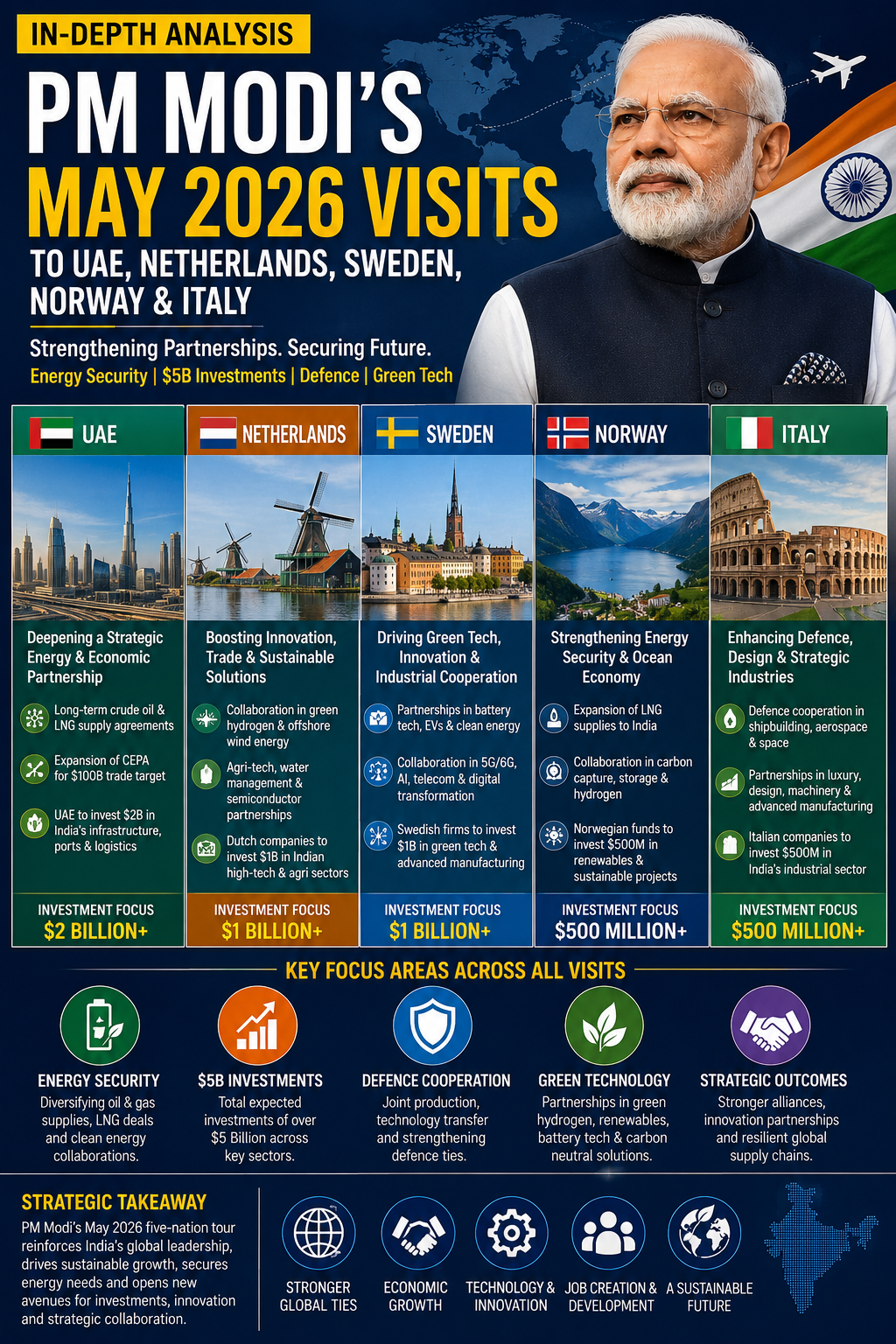
PM Modi Five-Nation Tour 2026: Key Deals, Energy Pacts & Strategic Outcomes
Introduction and Strategic Context of the Tour
The Timing and Global Backdrop In mid-May 2026, as geopolitical tensions in West Asia escalated due to conflicts involving Iran, disrupting global energy supplies and pushing oil prices higher, Prime Minister Narendra Modi embarked on a high-stakes six-day, five-nation tour from May 15 to 20. The destinations — United Arab Emirates (UAE), Netherlands, Sweden, Norway, and Italy — were chosen with precision to address India’s immediate economic vulnerabilities while advancing long-term strategic goals.
This tour came just days after PM Modi’s public appeal to citizens to moderate gold purchases, reduce discretionary foreign travel, and conserve fuel. While urging domestic restraint, the Prime Minister proactively engaged internationally to secure energy supplies, attract investments, and diversify partnerships. This duality exemplifies pragmatic diplomacy: austerity at home paired with assertive outreach abroad.
India’s Position in 2026 India, the world’s fifth-largest economy (projected to be third soon), faces a dual challenge — sustaining 6.5-7%+ GDP growth while managing import dependence. Oil imports account for a massive portion of the trade deficit. Gold imports hit nearly $72 billion in FY26. The current account deficit (CAD) and rupee stability require careful management of foreign exchange. This tour directly targets these pain points.
Key Overarching Objectives
- Energy Security — Long-term oil, gas, and LPG supplies amid supply chain disruptions.
- Investment and Trade Boost — Leveraging post-India-EU FTA and India-EFTA agreements.
- Technology and Green Transition — Semiconductors, renewables, AI, and climate cooperation.
- Defence and Strategic Autonomy — Diversifying partnerships in a multipolar world.
- Diaspora Engagement and People-to-People Ties — Harnessing soft power.
PM Modi has undertaken over 100 international visits, strengthening ties with more than 79 countries. This tour reinforces Vishwa Bandhu philosophy while supporting Atmanirbhar Bharat.
UAE Visit – Cornerstone of Energy and Defence Cooperation
Arrival and High-Level Engagements PM Modi’s first stop was Abu Dhabi, where he met UAE President Sheikh Mohamed bin Zayed Al Nahyan. This marked his eighth visit to the UAE, underscoring the extraordinary depth of bilateral relations.
Major Agreements and Outcomes India and UAE signed several landmark pacts:
- Framework for Strategic Defence Partnership — Covering defence manufacturing, innovation, military training, maritime security, cyber defence, and secure communications.
- Strategic Petroleum Reserves Collaboration — ADNOC to support storage of 30 million barrels in Indian reserves, plus joint work on strategic gas reserves.
- Long-term LPG Supply Agreement — Between Indian Oil Corporation (IOCL) and ADNOC for stable domestic supplies.
- Ship Repair Cluster in Vadinar, Gujarat — Major maritime infrastructure boost.
- $5 Billion Investment Pledge — In Indian infrastructure, banking (RBL Bank, Sammaan Capital), and growth sectors.
- Additional MoUs on skill development, AI, and comprehensive energy partnership.
Economic Data and Impact Bilateral trade stands at nearly $80-85 billion annually, making UAE India’s 3rd largest trading partner. UAE is also a top FDI source. Over 4.5 million Indians live and work in the UAE, remitting billions and forming a vital bridge.
Geopolitical Relevance Amid West Asia tensions, these pacts reduce India’s vulnerability to Hormuz Strait disruptions. Local currency trade settlement further eases dollar pressure. PM Modi condemned attacks on UAE that affected Indian nationals, highlighting strong people-centric diplomacy.
Broader Implications These deals directly support India’s Strategic Petroleum Reserves Programme and Make in India in defence and maritime sectors. The ship repair cluster in Gujarat is expected to create thousands of jobs and position India as a regional hub. Analysts project these agreements could help save or stabilize billions in import bills over the coming years.
Historical Evolution of Ties From the 2010s CEPA to Comprehensive Strategic Partnership, India-UAE relations have transformed. The UAE’s Vision 2031 and India’s development goals align perfectly on diversification, innovation, and stability.
Netherlands Visit – Gateway to European Technology and Investment
Bilateral Focus and Key Meetings PM Modi held talks with Dutch Prime Minister Rob Jetten and called on King Willem-Alexander and Queen Máxima. He also addressed the Indian diaspora, the largest on mainland Europe.
Trade and Investment Statistics
- Bilateral trade: USD 27.8 billion (2024-25).
- Cumulative Dutch FDI in India: Over USD 55.6 billion (4th largest investor).
Priority Sectors
- Semiconductors and high-tech supply chains.
- Water management and agriculture technology.
- Green hydrogen, clean energy, and climate resilience.
- Defence cooperation and innovation ecosystems.
Strategic Significance Netherlands acts as Europe’s logistics and investment hub. Discussions advanced implementation of the India-EU Free Trade Agreement (signed earlier in 2026), focusing on resilient supply chains post-global disruptions. This visit strengthens India’s position in critical technologies amid global de-risking from certain supply sources.
Diaspora and Cultural Ties The Indian community in the Netherlands plays a key role in bilateral relations, contributing to knowledge transfer in science, IT, and entrepreneurship.
Nordic Engagements – Sweden, Norway, and the 3rd India-Nordic Summit
Sweden Visit Highlights Bilateral talks with PM Ulf Kristersson focused on green transition, AI, startups, defence, space, and resilient supply chains. Bilateral trade: USD 7.75 billion; Swedish FDI: significant in automotive, engineering, and renewables.
Norway Visit and Historic Milestone This was the first standalone PM visit to Norway in 43 years. PM Modi held talks with PM Jonas Gahr Støre. Norwegian investments (especially the Government Pension Fund) in India stand at nearly USD 28 billion. Focus areas: blue economy, clean tech, Arctic cooperation, and capitalizing on India-EFTA Trade Agreement.
3rd India-Nordic Summit in Oslo Leaders from Norway, Sweden, Denmark, Finland, and Iceland participated. Overall Nordic-India trade: USD 19 billion (2024). Key themes:
- Technology, innovation, and deep-tech.
- Green transition and renewable energy.
- Sustainability, blue economy, defence, space, and Arctic affairs.
This summit builds on previous ones in Stockholm (2018) and Copenhagen (2022), elevating ties to a more strategic level. Discussions emphasized “Green Strategic Partnership” and resilient supply chains.
Long-term Potential Nordic countries excel in innovation, sustainability, and governance — areas where India seeks collaboration to achieve net-zero goals and technological self-reliance.
Italy Visit and Overall Outcomes
Italy Engagements Meetings with President Sergio Mattarella and PM Giorgia Meloni. Bilateral trade: USD 16.77 billion; Italian FDI: USD 3.66 billion. Focus on defence, clean energy, science & technology under the Joint Strategic Action Plan 2025-2029.
Cumulative Impact of the Tour
- Energy Security: Direct mitigation of oil price shocks.
- Investment Inflows: Billions in committed funds.
- Trade Expansion: Leveraging FTAs for export growth.
- Technological Leap: Collaborations in semiconductors, AI, green tech.
- Strategic Depth: Diversified partnerships enhancing India’s global standing.
Critiques and Challenges While highly productive, outcomes depend on implementation. Short-term forex pressures require sustained domestic efforts alongside such diplomacy.
Vision for the Future This tour embodies PM Modi’s foreign policy: proactive, multi-aligned, and results-driven. It strengthens India’s resilience in a volatile world while advancing economic development goals. As India aims for developed nation status by 2047, such engagements are crucial.
Conclusion: Diplomacy That Delivers PM Modi’s five-nation tour of May 2026 stands as a masterclass in strategic statecraft. From securing energy pacts in the Gulf to forging green-tech alliances in Europe, it addresses immediate crises while laying foundations for long-term prosperity. In an era of uncertainty, India under Modi continues to emerge as a reliable global partner and a rising power committed to growth, stability, and sustainability.
Related Articles
India’s Union Budget FY 2026-27: ₹53.47 Lakh Crore Detailed Overview, Sector-Wise Allocation & Impact
READ MORE →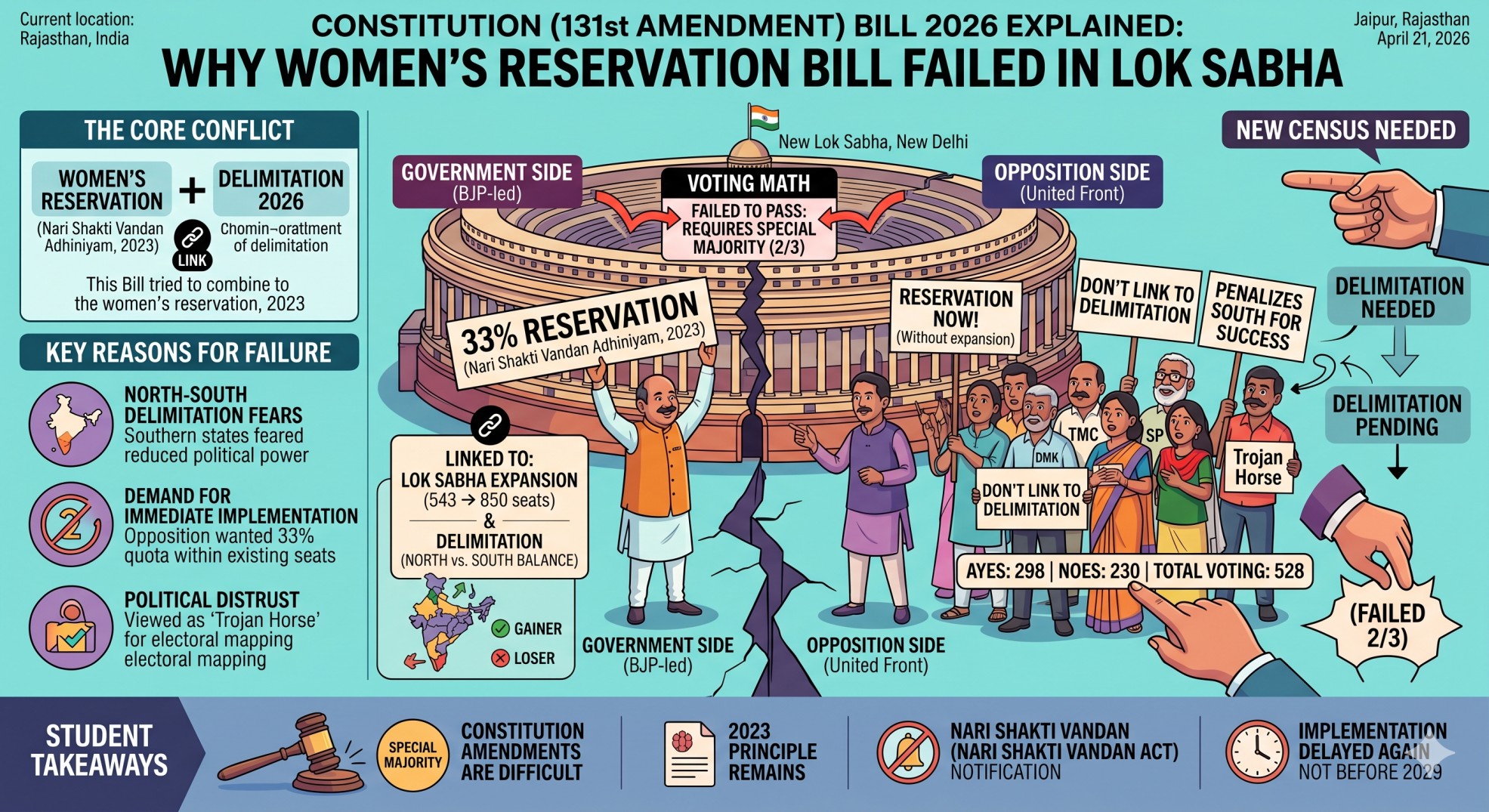
Constitution (131st Amendment) Bill 2026 Explained: Why Women’s Reservation Bill Failed in Lok Sabha
READ MORE →
Census 2027 Self Enumeration: घर बैठे ऑनलाइन जनगणना फॉर्म कैसे भरें | पूरी प्रक्रिया हिंदी में
READ MORE →