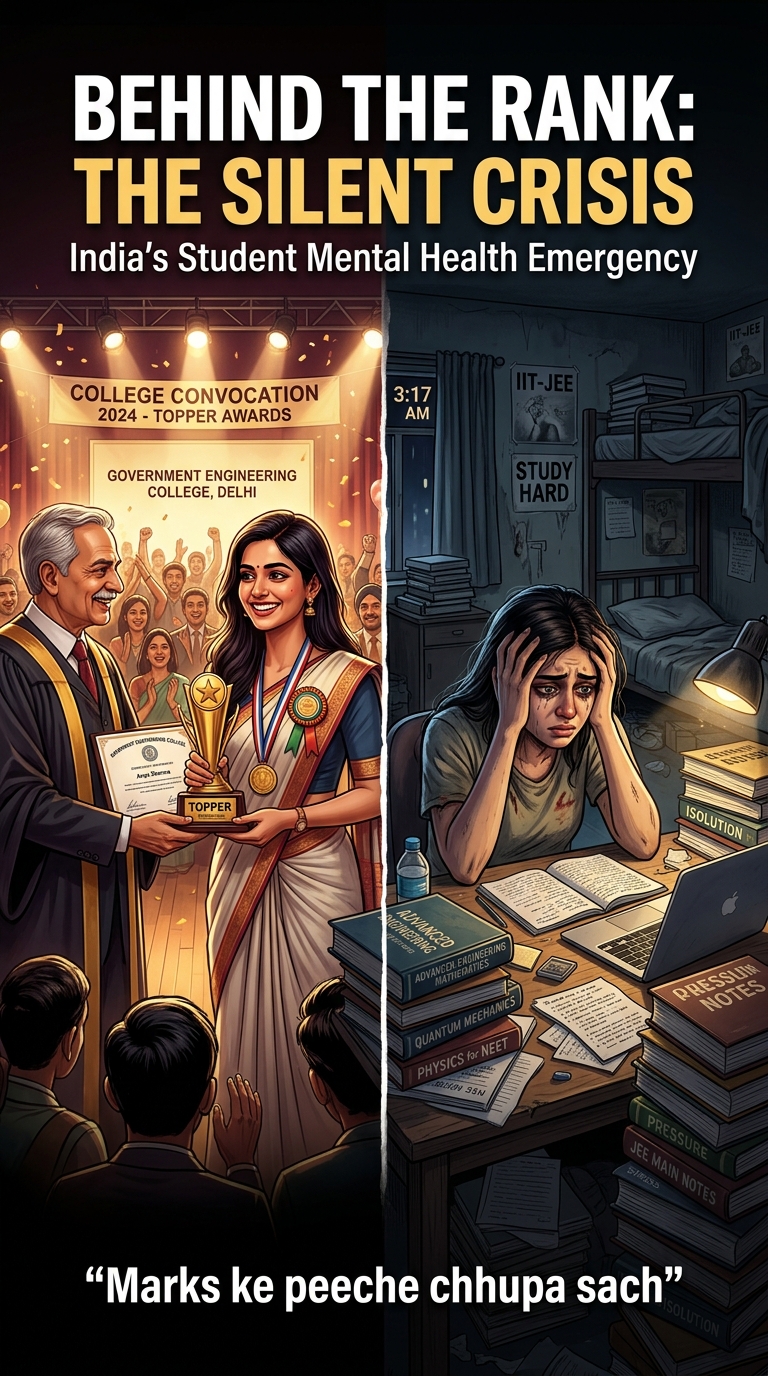
Why Students Are Taking Extreme Steps in India’s Top Colleges (Full Analysis)
 Student Suicides in Top Engineering Colleges: Understanding the Crisis Beyond Headlines
Introduction
In recent months, reports of multiple student deaths at premier engineering institutes in India have sparked widespread concern. When several such incidents occur within a short time frame in a single campus, it naturally raises difficult questions. What pressures are students facing? Are institutions equipped to support them? And most importantly, what needs to change to prevent further tragedies?
These incidents are not isolated. Across India, student mental health has quietly become one of the most serious yet under-discussed challenges in the education system. According to national data trends over the past decade, student suicides have been rising steadily, reflecting deeper structural and societal issues.
This blog does not aim to sensationalize events. Instead, it seeks to understand the crisis from multiple angles—academic pressure, mental health, social expectations, institutional gaps—and explore meaningful solutions.
What Is Happening in Premier Engineering Colleges
Top engineering colleges are often seen as symbols of success. Getting into one requires years of intense preparation, discipline, and sacrifice. For many students, admission represents the fulfillment of a dream—not just their own, but also their family’s.
However, once inside, students encounter a very different reality.
The academic environment is highly competitive. Students who were top performers in school suddenly find themselves surrounded by equally capable peers. The shift from being “the best” to “one among many” can be psychologically destabilizing.
In campuses where multiple tragic incidents occur within a short time span, the impact spreads beyond those directly affected. It creates:
- Fear among students
- Emotional distress within peer groups
- Anxiety among parents
- Questions about institutional responsibility
These environments can quickly become emotionally heavy, especially if support systems are not strong.
Academic Pressure: The Silent Burden
The Weight of Expectations
From an early age, students in India are conditioned to see academic success as the primary path to a stable future. Competitive exams become life-defining milestones.
By the time students reach engineering colleges, they have already spent years under pressure. However, the pressure doesn’t end—it changes form.
Instead of entrance exams, students now face:
- Continuous evaluations
- Tight deadlines
- Complex coursework
- Internships and placements pressure
Fear of Failure
Failure in such environments is often not normalized.
A low grade or academic setback can feel catastrophic because:
- Students tie self-worth to performance
- Peer comparison is constant
- Fear of disappointing parents looms large
This creates a cycle where stress builds silently over time.
Mental Health Crisis in Indian Colleges
A Growing but Invisible Problem
Mental health issues among students are not new—but awareness and infrastructure have not kept pace.
Common challenges include:
- Anxiety
- Depression
- Burnout
- Panic attacks
Despite this, many students hesitate to seek help.
Stigma Around Mental Health
One of the biggest barriers is stigma.
Students often feel:
- “People will judge me”
- “I should be strong enough to handle this”
- “Others have it worse”
This leads to internalization of problems instead of seeking support.
Loneliness and Hostel Life
The Reality of Living Away From Home
For many students, college is the first time they live away from family.
While this brings independence, it also brings:
- Emotional distance
- Lack of immediate support
- Difficulty in adjusting
Isolation Despite Crowds
Ironically, students can feel lonely even in crowded campuses.
Reasons include:
- Difficulty forming deep connections
- Cultural or language differences
- Academic focus limiting social interaction
Over time, isolation can intensify emotional struggles.
Are Institutions Failing Students?
This is a difficult but necessary question.
Gaps in Support Systems
Many institutions have counseling centers—but often:
- They are understaffed
- Students are unaware of them
- Access is limited
Academic Structure Issues
Rigid academic systems can contribute to stress:
- Lack of flexibility
- High workload
- Limited mental health breaks
Need for Safe Spaces
Students need environments where they can:
- Speak openly
- Share struggles
- Seek help without fear
In many cases, such spaces are insufficient.
Social Media and the Comparison Trap
The Illusion of Perfection
Social media amplifies pressure by constantly showcasing success:
- Internship announcements
- Achievements
- “Perfect” lifestyles
Students compare themselves and feel inadequate.
Impact on Self-Esteem
This leads to:
- Reduced confidence
- Increased anxiety
- Fear of falling behind
The digital environment intensifies existing academic stress.
Warning Signs We Often Ignore
One of the biggest challenges is recognizing distress early.
Common signs may include:
- Withdrawal from friends
- Sudden drop in performance
- Loss of interest in activities
- Changes in sleep or eating patterns
- Persistent sadness or irritability
Often, these signs are dismissed as “normal stress,” which delays intervention.
The Role of Parents
Parents play a crucial role in shaping student mental health.
Expectation vs Support
High expectations are common, but they must be balanced with:
- Emotional support
- Open communication
- Acceptance of setbacks
Creating Safe Communication Channels
Students should feel comfortable discussing:
- Failures
- Stress
- Doubts
Without fear of judgment.
The Role of Peer Groups
Friends are often the first line of support.
Strong peer networks can:
- Reduce loneliness
- Provide emotional relief
- Encourage seeking help
However, peer groups also need awareness to recognize distress.
What Needs to Change: Solutions
1. Strengthening Mental Health Infrastructure
- Increase counseling staff
- Ensure easy access
- Promote awareness programs
2. Reducing Academic Pressure
- Flexible grading systems
- Reduced overload
- Encouraging learning over competition
3. Normalizing Mental Health Conversations
- Conduct workshops
- Encourage open dialogue
- Remove stigma
4. Building Supportive Campus Culture
- Collaboration over competition
- Inclusivity
- Emotional well-being
5. Role of Government and Policy
- Mandate mental health support in institutions
- Monitor student well-being
- Provide funding for counseling services
Conclusion
The recent incidents in top engineering colleges are a wake-up call. They highlight not just individual struggles but systemic issues within the education system.
This is not a problem with a single cause or a simple solution. It is a complex intersection of academic pressure, mental health challenges, social expectations, and institutional gaps.
Addressing it requires collective effort—from students, parents, educators, institutions, and policymakers.
Awareness is the first step. Action must follow.
🔍 Deep Analysis: Student Suicide Crisis in India
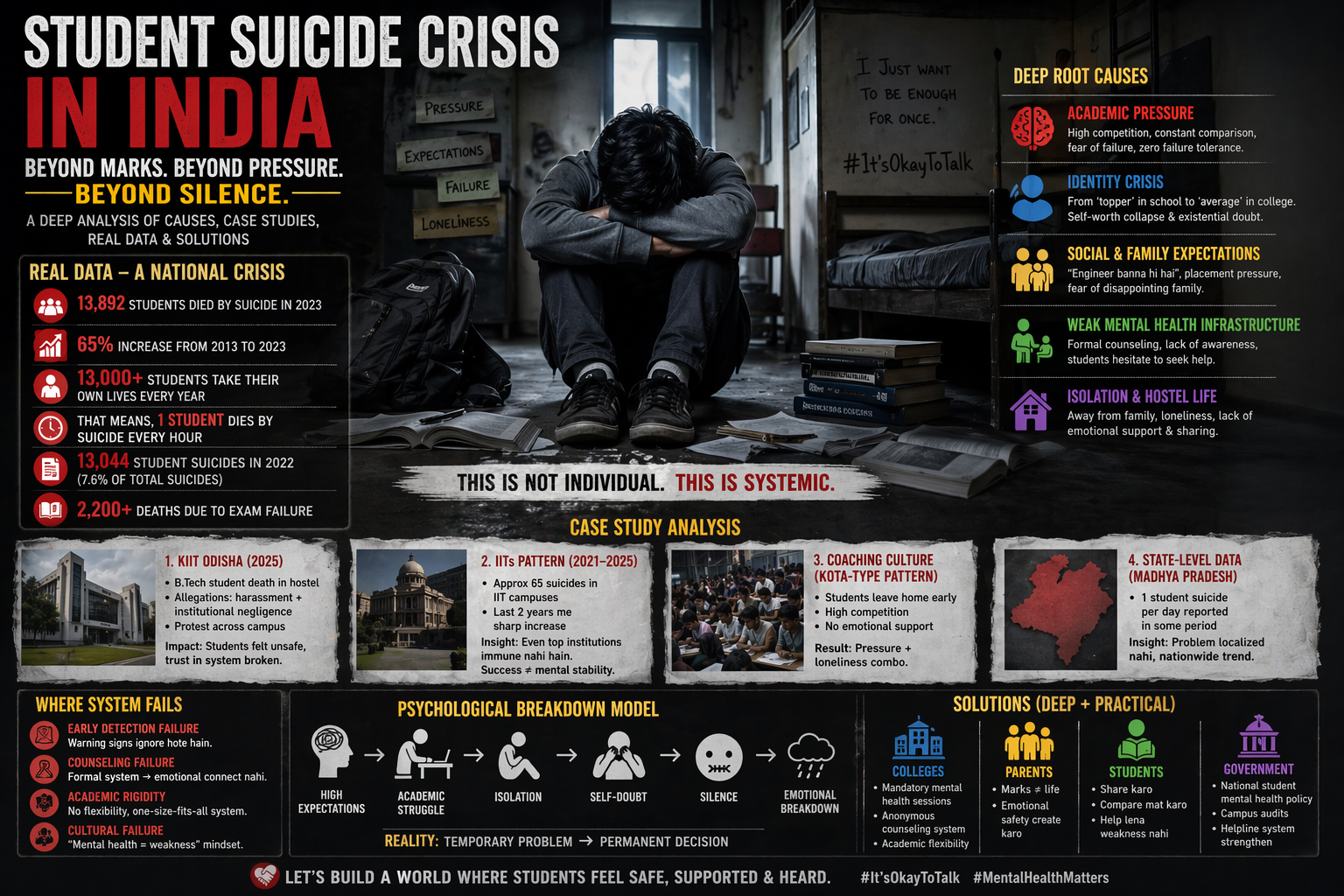
1. Real Data (Strong Foundation for Blog)
India me student suicide koi chhota issue nahi hai — yeh ek national crisis ban chuka hai.
📊 Key Statistics:
- 2023 me 13,892 students died by suicide ([The Times of India][1])
- 2013 se 2023 tak 65% increase hua hai ([Supreme Court Observer][2])
- Har saal approx 13,000+ students apni jaan lete hain ([IC3 Institute][3])
- Matlab:
👉 हर घंटे 1 student suicide करता है ([Wikipedia][4]) - 2022 me:
- 13,044 student suicides (7.6% total suicides) ([Press Information Bureau][5])
- Sirf exam failure se 2,200+ deaths ([PMC][6])
👉 Yeh numbers clear dikhate hain:
Problem individual nahi, systemic hai.
🧠 2. Deep Root Cause Analysis
🔴 (A) Academic Pressure = Primary Trigger
Top colleges me problem aur intense ho jati hai:
- Sab topper hote hain → comparison extreme ho jata hai
- Failure tolerance zero hota hai
- Continuous competition
Research ke according:
👉 Academic pressure is one of the major causes of student suicide ([PMC][7])
🔵 (B) Identity Crisis (Most Ignored Factor)
School me:
👉 “Topper”
College me:
👉 “Average”
Ye shift dangerous hota hai:
- Self-worth collapse
- Confidence break
- Existential doubt: “Main kaun hoon?”
🟡 (C) Social & Family Expectations
Indian system me:
- “Engineer banna hi hai”
- “Placement nahi hua to failure”
Data shows:
👉 Low income + pressure groups me suicide zyada hota hai ([CMHLP][8])
🟢 (D) Mental Health Infrastructure Weak
- Counseling centers formal hote hain, effective nahi
- Students hesitate karte hain
- Awareness kam hai
⚫ (E) Isolation + Hostel Life
- Family support zero
- Emotional sharing kam
- Loneliness high
👉 Yeh silent factor hota hai jo gradually impact karta hai
⚠️ 3. Pattern Analysis (Important Insight)
Student suicide randomly nahi hota — ek pattern hota hai:
Step-by-step breakdown:
- High expectations
- Academic struggle
- Isolation
- Self-doubt
- Silence
- Emotional breakdown
👉 Problem ye hai:
Step 3–5 pe system fail ho jata hai
📚 4. Case Study Analysis (Real Examples)
🧾 Case Study 1: KIIT Odisha (2025)
- B.Tech student death in hostel
- Allegations: harassment + institutional negligence
- Protest across campus
👉 Impact:
- Students felt unsafe
- Trust in system broken
([Wikipedia][9])
🧾 Case Study 2: IITs Pattern (2021–2025)
- Approx 65 suicides in IIT campuses
- Last 2 years me sharp increase
👉 Insight:
- Even top institutions immune nahi hain
- Success ≠ mental stability
([LinkedIn][10])
🧾 Case Study 3: Coaching Culture (Kota-type Pattern)
(General pattern analysis based on reports)
- Students leave home early
- High competition
- No emotional support
👉 Result:
- Pressure + loneliness combo
🧾 Case Study 4: State-Level Data (Madhya Pradesh)
- 1 student suicide per day reported in some period ([The Times of India][11])
👉 Insight:
- Problem localized nahi
- Nationwide trend
🧩 5. System Failure Analysis
🔴 Where System Fails:
1. Early Detection Failure
- Warning signs ignore hote hain
2. Counseling Failure
- Formal system → emotional connect nahi
3. Academic Rigidity
- No flexibility
- One-size-fits-all system
4. Cultural Failure
- “Mental health = weakness” mindset
⚡ 6. Psychological Breakdown Model
Student ke mind me kya hota hai:
- “Main fail ho gaya”
- “Sab mujhse aage hain”
- “Mere parents disappointed honge”
- “Mere paas option nahi hai”
👉 Reality:
Temporary problem → permanent decision
🌍 7. Bigger Picture (India vs World)
- India me youth (15–29 age group) me suicide rate high hai ([Wikipedia][12])
- Education pressure globally bhi hai
- But India me:
- Competition zyada
- Support system kam
💡 8. What Experts Say
Experts ke according major causes:
- Academic stress
- Family pressure
- Emotional isolation
- Lack of coping skills
([IPC 2025][13])
🚀 9. Solutions (Deep + Practical)
🎓 Colleges:
- Mandatory mental health sessions
- Anonymous counseling system
- Academic flexibility
👨👩👧 Parents:
- Marks ≠ life
- Emotional safety create karo
🧑🎓 Students:
- Share karo
- Compare mat karo
- Help lena weakness nahi
🏛 Government:
- National student mental health policy
- Campus audits
- Helpline system strengthen
Related Articles

अरावली की कटाई पर सुप्रीम कोर्ट का बड़ा फैसला: 100 मीटर नियम नहीं माना तो दिल्ली रेगिस्तान बनेगी
READ MORE →
गलवान घाटी युद्ध 2020: पूरी सच्ची कहानी, क्यों हुआ संघर्ष और Battle of Galwan Movie की पूरी जानकारी
READ MORE →
शिवकर बापूजी तलपड़े: राइट ब्रदर्स से 8 साल पहले भारत का पहला विमान | मरुत्सखा की प्रेरणादायक कहानी
READ MORE →