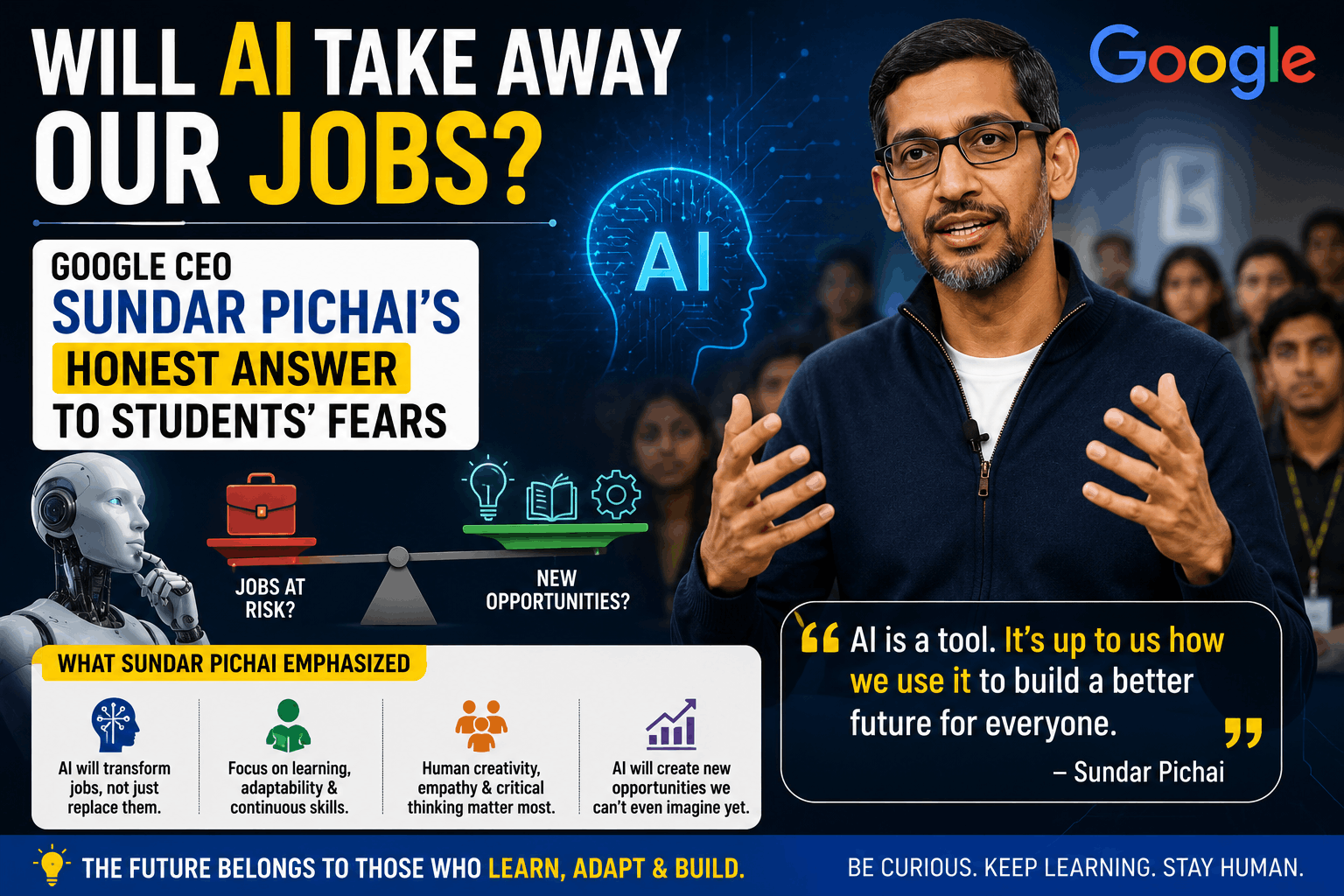
Will AI Take Away Our Jobs? Google CEO Sundar Pichai’s Honest Answer to Students’ Fears
Will AI Take Away Our Jobs? Google CEO Sundar Pichai’s Honest Answer to Students’ Fears
In May 2026, as students across the world prepare for graduation amid growing anxiety about artificial intelligence, Google CEO Sundar Pichai addressed one of the most pressing questions of our time: Will AI steal our jobs?
Speaking ahead of his commencement address at Stanford University, Pichai acknowledged the deep concerns of the younger generation while maintaining a cautiously optimistic outlook. His response, given during an interview on the Hard Fork podcast, has sparked widespread discussion about the future of work in the AI era.
The Rising Anxiety Among Students and Young Professionals
The fear is real and widespread. Recent surveys show that a large percentage of students and entry-level professionals are worried that AI tools like ChatGPT, Gemini, Claude, and Grok will replace them before they even begin their careers.
- Unemployment rates for new graduates have hit a four-year high in early 2026.
- Fields like content writing, coding, graphic design, data analysis, customer service, and even basic legal research are seeing increased automation.
- Many students have started “booing” AI during tech events, reflecting deep frustration and fear.
In this environment, Pichai’s comments carry significant weight as he leads one of the companies at the forefront of the AI revolution.
What Exactly Did Sundar Pichai Say?
When asked about his strategy for addressing students who might boo AI during his Stanford speech, Pichai responded thoughtfully:
“People rightly are anxious about what the future that this technology will bring.”
He recognized that the rapid pace of AI development feels overwhelming for humans, who are not naturally wired to handle such fast change. However, he firmly believes that the next generation will not only adapt but actively shape the future of AI.
Pichai emphasized that today’s graduates will be the ones who:
- Drive AI’s progress
- Set ethical boundaries
- Create new opportunities that we cannot yet imagine
He rejected the most pessimistic predictions that AI will cause massive, permanent job losses. Instead, he sees AI as a transformative technology that will evolve and transition jobs rather than completely eliminate them.
Pichai’s Core Message: Adaptation is Key
Throughout his recent interviews, Pichai has consistently delivered three main points:
- AI Will Impact Every Job No profession is safe — not even his own as CEO. He has openly said that being a CEO might be “one of the easier things for AI to do one day.”
- Some Jobs Will Disappear, But New Ones Will Emerge Just as the internet created entirely new careers (social media managers, YouTube creators, app developers), AI will spawn new roles we cannot fully predict today.
- The Winners Will Be Those Who Learn to Use AI Pichai’s strongest advice: “The people who learn to adopt and adapt to AI will do better.” Whether you want to be a teacher, doctor, lawyer, engineer, or artist — those who master AI tools will outperform those who resist them.
Historical Perspective: Technology Has Always Disrupted Jobs
Pichai often reminds people that this is not the first time technology has caused job anxiety:
- The Industrial Revolution replaced manual labor but created factories and new industries.
- Computers and the internet eliminated typists and travel agents but gave birth to software engineering, digital marketing, and e-commerce.
AI, according to Pichai, is more profound than electricity or fire — but humanity has always adapted.
The Other Side: Real Concerns That Cannot Be Ignored
While Pichai remains optimistic, critics argue that the current wave of AI is different because:
- It targets cognitive and creative work, not just physical labor.
- The speed of adoption is unprecedented.
- Inequality could widen if only certain groups have access to advanced AI tools and training.
Entry-level positions in tech, journalism, finance, and administration are already shrinking in many companies.
What Should Students and Professionals Do?
Based on Pichai’s message and broader expert consensus, here are practical steps:
- Become AI-fluent: Learn to use tools like Gemini, ChatGPT, Midjourney, and Cursor effectively.
- Focus on Human Skills: Creativity, emotional intelligence, critical thinking, leadership, and complex problem-solving remain difficult for AI to fully replicate.
- Embrace Lifelong Learning: Treat education as a continuous process rather than a one-time degree.
- Build Domain Expertise: Combine deep knowledge in your field with AI capabilities.
- Develop Ethical Awareness: Help shape how AI is used responsibly in society.
Conclusion: Fear or Opportunity?
Sundar Pichai’s response to students’ concerns is both empathetic and forward-looking. He acknowledges the anxiety as legitimate but urges the next generation not to fear AI, but to master it.
The coming decade will be defined by how well we integrate artificial intelligence into society. Those who view AI as a powerful collaborator rather than an enemy will likely thrive, while those who resist change may struggle.
As Pichai prepares to address Stanford graduates, his message is clear: The future belongs to those brave enough to shape it — not hide from it.
The question is no longer whether AI will change jobs. The real question is: Will you change with it?
Related Articles
Annie Easley: NASA की Human Computer जिसने बिना मशीन के स्पेस का भविष्य बदला
READ MORE →
AI Discovers 10,091 New Exoplanet Candidates | Princeton University TESS Study 2026 Full Analysis
READ MORE →
Best Career Courses After 12th 2026 in Hindii | 12वीं के बाद सबसे अच्छा कोर्स कौन सा है
READ MORE →