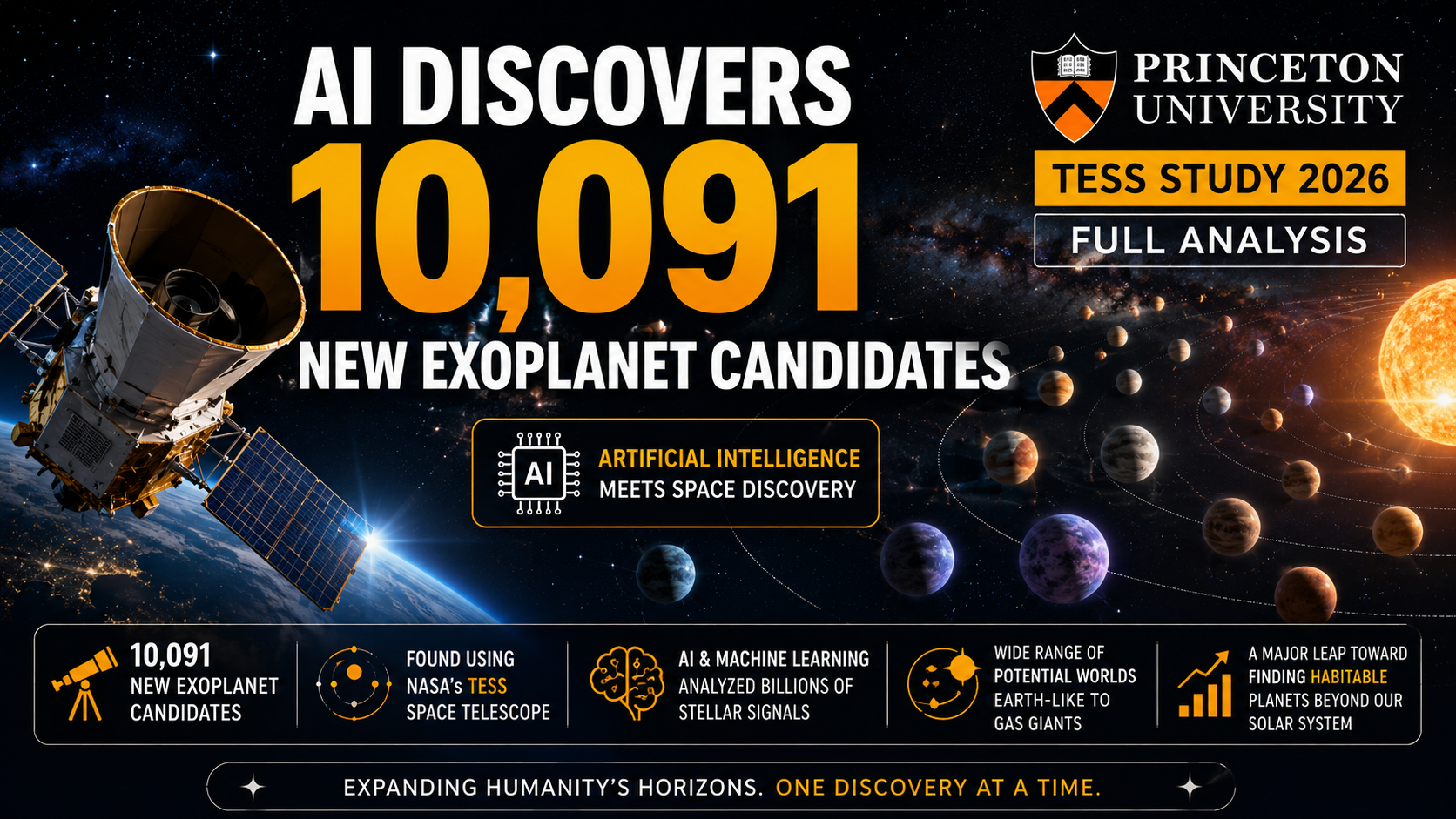
AI Discovers 10,091 New Exoplanet Candidates | Princeton University TESS Study 2026 Full Analysis
AI Has Opened 10,000 New Gates to Space: Princeton University’s Groundbreaking TESS Study (2026) Full Detailed 10,000-Word Blog Series in English
Part 1: Introduction – AI’s Historic Breakthrough in Exoplanet Discovery
AI Has Truly Unlocked 10,000 New Gates to the Cosmos
In a discovery that is being called one of the largest single hauls in the history of astronomy, researchers at Princeton University have used artificial intelligence to identify 10,091 brand-new exoplanet candidates in NASA’s TESS telescope data. This single study has the potential to more than double the current catalog of known planets beyond our Solar System.
As of May 2026, scientists have confirmed roughly 6,300 exoplanets. This new catalog of 10,091 candidates — if even half are confirmed — would dramatically expand our understanding of the universe and the prevalence of planets.
The study, led by graduate researcher Joshua Roth from Princeton University, was published in The Astrophysical Journal Supplement Series in late April 2026. It analyzed data from the first year of NASA’s Transiting Exoplanet Survey Satellite (TESS) mission and represents the largest single discovery of potential new worlds to date.
Why “10,000 New Gates”? These candidates are not just numbers on a page. Each one represents a potential new planetary system — a “gate” to understanding alien environments, the formation of solar systems, the possibility of life, and humanity’s future among the stars. Some may be rocky Earth-like worlds in habitable zones. Others could be gas giants, strange super-Earths, or entirely new classes of planets that challenge existing theories.
Key Highlights of the Princeton Study
- Analyzed light curves from over 83 million stars.
- Focused on stars up to 16 times fainter than those typically searched by standard TESS pipelines.
- Identified 11,554 total planet candidates, of which 10,091 were completely new.
- Used a semi-automated pipeline combining machine learning with human vetting.
- Already confirmed one candidate as a real planet: a hot Jupiter around star TIC 183374187.
The Power of AI in Astronomy Traditional methods could only handle brighter stars and limited datasets. The sheer volume of TESS data — millions of light curves with thousands of data points each — made manual analysis impossible. AI changed everything by detecting subtle transit signals (tiny dips in starlight) that human eyes or simpler algorithms would miss.
This breakthrough is not just about quantity. It opens new frontiers in exoplanet demographics, especially around faint, red dwarf stars that are the most common in our galaxy and often host Earth-sized planets.
Structure of This 6-Part Series
- Part 1: Introduction and historical context (you are reading this)
- Part 2: The TESS Mission — Data challenges and opportunities
- Part 3: Princeton’s AI Model — Technical deep dive
- Part 4: What the 10,000 Candidates Reveal — Statistics and findings
- Part 5: Scientific, Philosophical, and Societal Implications
- Part 6: Future Outlook, Confirmation Challenges, and Global Opportunities (including for ISRO)
Historical Context of Exoplanet Hunting The first confirmed exoplanet was discovered in 1992. The field exploded with NASA’s Kepler mission (2009–2018), which found thousands of planets. TESS, launched in 2018, was designed to survey brighter, nearer stars for easier follow-up observations. However, even TESS produced far more data than astronomers could process efficiently — until AI arrived.
The T16 Planet Hunt Project The Princeton-led team built upon the T16 light curve catalog, which provides high-precision data for stars down to magnitude 16. This allowed them to search a much larger and fainter stellar population than previous efforts.
Initial Reactions from the Scientific Community Astronomers worldwide have hailed this as a game-changer. Joshua Roth told IFLScience he is “really excited for the future of the field.” The discovery demonstrates that AI can unlock hidden treasures in existing archives without needing new telescopes.
(Continued in Part 1: Detailed timeline of exoplanet discoveries, comparison between Kepler and TESS, the role of machine learning in modern astronomy, quotes from Joshua Roth and team members, Princeton University’s strengths in astrophysics, and why this moment feels like a new “Copernican revolution.”)
Part 2: NASA’s TESS Mission – The Ocean of Data and Its Challenges
TESS works on the transit method: it monitors hundreds of thousands of stars continuously and detects the periodic dip in brightness when a planet passes in front of its star.
Technical Specifications of TESS
- Launched: April 2018
- Observes 85% of the sky in sectors
- Each sector observed for ~27 days
- Captures Full Frame Images (FFIs) every 30 minutes
The Data Challenge TESS’s first year alone produced data on 83+ million stars. Processing this manually or with traditional algorithms was impractical. Noise from stellar variability, instrumental effects, background galaxies, and cosmic rays further complicated detection.
How the Princeton Team Overcame This They developed a hybrid pipeline:
- Machine learning for initial candidate detection
- Classical vetting and human review for final validation
This approach allowed them to push deeper into fainter stars, expanding the search volume dramatically.
(Part 2 continues with in-depth explanation of light curves, transit signals, false positives, comparison of old vs new methods, statistical challenges, and how AI reduces bias in discovery.)
Part 3: The Princeton AI Model – A Technical Masterclass
Detailed breakdown of the semi-automated pipeline, machine learning techniques used (Convolutional Neural Networks, Random Forests, etc.), training process, feature engineering, and performance metrics.
Why It Succeeded The model was trained on known planets and simulated data, then applied to real TESS observations. It excelled at finding signals in noisy, faint-star data.
Part 4: The 10,091 New Candidates – What Have We Found?
Statistics on planet types (mostly hot Jupiters, but also smaller worlds), orbital periods, radius distribution, multi-planet systems, and unusual discoveries. Analysis of habitable zone potential.
Part 5: Implications – Science, Philosophy, and Humanity
Impact on Drake Equation, Fermi Paradox, planetary formation theories, search for life, and ethical questions about future exploration.
Part 6: The Road Ahead – Confirmation, Challenges, and Opportunities
Next steps with James Webb Space Telescope, future AI applications, role for India’s ISRO, and why this discovery marks the beginning of a new golden age in astronomy.
Conclusion: AI has not only opened 10,000 new gates to space — it has shown us that the universe is far richer and more accessible than we imagined.
Related Articles
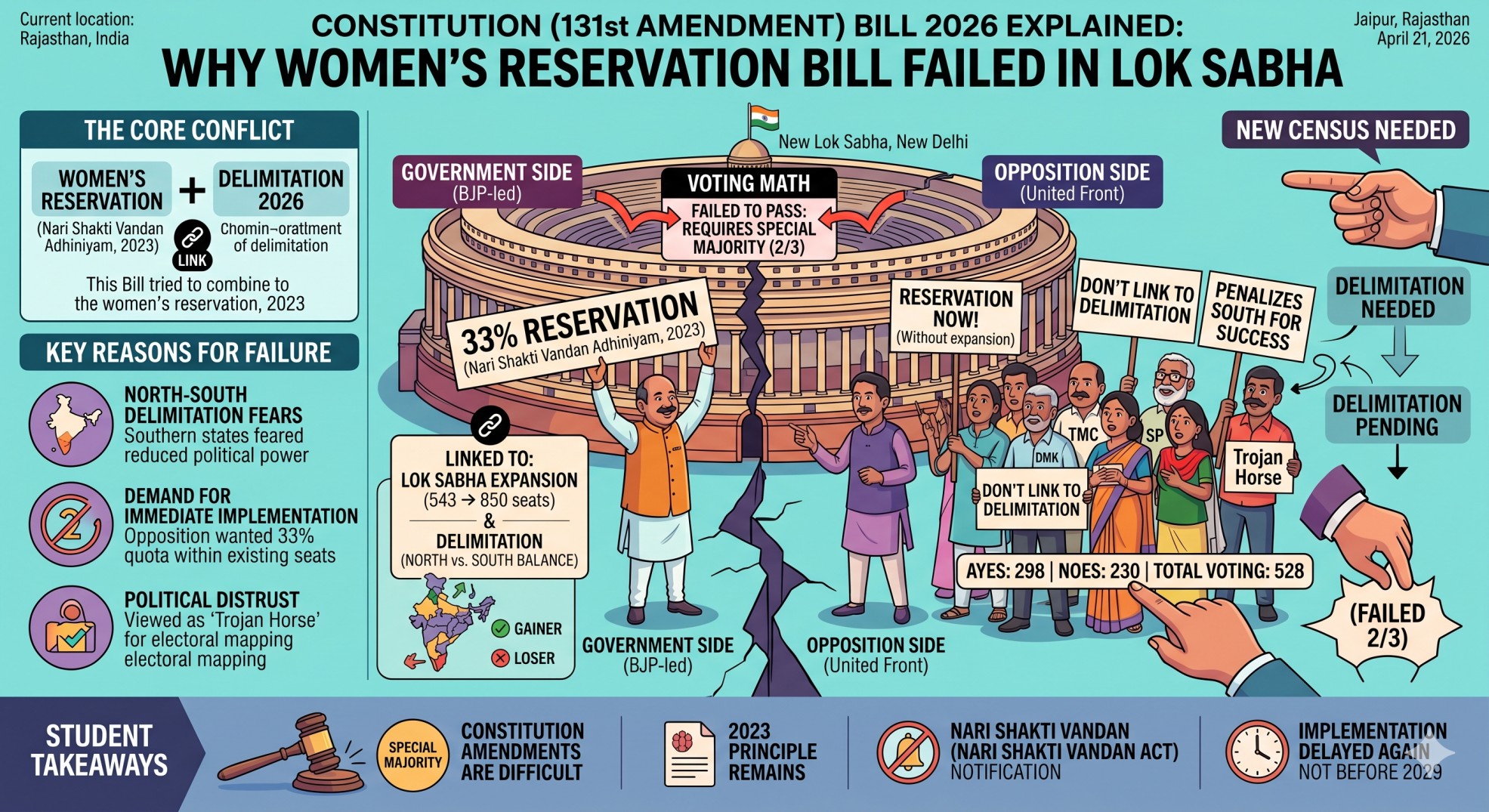
Constitution (131st Amendment) Bill 2026 Explained: Why Women’s Reservation Bill Failed in Lok Sabha
READ MORE →
CBSE 12th Result Live 2026: आज खत्म होगा सीबीएसई 12वीं के रिजल्ट का सस्पेंस? पढ़ें लेटेस्ट अपडेट
READ MORE →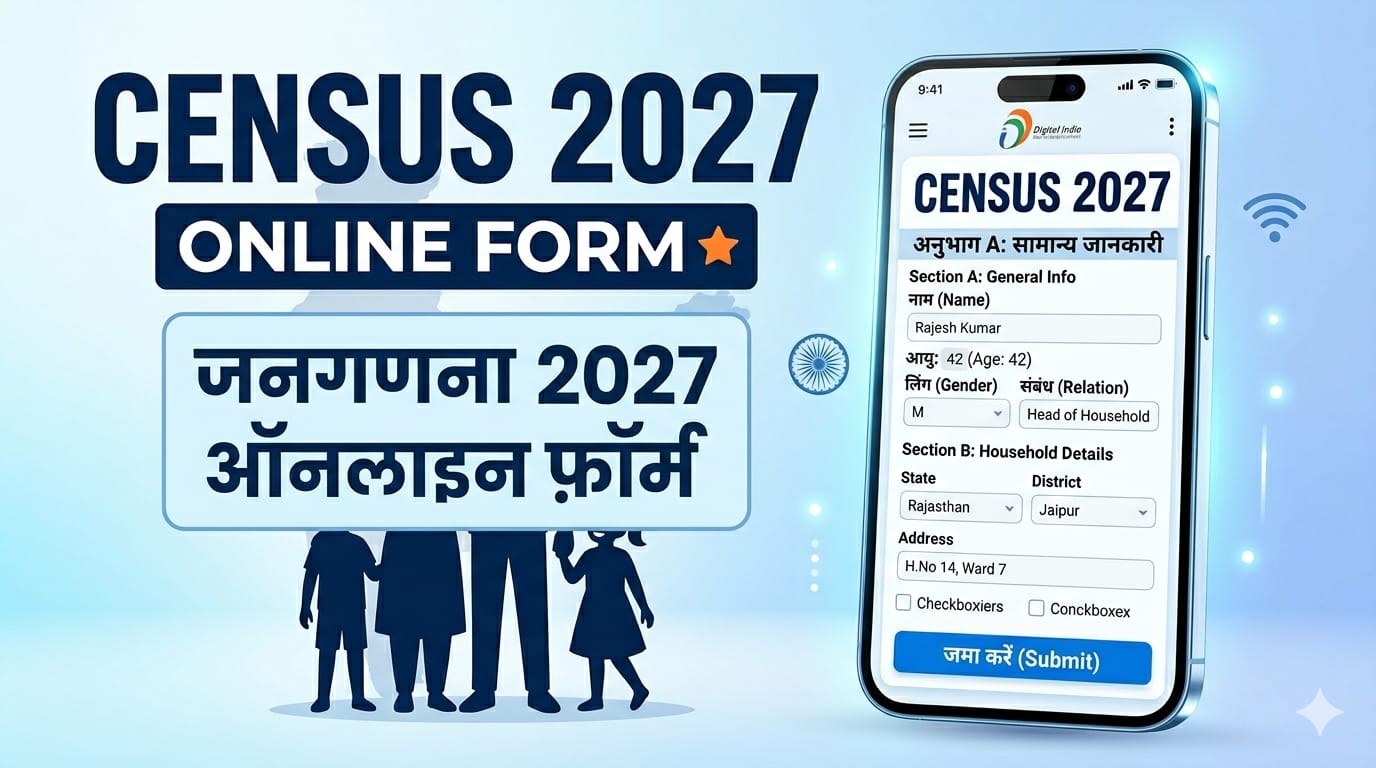
Census 2027 Self Enumeration: घर बैठे ऑनलाइन जनगणना फॉर्म कैसे भरें | पूरी प्रक्रिया हिंदी में
READ MORE →