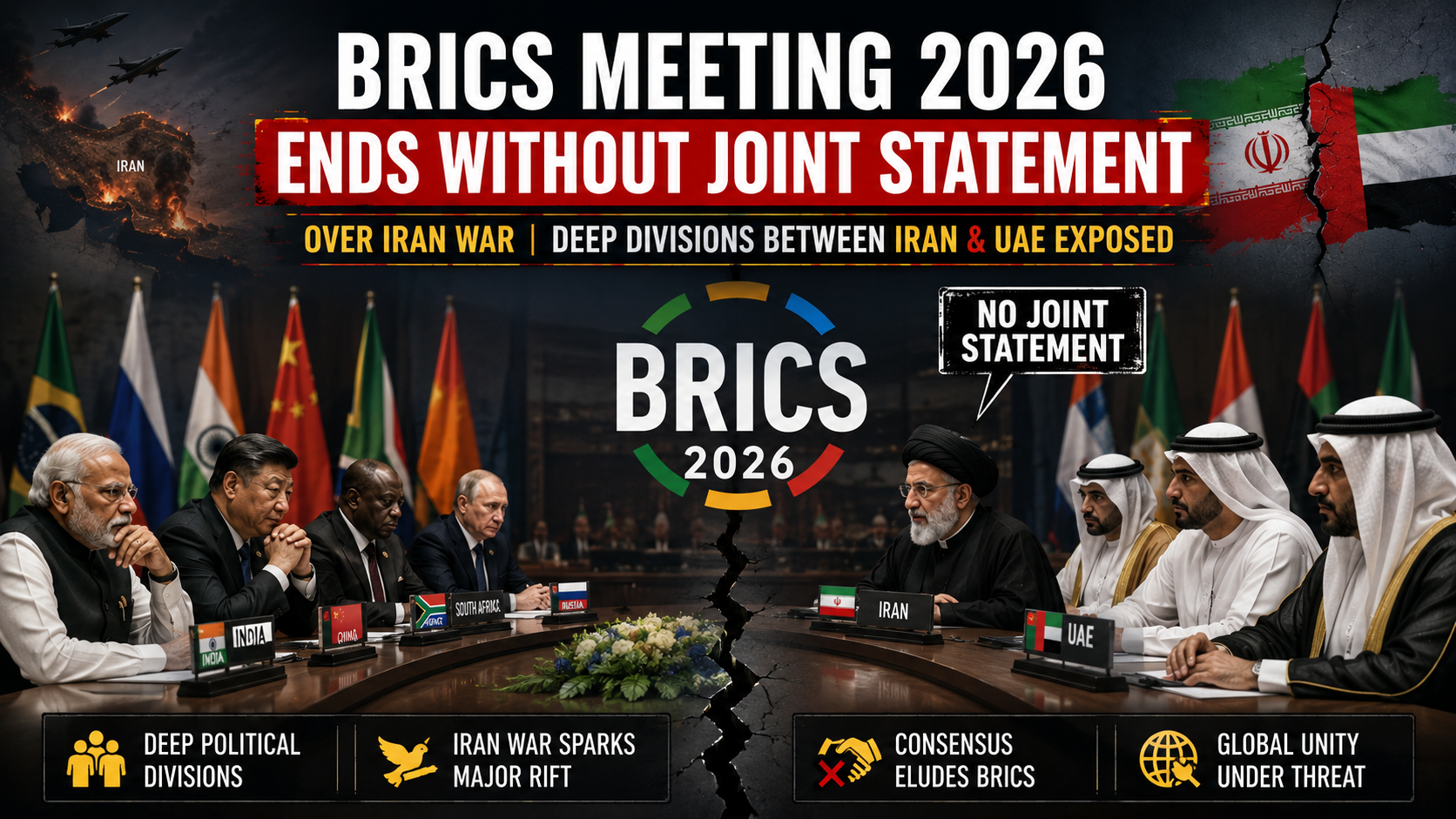
BRICS Meeting 2026 Ends Without Joint Statement Over Iran War | Deep Divisions Between Iran & UAE Exposed
BRICS Divisions Over the Iran War: A Major Test for the Bloc’s Unity
Introduction: BRICS Meeting Ends Without Joint Statement
In a significant setback for the expanded BRICS grouping, the two-day Foreign Ministers’ Meeting held in New Delhi on 14-15 May 2026 concluded without a joint statement. India, as the 2026 BRICS Chair, was forced to issue only a Chair’s Statement that openly acknowledged “differing views” among members on the ongoing war in Iran.
This marks the second consecutive BRICS meeting in 2026 where the bloc failed to produce a unified position on the Iran conflict. The deep divisions, particularly between Iran and the UAE (both full members), have exposed the limitations of BRICS as a geopolitical force in a multipolar world.
The meeting, intended to prepare for the full BRICS Summit in September 2026, was overshadowed by the US-Israel military campaign against Iran that began on 28 February 2026.
Background of the 2026 Iran War
On 28 February 2026, the United States and Israel launched a major military operation (codenamed Operation Epic Fury by the US) against Iran. The strikes targeted Iranian leadership, nuclear facilities, missile sites, air defences, and military infrastructure.
Key developments in the conflict:
- Supreme Leader Ayatollah Ali Khamenei was killed in the initial strikes.
- Iran responded with large-scale missile and drone attacks on Israel, US bases, and targets in Gulf countries, including the UAE.
- Disruptions in the Strait of Hormuz (through which 20% of global oil passes) caused sharp spikes in oil prices and global energy insecurity.
- A fragile ceasefire was brokered in early April 2026 with Pakistan’s mediation, but tensions remain extremely high with sporadic incidents continuing.
The war has created direct fault lines inside BRICS because both Iran and the UAE are now full members following the bloc’s expansion.
Positions of Major BRICS Members: Deep Divisions Exposed
Iran’s Position Iranian Foreign Minister Abbas Araghchi strongly urged BRICS members to condemn the “unlawful aggression” by the US and Israel. He accused the UAE of direct involvement in operations against Iran and demanded practical steps to stop “warmongering” and violations of international law.
UAE’s Position The UAE categorically rejected Iran’s allegations and opposed any language that condemned the US-Israel actions. It highlighted Iranian attacks on its territory and emphasised the need to protect sovereignty and secure maritime routes.
Russia Russia backed Iran’s call for strong condemnation of Western aggression, consistent with its anti-Western stance and close military ties with Tehran.
China China adopted a cautious, balanced approach. While it has strong energy ties with Iran, it also maintains massive economic relationships with Gulf Arab states. Beijing pushed for diplomacy and de-escalation without strongly favouring one side.
India (Chair) India maintained a strictly neutral and pragmatic stance. It emphasised:
- Dialogue and diplomacy
- Respect for sovereignty
- Unimpeded maritime flows (critical for India’s energy imports)
- Protection of civilians and Indian expatriates in the region
India’s priority remains energy security, safe sea lanes, and protecting its strategic interests with both Iran and the Gulf countries.
Other Members (Brazil, South Africa, Egypt, Ethiopia, Indonesia) Most other members leaned towards general principles of peace and stability rather than taking strong sides. Arab and African members often showed sympathy for UAE’s security concerns.
What Happened in the New Delhi Meeting (14-15 May 2026)?
- Intense closed-door negotiations took place over two days.
- Iran pushed hard for explicit condemnation of US-Israel actions.
- The UAE blocked any such language.
- Multiple drafts of a joint statement failed due to reservations from both sides.
- India, as chair, issued a neutral Chair’s Statement that noted “differing views among some members” on the Middle East situation.
- The statement focused on broad principles: dialogue, respect for international law, secure shipping lanes, and multilateralism, without naming any country or assigning blame.
Iran reportedly blamed the UAE for blocking the statement, while other members appreciated India’s efforts to keep the process alive.
Implications for BRICS
- Unity Under Strain — The expanded BRICS (now 10 members) is finding it difficult to manage internal geopolitical rivalries. This weakens its claim as a strong alternative to Western-dominated institutions like the G7.
- Challenge to Multipolarity — BRICS positions itself as the voice of the Global South, yet it struggles to speak with one voice on major conflicts.
- India’s Rising Diplomatic Role — By successfully issuing a Chair’s Statement and preventing total breakdown, India has reinforced its image as a responsible, neutral bridge-builder. Many members now see India as a potential mediator.
- Economic Consequences — Rising oil prices, supply chain disruptions, and sanctions risks are hurting all BRICS economies. Energy importers like India, China, and Brazil are particularly affected.
- Future of the Bloc — The September 2026 BRICS Summit in India will face the same challenges. Without better mechanisms for managing disagreements, BRICS risks becoming more of an economic forum than a geopolitical powerhouse.
Why These Divisions Matter
The Iran war has highlighted a core contradiction in BRICS: members have vastly different security alliances, energy dependencies, and relationships with the West. While economic cooperation (trade, de-dollarisation, alternative payment systems) continues to progress, political and security issues expose deep fault lines.
For India, the situation is especially delicate. New Delhi maintains strong strategic ties with both Iran (energy, Chabahar port, INSTC) and the UAE/Saudi Arabia (energy security, investments, diaspora safety). Balancing these relationships while chairing BRICS demonstrates sophisticated diplomacy.
Conclusion: A Defining Test for BRICS
The May 2026 New Delhi meeting has made one thing clear — BRICS is not yet a cohesive geopolitical bloc. The Iran war has become its biggest test since expansion.
Whether BRICS can transform its diversity into strength or allow divisions to weaken it will define its relevance in the coming years. For now, India’s balanced approach has prevented a complete collapse, but sustained unity will require much more than chair statements.
The world is watching whether the “Global South” can truly unite or if great power rivalries and regional conflicts will continue to fragment it.
Related Articles
India’s Union Budget FY 2026-27: ₹53.47 Lakh Crore Detailed Overview, Sector-Wise Allocation & Impact
READ MORE →
Goodbye to the 24-Hour Day: Will Earth Really Have 25-Hour Days in the Future?
READ MORE →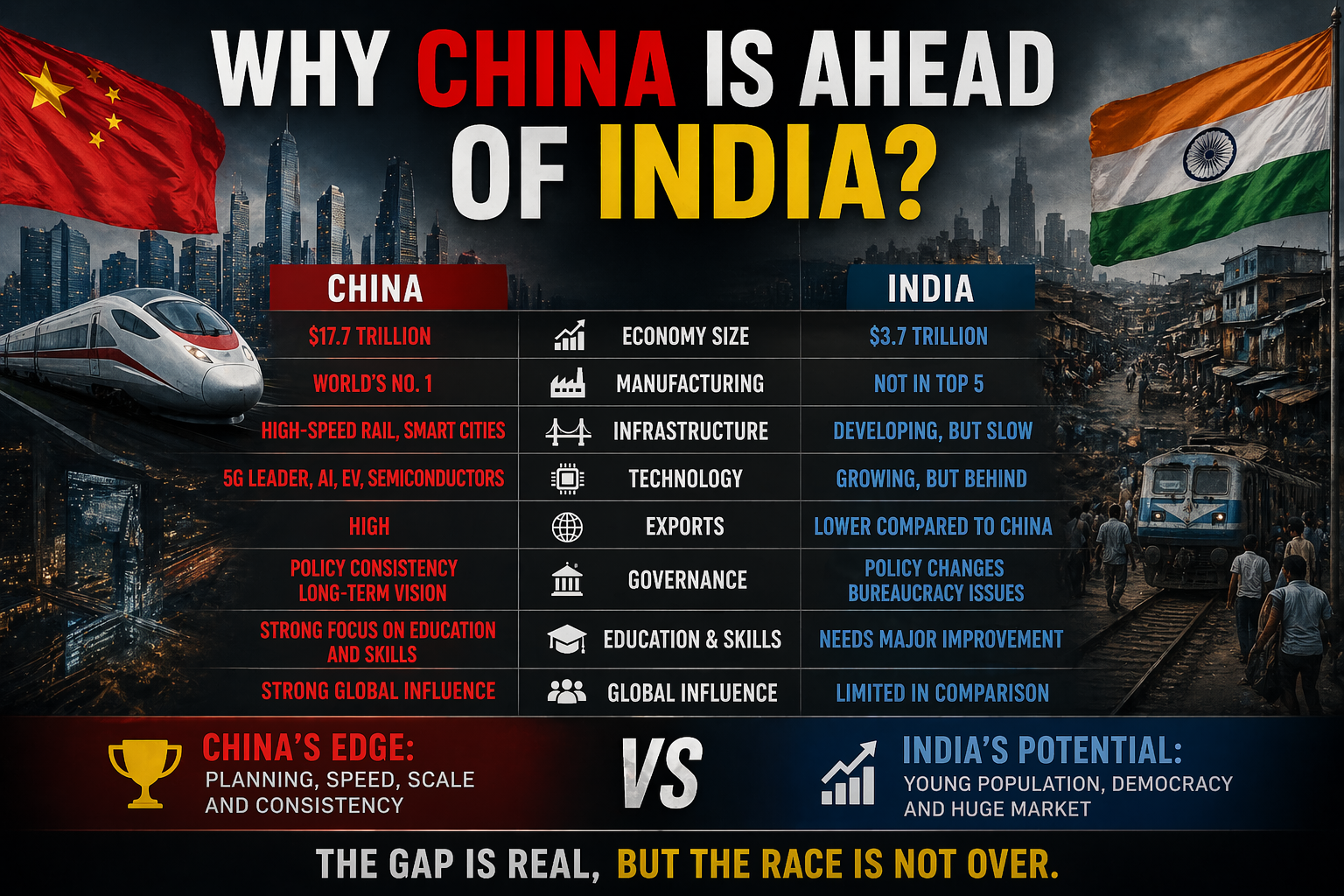
India vs China: Why China Is Ahead of India (From 1947 to 2026 Explained)
READ MORE →