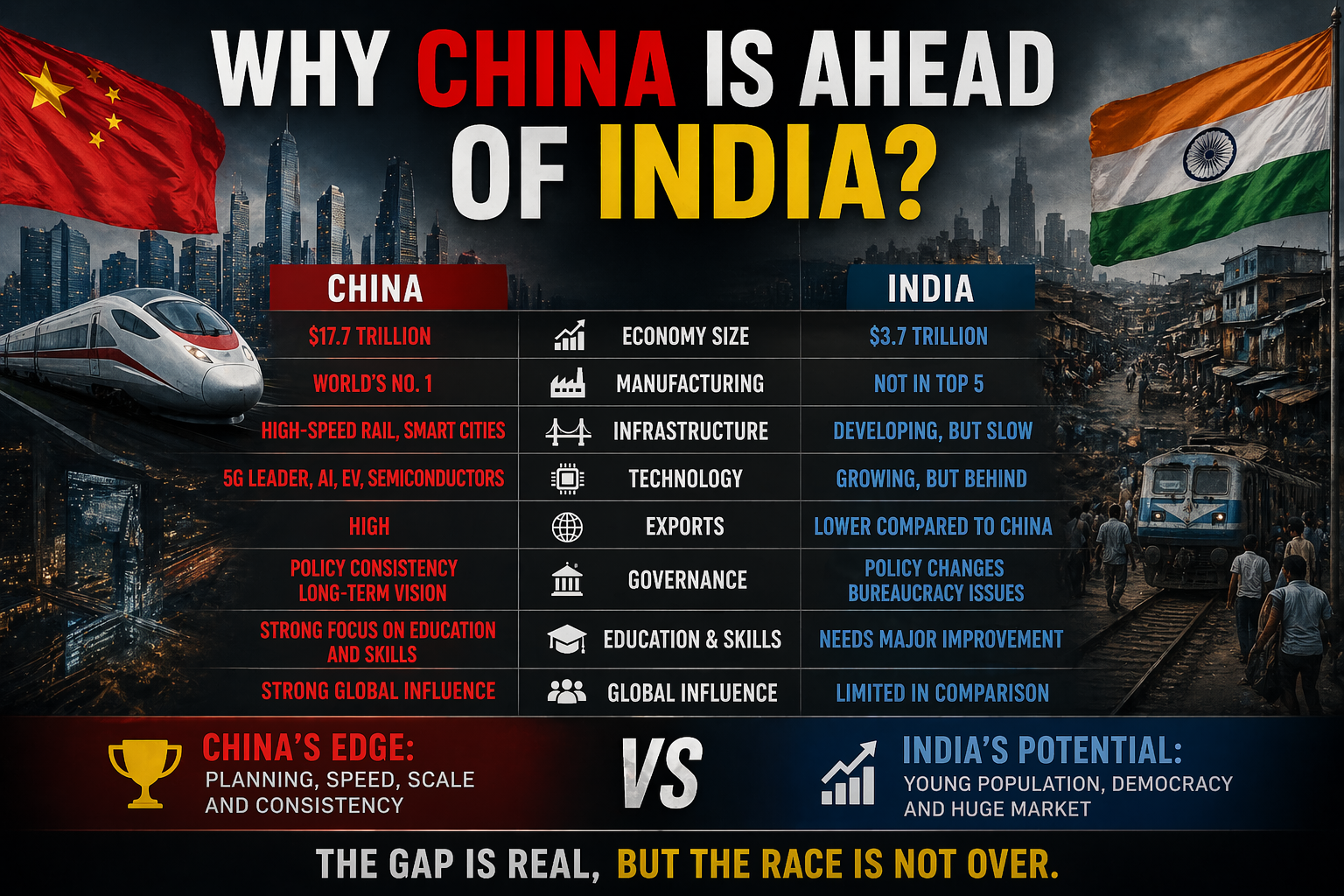
India vs China: Why China Is Ahead of India (From 1947 to 2026 Explained)
 India vs China – From Independence to Economic Power
1. Introduction: Why Compare India and China?
In the 21st century, the comparison between India and China has become one of the most discussed topics in global economics and geopolitics. Both countries are not only the two most populous nations in the world but also represent the future of Asia’s economic and political power.
China is currently the world’s second-largest economy, while India is rapidly emerging as one of the fastest-growing major economies. This contrast naturally raises an important question: Why is China so far ahead of India, despite both countries starting from similar conditions in the mid-20th century?
The answer is not simple. It involves a mix of historical decisions, political systems, economic strategies, and global engagement.
- How both nations started after independence
- The key decisions that shaped their growth
- The turning points that created the gap
Rather than just comparing numbers, this analysis focuses on understanding the development models of both countries — one driven by centralized control and rapid execution, and the other by democratic processes and gradual reforms.
2. 1947 vs 1949 – Where Did It All Begin?
India – Independence in 1947
India gained independence from British colonial rule in 1947. At that time, the country faced enormous challenges such as widespread poverty, low literacy rates, a weak industrial base, and heavy dependence on agriculture.
The colonial economy had been structured mainly to serve British interests, leaving India with minimal infrastructure and limited industrial development.
India adopted a democratic system, giving citizens the right to vote and participate in governance. While this ensured political freedom, it also meant slower decision-making due to debates and opposition.
China – Revolution in 1949
China became the People’s Republic of China in 1949 after a long civil war. Under communist leadership, the country unified under a single-party system.
China also started with poor economic conditions, including poverty, weak infrastructure, and a war-damaged economy.
However, China adopted an authoritarian system, allowing faster implementation of policies without political opposition.
Key Difference
- India: Democracy (slow but inclusive)
- China: One-party rule (fast but controlled)
This fundamental political difference shaped their long-term development paths.
3. 1950–1970: The Foundation Building Phase
India’s Strategy
India adopted a socialist-inspired mixed economy. The government introduced Five-Year Plans and focused on building public sector industries.
- Investment in heavy industries
- Focus on self-reliance
- Development of infrastructure and institutions
However, challenges included bureaucratic delays, slow implementation, and strict government control over businesses, known as the License Raj.
China’s Strategy
China followed a centralized and aggressive economic approach.
The Great Leap Forward aimed to rapidly industrialize the country but failed, leading to famine. Later, the Cultural Revolution caused social and economic disruption.
Insight
- India was stable but slow
- China was fast but unstable
During this phase, neither country achieved strong economic growth, and China faced serious setbacks.
4. 1978 – The Turning Point
China’s Economic Reforms
In 1978, China introduced major economic reforms that transformed its economy. The country shifted from a closed socialist system to a market-oriented approach.
- Opening up to foreign investment
- Establishment of Special Economic Zones
- Encouragement of private businesses
China combined political control with economic flexibility, which proved highly effective.
Impact
- Rapid industrial growth
- Expansion of manufacturing
- Increase in exports
- Reduction in poverty
China became known as the “Factory of the World.”
India During the Same Period
India continued with strict regulations and limited global integration. Economic growth remained slow due to the License Raj system.
Key Reason for the Gap
- China started reforms in 1978
- India started reforms in 1991
This time gap allowed China to build a strong lead in manufacturing, infrastructure, and global trade.
Conclusion (So Far)
By the late 1970s, both countries had similar starting points, but China took an early and bold step toward economic reform. India remained cautious, leading to a gap in growth.
This difference in speed, strategy, and timing became the foundation of the economic difference seen today.
5. 1991 Economic Reforms – India Finally Opens Up
By the late 1980s, India was facing a serious economic crisis. The country had low foreign exchange reserves, a high fiscal deficit, and slow economic growth.
This situation led to the historic economic reforms of 1991, which changed the direction of India’s economy.
Key Features of the Reforms
- Liberalisation: Reduction of government control over industries
- Privatisation: Growth of private sector participation
- Globalisation: Opening the economy to global markets
Major changes included removal of License Raj restrictions, encouragement of foreign investment, and reduction in import tariffs.
Impact on India
- Growth of IT and service sector
- Rise of global Indian companies
- Increase in GDP growth rate
Cities like Bangalore and Hyderabad emerged as major technology hubs.
China’s Position at That Time
By 1991, China had already built a strong manufacturing base, attracted global investment, and established itself as a leading exporter.
India’s reforms were powerful but came much later, allowing China to gain a significant lead.
6. Manufacturing vs Service Economy – The Core Difference
One of the most important reasons behind the economic gap between India and China is the type of economy each country developed.
China: Manufacturing-Based Economy
- Large-scale production of goods
- Export-oriented industries
- Development of industrial zones
China benefited from cheap labor, strong infrastructure, and consistent government support.
India: Service-Based Economy
- Growth driven by IT and software services
- Outsourcing and business services
- Knowledge-based industries
Key Difference
- Manufacturing creates large-scale employment
- Services require skilled workforce
As a result, China reduced poverty faster, while India created wealth but faced employment challenges.
7. Infrastructure Gap – The Visible Difference
The most noticeable difference between India and China is infrastructure development.
China’s Infrastructure Development
- High-speed rail networks
- Modern highways and expressways
- Large ports and industrial corridors
Infrastructure projects in China are executed quickly and on a large scale.
India’s Infrastructure Challenges
- Land acquisition issues
- Bureaucratic delays
- Legal and environmental clearances
- Funding limitations
Impact
Infrastructure affects business efficiency, transportation costs, and investment opportunities.
China’s strong infrastructure attracted global manufacturing, while India lagged in industrial growth.
8. Governance System – Speed vs Democracy
A major difference between India and China lies in their governance systems.
China: Centralized System
- Fast decision-making
- Efficient policy implementation
- Long-term planning
Projects are approved and completed quickly without political delays.
India: Democratic System
- Public participation and elections
- Debates and opposition
- Transparency in governance
While democracy ensures freedom, it often slows down decision-making and project execution.
Trade-Off
- China: Speed and efficiency
- India: Freedom and inclusiveness
China’s system enables rapid growth, while India’s system builds long-term stability and protects rights.
Conclusion (Part 2)
By the early 2000s, the gap between India and China had widened due to differences in reform timing, economic structure, infrastructure development, and governance systems.
However, India’s democratic model offers long-term sustainability and growth potential.
9. Education & Skill Development – Quantity vs Quality
Education and workforce skills play a crucial role in economic growth. Both India and China invested in education, but their focus and outcomes differ significantly.
China’s Approach
- Mass education and literacy improvement
- Technical and vocational training
- Industry-oriented skill development
China focused on making its population employable in large-scale industries, creating a strong manufacturing workforce.
India’s Approach
- Development of top institutions
- Strong higher education system
- Globally competitive professionals
However, India faces challenges such as skill gaps, limited vocational training, and mismatch between education and industry needs.
Key Difference
- China focuses on mass skill development
- India focuses on elite education
As a result, China built a large skilled workforce, while India produced top talent but lacked widespread industrial skills.
10. Global Strategy & Expansion – Influence Beyond Borders
Economic growth depends not only on domestic policies but also on global engagement and strategy.
China’s Global Strategy
- Investments in developing countries
- Infrastructure projects across continents
- Expansion of trade networks
China has increased its global influence through large-scale infrastructure and investment projects.
India’s Global Approach
- Diplomatic partnerships
- Strategic alliances
- Promotion of cultural and democratic values
India relies more on soft power, global relationships, and its diaspora to expand influence.
Key Difference
- China focuses on investment-led expansion
- India focuses on relationship-based engagement
11. Military & Technology – Power and Innovation
Military strength and technological advancement are important for global influence.
China’s Strength
- Heavy investment in defense modernization
- Strong manufacturing capabilities
- Rapid growth in advanced technologies
China aims to become a global technological leader through innovation and scale.
India’s Position
- Strong and capable military forces
- Strategic geographical advantage
- Growing defense sector
However, India still depends on imports for many defense technologies and lacks large-scale manufacturing compared to China.
Key Difference
- China leads in manufacturing and technology integration
- India is strong in defense but weaker in industrial base
12. Current Reality (2025–2026) – Where Do They Stand Today?
Today, the gap between India and China is clearly visible across economic and development indicators.
Economic Comparison
- China has a much larger GDP
- China dominates global manufacturing and exports
- India is among the fastest-growing major economies
Development Comparison
China has advanced infrastructure, a highly industrialized economy, and a strong position in global supply chains.
India is growing rapidly with a strong service sector, digital innovation, and an expanding startup ecosystem.
India’s Strength Today
- Young population
- Digital growth and innovation
- Increasing global importance
Reality Check
- China is ahead in scale and speed
- India is catching up with stability and long-term potential
Conclusion (Part 3)
China currently leads in manufacturing, infrastructure, and global influence, while India is emerging in services, technology, and innovation.
The gap remains significant, but India has the potential to reduce it in the coming years.
13. Why China is Ahead – Final Reasons
China’s lead over India is the result of multiple long-term strategic decisions rather than a single factor.
Major Reasons
- Early economic reforms starting in 1978
- Strong focus on manufacturing and exports
- Heavy investment in infrastructure
- Fast decision-making and policy execution
- Development of a large skilled workforce
These factors allowed China to grow rapidly and establish itself as a global economic power.
14. Future: Can India Catch Up?
India has strong potential to reduce the gap with China in the coming years.
Growth Drivers
- Young and growing population
- Rapid digital and technological growth
- Government initiatives supporting industry
- Global supply chain diversification
Challenges
- Infrastructure limitations
- Skill development gaps
- Slower policy implementation
India’s growth will depend on how effectively it addresses these challenges.
15. Conclusion – Two Development Models
India and China represent two different paths of development.
China’s Model
- Centralized governance
- Fast execution
- Manufacturing-driven economy
India’s Model
- Democratic system
- Gradual reforms
- Service-based growth
China is ahead today, but India’s long-term potential remains strong due to its democratic system and growing economy.
The comparison highlights how different strategies can lead to different outcomes in national development.
Related Articles
Microsoft AI CEO Mustafa Suleyman की बड़ी चेतावनी — AI का भविष्य सुरक्षित या ख़तरनाक? पूरी रिपोर्ट पढ़ें
READ MORE →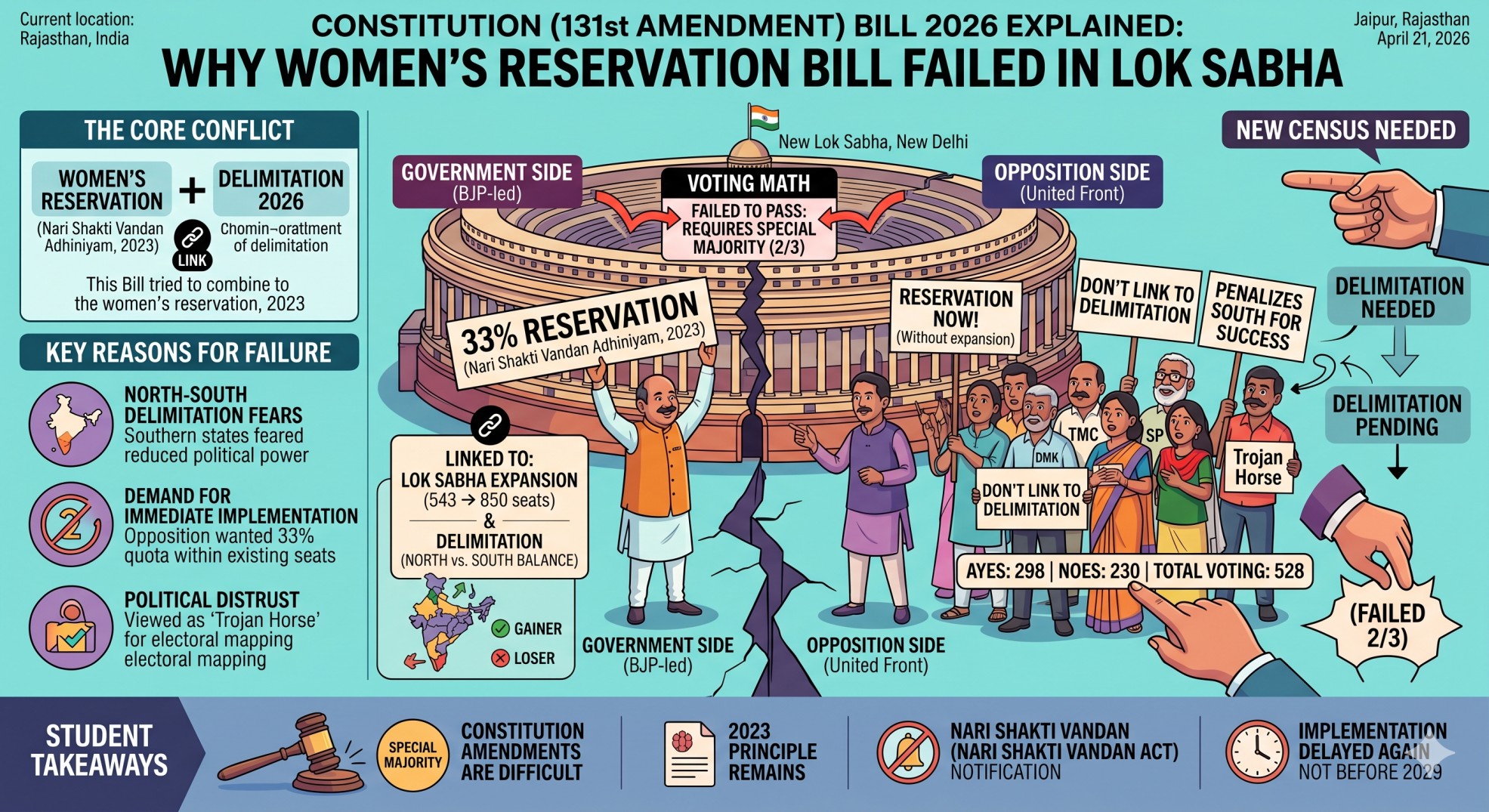
Constitution (131st Amendment) Bill 2026 Explained: Why Women’s Reservation Bill Failed in Lok Sabha
READ MORE →
12वीं के बाद क्या करें? Science, Commerce, Arts के लिए Best Courses और Career Options 2026
READ MORE →
Sijimali Hills Protest Explained: Why Tribals Oppose Vedanta Mining Project
READ MORE →