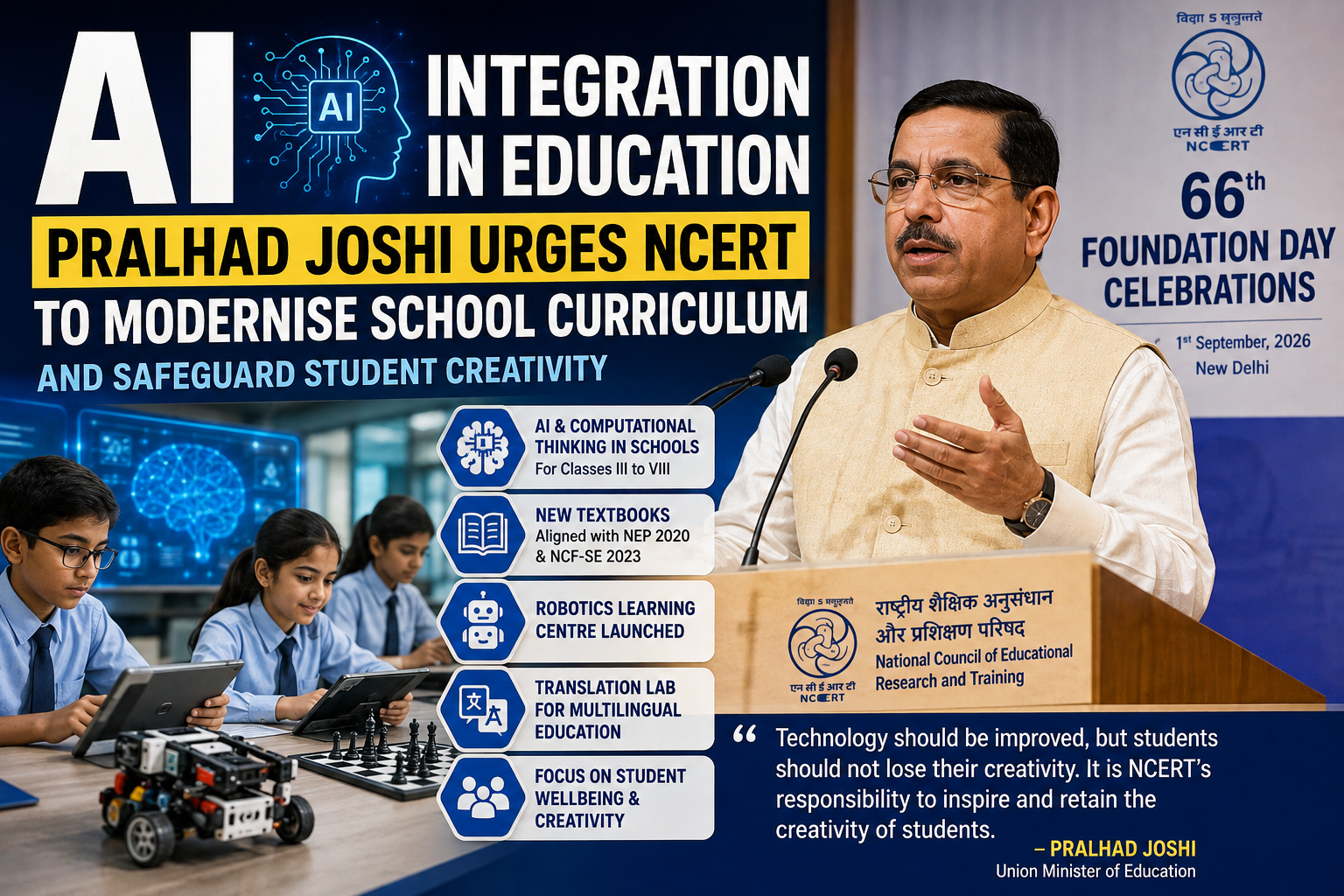
AI Integration in Education Pralhad Joshi: NCERT
AI Integration in Education Pralhad Joshi: What the Education Minister Said
The AI Integration in Education Pralhad Joshi discussion took centre stage at the 66th Foundation Day celebrations of the National Council of Educational Research and Training (NCERT) in New Delhi on September 1, 2026.
Union Minister for Education Pralhad Joshi highlighted the growing role of Artificial Intelligence in education and society. He called for NCERT to strengthen its research ecosystem and use technology to prepare students for a rapidly changing world.
At the same time, the Minister stressed that technology should not come at the cost of creativity, critical thinking, problem-solving and innovation.
The event also saw the inauguration of a Robotics Learning Centre, Translation Lab and upgraded Television Studio at NCERT. These facilities are intended to support technology-enabled learning, multilingual education and the creation of educational content. (Press Information Bureau)
NCERT 66th Foundation Day 2026: Key Highlights
| Particular | Details |
|---|---|
| Event | NCERT 66th Foundation Day |
| Date | September 1, 2026 |
| Venue | NCERT Headquarters, New Delhi |
| Chief Guest | Union Education Minister Pralhad Joshi |
| Major Focus | AI, technology, research and curriculum reforms |
| New Facility | Robotics Learning Centre |
| New Facility | Translation Lab |
| New Facility | Upgraded Television Studio |
| Education Framework | NEP 2020 and NCF-SE 2023 |
| New Textbooks | Grades 1–9 |
| Language Focus | Multilingual education |
| Other Focus Areas | Creativity, critical thinking and student wellbeing |
According to the Ministry of Education, NCERT has played a major role in India's school education system for more than six decades through textbooks, learning materials and curriculum frameworks. (Press Information Bureau)
Why AI Is Becoming Important in School Education
Artificial Intelligence is increasingly becoming part of everyday life.
Students are already interacting with digital platforms, recommendation systems, search tools and AI-powered applications. This means schools cannot treat AI as a technology that belongs only to higher education or professional courses.
The government has therefore been moving toward introducing computational thinking and AI-related learning at earlier stages of school education.
The objective is not simply to teach students how to use AI tools.
Instead, students need to understand how technology works, how to evaluate information, how to solve problems and how to use AI responsibly.
The Ministry of Education has identified skills such as:
-
Logical thinking
-
Problem-solving
-
Pattern recognition
-
Computational thinking
-
Data literacy
-
Digital literacy
-
AI awareness
-
Innovation
-
Ethical decision-making
as important components of future-ready education. (Press Information Bureau)


Computational Thinking and AI Curriculum for Classes III to VIII
One of the biggest developments in India's school education system is the introduction of a dedicated Computational Thinking and Artificial Intelligence curriculum for Classes III to VIII.
The programme is being implemented from the 2026–27 academic session through NCERT and CBSE.
The curriculum aims to build AI readiness by first developing computational thinking skills.
Students are expected to work on concepts such as:
-
Logical reasoning
-
Problem-solving
-
Pattern recognition
-
Algorithmic thinking
-
Digital literacy
-
Understanding AI in daily life
-
Responsible technology use
The approach is designed to be age-appropriate and activity-based rather than focused only on theoretical learning. (Press Information Bureau)
What Will Students Learn?
The new approach focuses on building the foundations required to understand AI.
For younger students, learning can involve puzzles, games, visual activities and problem-solving exercises.
The objective is to teach children how to break a large problem into smaller parts and identify patterns or logical relationships.
As students move into higher classes, these foundations can support more advanced learning in AI, programming, data and related technologies.
The government has also emphasised that responsible and ethical use of AI should remain an important part of this learning process. (Press Information Bureau)
AI Curriculum for Classes IX to XII
The changes are not limited to Classes III to VIII.
According to the Ministry of Education, the curriculum for Artificial Intelligence and allied subjects for Classes IX to XII has also been finalised.
This creates a more structured progression from computational thinking at the lower levels toward AI-related learning at higher classes. (Press Information Bureau)
This progression is important because students will increasingly encounter AI not only as consumers but also as potential creators, researchers and professionals.
AI Should Not Replace Student Creativity
One of the central messages from Pralhad Joshi at the NCERT event was that technological advancement must be balanced with human creativity.
The purpose of introducing AI in schools should not be to make students dependent on automated tools.
Instead, AI should support students while teachers continue to develop:
-
Independent thinking
-
Creativity
-
Curiosity
-
Reasoning
-
Problem-solving
-
Innovation
This distinction is especially important because generative AI can produce answers quickly.
But a fast answer is not necessarily a correct answer.
Students therefore need the ability to question information and independently evaluate whether an AI-generated response is accurate.
The government has specifically highlighted critical thinking and responsible AI use as important parts of AI education. (Press Information Bureau)
Why Critical Thinking Matters in the AI Era
AI tools can generate text, images, summaries, code and other content within seconds.
However, AI systems can also produce incorrect or misleading information.
That is why students should not be trained merely to copy AI-generated answers.
Instead, education needs to teach students to ask:
Is this information correct?
What is the source?
Can the information be verified?
Does the answer actually solve the problem?
Is AI being used ethically?
These skills become increasingly important as AI becomes more common in education and society.
NEP 2020 and the Changing Education System
The developments discussed at the NCERT Foundation Day are closely connected with the National Education Policy (NEP) 2020.
NEP 2020 places greater emphasis on:
-
Holistic development
-
Creativity
-
Critical thinking
-
Experiential learning
-
Competency-based education
-
Multidisciplinary learning
-
Technology
-
Indian languages
-
Indian Knowledge Systems
The government has been using the National Curriculum Framework for Foundational Stage (NCF-FS) 2022 and National Curriculum Framework for School Education (NCF-SE) 2023 as important frameworks for these reforms. (Press Information Bureau)
NCERT New Textbooks for Grades 1 to 9
Another important update highlighted by Pralhad Joshi was the development of new textbooks.
According to the Ministry of Education, NCERT has been working on new textbooks for Grades 1 to 9 based on the new curriculum frameworks.
These textbooks are intended to make learning more engaging and relevant while incorporating India's heritage and Indian Knowledge Systems.
The government also highlighted the multilingual dimension of this work.
Textbooks for Grades 1 to 8 are being prepared in all 22 languages listed in the Eighth Schedule of the Constitution, along with primers in different Indian languages, including tribal languages. (Press Information Bureau)


Indian Knowledge Systems in New Textbooks
The textbook reforms are not only about adding technology.
The government says the new learning materials are also being rooted in India's heritage.
Indian Knowledge Systems (IKS) are being integrated across the textbooks.
This approach attempts to combine modern education with India's cultural, historical and intellectual traditions.
The broader objective is to create learning materials that are relevant to modern students while maintaining connections with India's knowledge heritage. (Press Information Bureau)
Multilingual Education Gets More Attention
Language is another major part of the NCERT reforms.
The Ministry has highlighted the preparation of textbooks in all 22 languages listed in the Eighth Schedule.
NCERT has also been working on primers in multiple Indian languages, including tribal languages.
This is significant because students often understand concepts more effectively when early learning is available in familiar languages.
Multilingual educational resources can therefore help improve accessibility and participation across different regions and communities. (Press Information Bureau)
NCERT Launches Robotics Learning Centre
Technology was not limited to discussions during the Foundation Day event.
NCERT also inaugurated a Robotics Learning Centre.
The centre is expected to support hands-on learning and experimentation involving emerging technologies.
Robotics can provide students with opportunities to connect concepts from mathematics, science, programming and engineering with practical activities.
This type of experiential learning is consistent with the broader educational direction under NEP 2020. (Press Information Bureau)
Translation Lab to Support Indian Languages
NCERT also inaugurated a Translation Lab.
The facility is expected to strengthen educational content in Indian languages and support multilingual learning.
This becomes particularly relevant as the government expands textbook availability across multiple languages.
The combination of translation technology and educational content can help NCERT distribute learning resources to a much wider student population. (Press Information Bureau)
Upgraded Television Studio for Digital Learning
An upgraded Television Studio was also inaugurated during the celebrations.
The facility is intended to support the production of educational content.
NCERT's digital education ecosystem includes platforms such as PM eVIDYA, DIKSHA and eJaadui Pitara.
The Ministry said the new facilities would support technology-enabled learning and educational content development. (Press Information Bureau)
Student Mental Health Also Remains a Priority
The AI discussion was not the only education-related concern raised at the event.
The government also emphasised the importance of student mental wellbeing.
As academic and technological pressures increase, schools need to consider the emotional and psychological needs of students.
The Ministry highlighted curricular interventions, psychosocial support and teacher training as part of this broader approach. (Press Information Bureau)
Education therefore cannot be reduced to examination scores alone.
Students also need opportunities to develop social, emotional, creative and practical skills.
Technology and Human Skills Must Work Together
The future of education is unlikely to be about choosing between technology and traditional learning.
Instead, the challenge is to combine both effectively.
AI can help students access information, explore ideas and work with digital tools.
Teachers, however, remain important for:
-
Mentoring
-
Explaining concepts
-
Encouraging curiosity
-
Developing values
-
Evaluating student understanding
-
Supporting creativity
-
Building human relationships
The government's approach therefore focuses on AI readiness without removing the human element from education.
AI Education Is Already Expanding in India
The latest NCERT developments are part of a wider government push toward AI and digital education.
In August 2026, the Ministry of Education stated that NCERT, in collaboration with CBSE, had introduced the dedicated Computational Thinking and AI curriculum for Classes III to VIII from 2026–27.
The government also said that the programme covers AI basics, generative AI, AI in daily life, programming fundamentals, ethics, cybersecurity and future career opportunities through its structured learning modules. (Press Information Bureau)
This shows that AI education is moving beyond an optional technology topic and becoming part of a broader school-learning strategy.
What Does This Mean for Students?
For students, these changes could gradually alter the way technology is taught in schools.
Instead of learning only basic computer operations, students may increasingly be introduced to concepts such as:
Computational Thinking → Problem Solving → AI Awareness → Digital Literacy → Responsible AI Use
At higher levels, students can then move toward programming, data, machine learning and other advanced fields.
The goal is to create students who can understand and use technology intelligently, rather than simply depend on it.
What Does This Mean for Teachers?
Teachers will also play a crucial role in the transition.
Introducing AI into classrooms requires educators to understand how these technologies work and how they can be used appropriately.
The government has therefore also included teacher-oriented components in its AI education initiatives.
Teacher training can help educators identify useful applications of AI while also teaching students about limitations, ethics and responsible use. (Press Information Bureau)
NCERT's Next Phase: More Innovative and Future-Ready
At the 66th Foundation Day event, Pralhad Joshi called for NCERT to become more innovative, inclusive, research-driven and future-ready.
The direction outlined at the event combines several priorities:
AI and technology
Research and innovation
Multilingual education
New curriculum frameworks
Indian Knowledge Systems
Robotics and hands-on learning
Digital educational content
Student mental wellbeing
Together, these areas represent a broader attempt to modernise school education while keeping students at the centre. (Press Information Bureau)
Key Takeaways
-
NCERT celebrated its 66th Foundation Day on September 1, 2026.
-
Union Education Minister Pralhad Joshi addressed the event in New Delhi.
-
He highlighted the growing importance of AI in education and society.
-
He called for stronger research and technology use at NCERT.
-
A Robotics Learning Centre was inaugurated.
-
A Translation Lab was inaugurated.
-
NCERT's Television Studio was upgraded.
-
New textbooks for Grades 1 to 9 are part of the ongoing curriculum reforms.
-
Textbooks for Grades 1 to 8 are being prepared in 22 Eighth Schedule languages.
-
Computational Thinking and AI curriculum for Classes III to VIII is being implemented from 2026–27.
-
AI and allied-subject curriculum for Classes IX to XII has been finalised.
-
Critical thinking, creativity, digital literacy and responsible AI use remain important priorities.
-
Student mental wellbeing and teacher training are also part of the broader education reform agenda. (Press Information Bureau)
Conclusion
The AI Integration in Education Pralhad Joshi discussion at NCERT's 66th Foundation Day reflects a larger transformation taking place in India's school education system.
AI is becoming increasingly relevant to classrooms, careers and everyday life. The government's approach is therefore moving toward earlier exposure to computational thinking, AI awareness and digital literacy.
At the same time, the message from NCERT's Foundation Day is that technology should not replace the qualities that make human learning valuable.
Creativity, critical thinking, problem-solving, innovation and responsible decision-making must remain at the centre of education.
With new textbooks, AI and computational thinking curriculum, robotics facilities, translation infrastructure and digital learning resources, NCERT is being positioned to play a larger role in preparing students for an increasingly technology-driven future.
The real challenge will be to ensure that students do not simply use AI, but learn to think critically with AI.


Related Articles

IPL Auction में पैसों की बारिश: किस खिलाड़ी पर टूटा करोड़ों का पहाड़?
READ MORE →
Affiliate Marketing कैसे कराती है कमाई? पूरी जानकारी और स्टेप-बाय-स्टेप गाइड 2026
READ MORE →
India-Austria Relations 2026: A Strategic Partnership for Defense & Trade
READ MORE →
Annie Easley: NASA की Human Computer जिसने बिना मशीन के स्पेस का भविष्य बदला
READ MORE →
Census 2027 Self Enumeration: घर बैठे ऑनलाइन जनगणना फॉर्म कैसे भरें | पूरी प्रक्रिया हिंदी में
READ MORE →
AI Discovers 10,091 New Exoplanet Candidates | Princeton University TESS Study 2026 Full Analysis
READ MORE →
6 दिन पहले अंडमान पहुंचा मानसून 2026: IMD अपडेट और पूर्ण विश्लेषण
READ MORE →