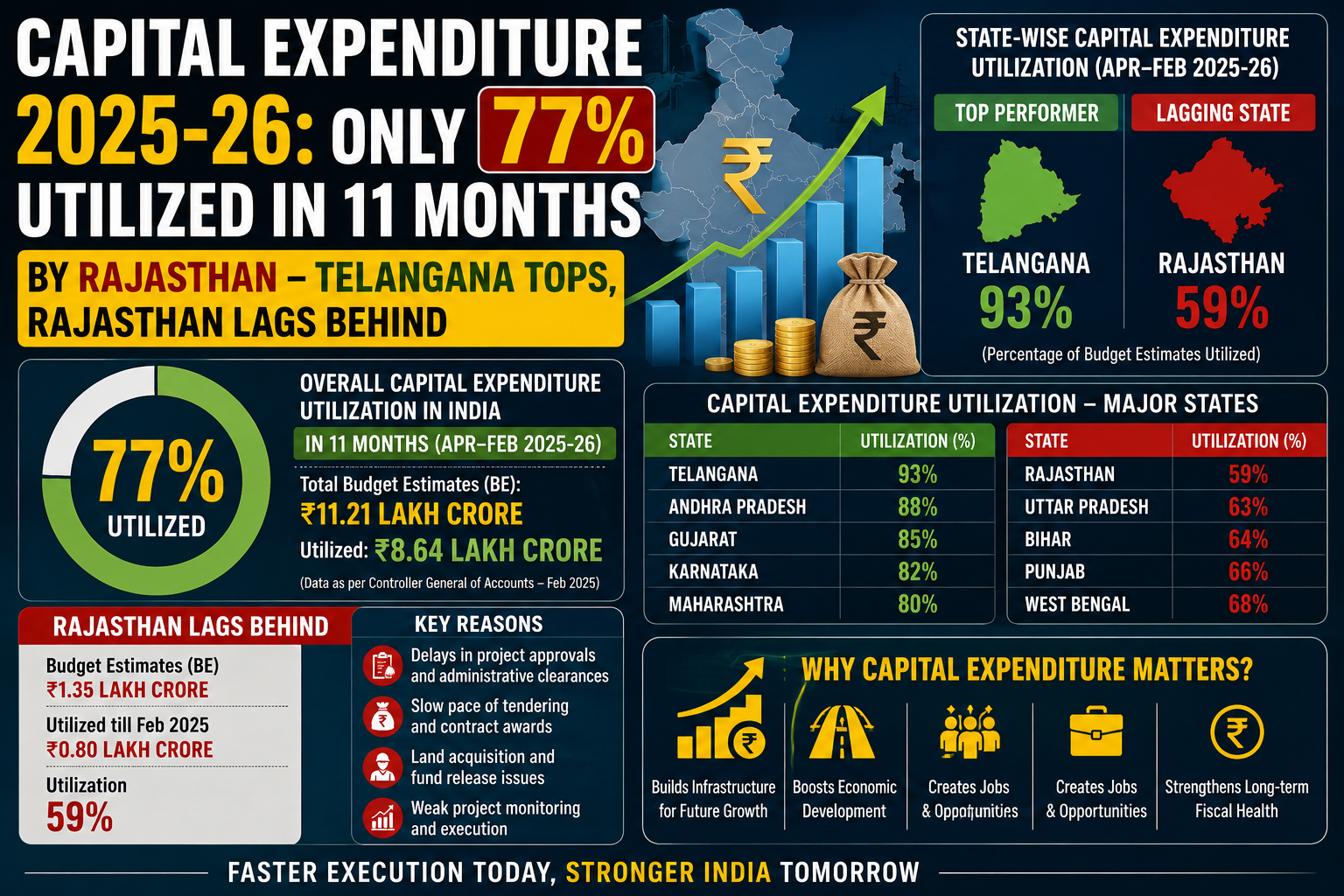
Capital Expenditure 2025-26: Only 77% Utilized in 11 Months – Telangana Tops, Rajasthan Lags Behind
Capital Expenditure in States 2025-26: Only 77% Utilized in 11 Months – Telangana Tops, Rajasthan Lags Behind
A Detailed Analysis of State Budget Performance in Financial Year 2025-26
The newspaper Rajasthan Patrika (19 May 2026 edition) has highlighted a concerning trend in India’s fiscal management. According to the latest data released by the Comptroller and Auditor General (CAG) and the Ministry of Finance, Indian states have utilized only 77% of their planned capital expenditure (Capex) in the first 11 months of the financial year 2025-26 (April 2025 to February 2026). This under-utilization of development funds raises serious questions about implementation efficiency, governance quality, and the actual pace of infrastructure creation across the country.
This comprehensive blog analyses the latest state-wise capital expenditure data, compares top and bottom performers, examines why some states are excelling while others like Rajasthan are lagging, and discusses the broader economic implications for India’s growth story.
What is Capital Expenditure (Capex) and Why Does It Matter?
Capital Expenditure refers to the money spent by governments on creating long-term assets such as roads, bridges, railways, power plants, schools, hospitals, irrigation facilities, industrial parks, and digital infrastructure. Unlike revenue expenditure (salaries, subsidies, pensions, freebies), Capex builds future productive capacity and generates long-term economic returns.
High and efficient Capex is considered the real engine of economic growth. It creates jobs, improves ease of doing business, attracts private investment, and raises the overall productivity of the state.
Key Findings from the Latest Data (First 11 Months of FY 2025-26)
According to the article and official figures:
- National Average Utilization: Only 77% of the budgeted capital expenditure was spent till March 2026 (11 months).
- The Centre itself achieved 84% utilization in the same period.
- Significant variation exists between states.
Top 5 States in Capital Expenditure Utilization
| Rank | State | Budgeted Capex (₹ Crore) | Actual Spent (₹ Crore) | Utilization % |
|---|---|---|---|---|
| 1 | Telangana | 36,504.45 | 53,873.31 | 147.58% |
| 2 | Karnataka | 68,172.24 | 69,852.42 | 102.46% |
| 3 | Himachal Pradesh | 10,228.79 | 9,984.05 | 96.73% |
| 4 | Haryana | 16,872.37 | 18,030.36 | 96.56% |
| 5 | Bihar | 41,972.79 | 36,576.5 | 87.14% |
Telangana has remarkably overshot its target (147.58%), showing exceptional implementation speed.
Bottom 5 States in Capital Expenditure Utilization
| Rank | State | Budgeted Capex (₹ Crore) | Actual Spent (₹ Crore) | Utilization % |
|---|---|---|---|---|
| 1 | Odisha | 65,012 | 42,831.36 | 65.88% |
| 2 | Tripura | 7,903.26 | 5,006.11 | 63.34% |
| 3 | Chhattisgarh | 26,341 | 15,047.25 | 57.12% |
| 4 | Jharkhand | 56,327.33 | 29,190.96 | 51.82% |
| 5 | West Bengal | 39,377.74 | 18,905.34 | 48.06% |
Rajasthan has also been highlighted as one of the under-performers in development spending despite having one of the largest budgets.
Why Rajasthan is Lagging Behind
The Rajasthan Patrika report points out that Rajasthan has spent only around 51% of its planned capital budget in some key areas. Reasons commonly cited for such under-performance include:
- Delay in land acquisition and forest clearances
- Slow tendering and procurement processes
- Frequent transfers of officials
- Overemphasis on revenue expenditure (subsidies and welfare schemes)
- Political instability or policy flip-flops in some projects
- Poor project monitoring and execution capacity at the ground level
Despite having a massive overall budget (over ₹5.37 lakh crore), the quality of spending in Rajasthan appears weaker compared to southern states.
Comparative Performance: Southern vs Northern & Eastern States
Southern states like Telangana, Karnataka, Tamil Nadu, and Andhra Pradesh continue to demonstrate better fiscal discipline and project execution capabilities. These states generally have:
- Stronger bureaucratic efficiency
- Better digital monitoring systems
- Clearer long-term vision documents
- Higher private sector participation in infrastructure
In contrast, many Hindi belt and eastern states are struggling with implementation even when they have large budgetary allocations.
National Implications of Low Capex Utilization
- Slower Economic Growth: Under-utilized Capex means delayed infrastructure, which hurts GDP growth, employment generation, and investor confidence.
- Rising Debt Burden: States are borrowing heavily to fund budgets. When this borrowed money is not spent productively, it leads to higher interest payments and future fiscal stress.
- Inequality Between States: States with high Capex utilization are pulling ahead in development, while laggards risk falling further behind.
- Centre’s Push: The Union Government has been providing interest-free loans specifically for Capex. Low utilization means states are not fully availing this opportunity.
- Inflation and Supply Chain Issues: Delayed projects often lead to cost overruns when executed later.
Challenges Faced by States in Capex Execution
- Bureaucratic red tape
- Shortage of skilled manpower for project monitoring
- Election-year populism shifting focus to freebies
- Land acquisition and environmental clearance delays
- Poor coordination between departments
- Corruption and leakages in some cases
Way Forward: How States Can Improve Capex Utilization
- Single Window Clearance Systems for faster approvals
- Real-time Digital Monitoring dashboards (like Telangana model)
- Public-Private Partnerships (PPP) to bring efficiency
- Capacity Building of officials
- Outcome-based Budgeting instead of input-based
- Strict penal provisions for delays in project completion
- Focus on Priority Sectors — roads, power, water, and education
Conclusion: From Allocation to Actual Development
The data for FY 2025-26 clearly shows that budget size alone is not enough. What matters ultimately is how effectively the money is spent on capital assets. States like Telangana and Karnataka are setting examples by not just allocating funds but ensuring their timely and efficient utilization.
For Rajasthan and other lagging states, this is a wake-up call. The coming months (and the next financial year 2026-27) must focus on improving execution capabilities, reducing delays, and prioritizing quality infrastructure development.
India’s dream of becoming a developed nation by 2047 heavily depends on how well its states perform on capital expenditure. Efficient spending today will determine the quality of life and economic opportunities for the next generation.
The gap between announcement and actual development must be bridged urgently.
reference rajasthan patrika and cag report
Related Articles

Goodbye to the 24-Hour Day: Will Earth Really Have 25-Hour Days in the Future?
READ MORE →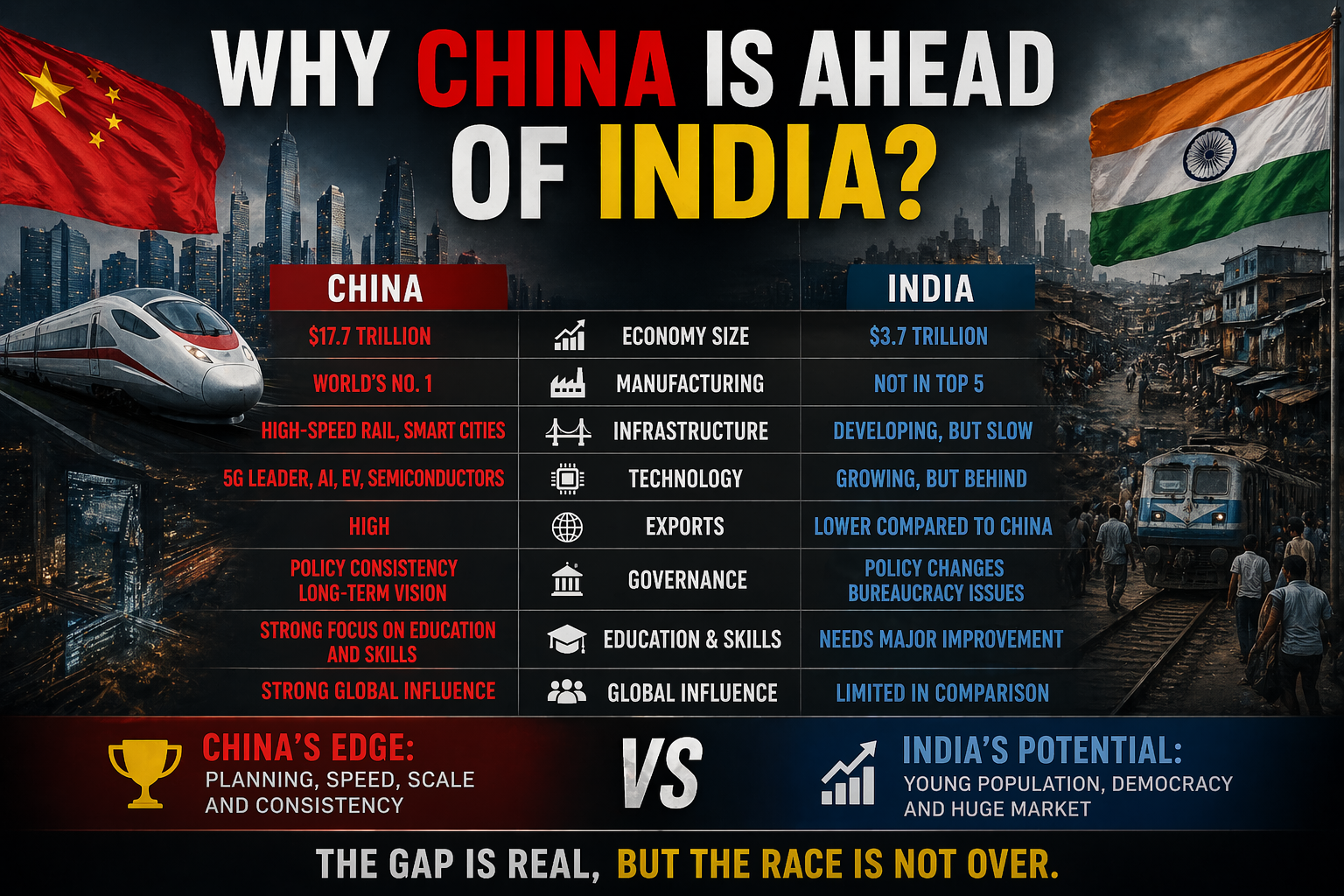
India vs China: Why China Is Ahead of India (From 1947 to 2026 Explained)
READ MORE →
Gold Import Duty India: क्यों बढ़ाया और असर क्या होगा
READ MORE →
Entertainment Industry Workers Dark Reality Behind Bollywood Superstars
READ MORE →