CBSE Digital Answer Sheet Checking: On-Screen Marking System for Class 12 Exams 2026
CBSE Introduces Digital Answer Sheet Checking: On-Screen Marking (OSM) System for Class 12 Board Exams 2026
The Central Board of Secondary Education (CBSE) has taken a major leap into the digital era with the introduction of On-Screen Marking (OSM) for Class 12 board examinations starting from 2026. This transformative shift replaces the traditional manual evaluation of physical answer sheets with a fully digital checking process. While the move aims to bring greater transparency, accuracy, and speed to the evaluation system, it has also sparked debates and concerns among students, parents, and teachers.
This comprehensive blog explores everything about CBSE’s new digital answer sheet checking system — its implementation, benefits, challenges, controversies, and what it means for students.
What is On-Screen Marking (OSM)?
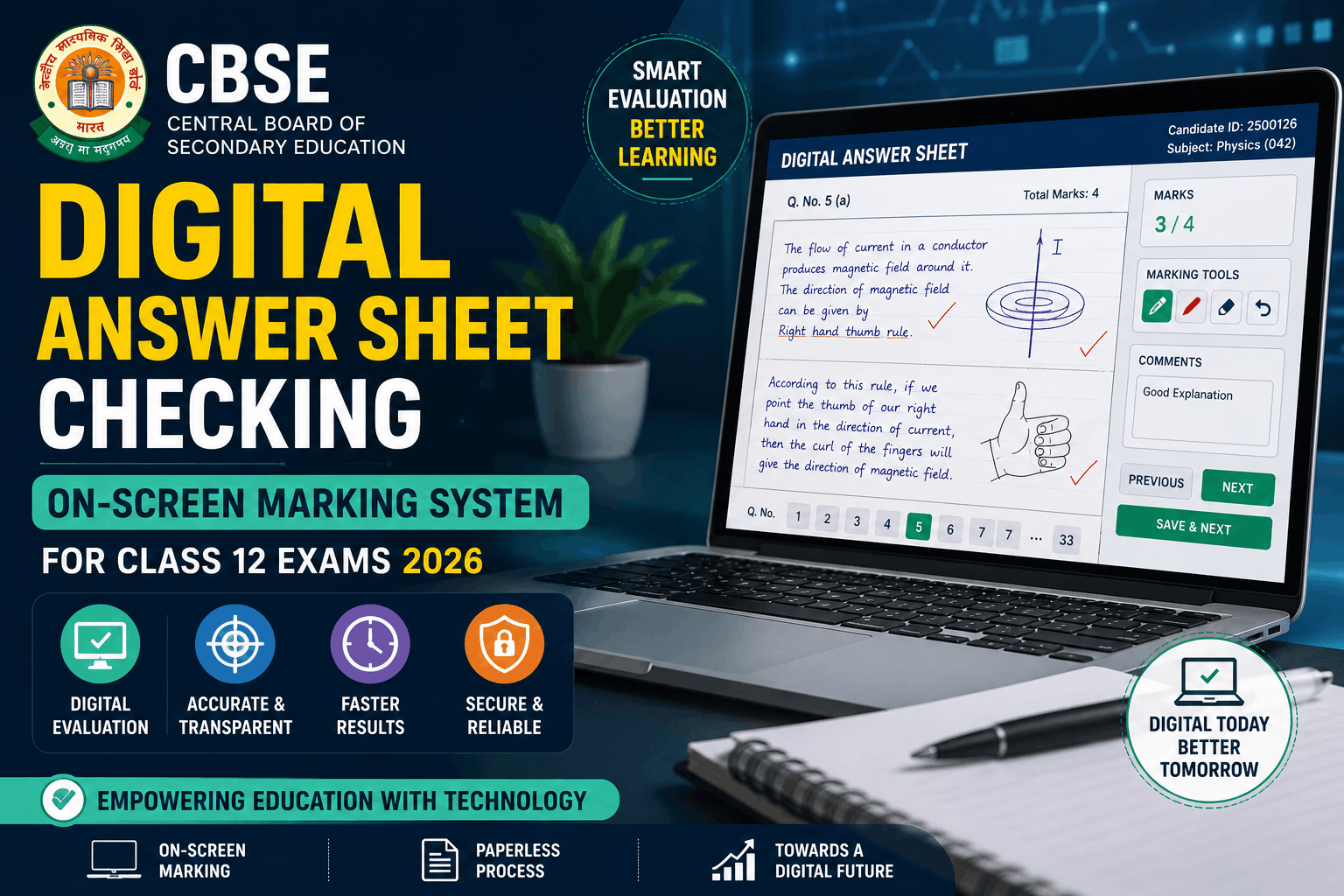
On-Screen Marking is a modern digital evaluation system where physical answer sheets are scanned at high resolution and uploaded to a secure online platform. Trained examiners then evaluate these digital copies on computer screens instead of handling physical papers.
Key features of the system:
- Answer sheets are scanned and converted into secure PDFs.
- Examiners access scripts through a dedicated software.
- Marks are entered digitally with automatic totaling.
- Multiple levels of moderation and quality checks.
- Reduced human handling of physical copies.
Official Announcement and Timeline
In February 2026, CBSE issued a formal notification announcing the introduction of OSM for Class 12 board exams. The board clarified that Class 10 answer sheets would continue to be evaluated in the traditional physical mode for 2026, while Class 12 became the first to undergo full digital evaluation.
The actual evaluation process began in early March 2026. Over 98 lakh answer books of more than 18 lakh Class 12 students were processed through this new system.
How Does the CBSE Digital Evaluation Process Work?
- Scanning Phase After the exams, answer booklets are collected and sent to designated scanning centers where high-quality scanners digitize each page.
- Quality Check A first-level verification ensures that all pages are properly scanned and readable.
- Secure Upload Scanned copies are uploaded to a highly secure platform managed by a technical partner.
- Digital Evaluation Examiners log in from designated centers and evaluate answers on screen. They can zoom, highlight, and annotate digitally.
- Moderation & Cross-Checking Assistant Head Examiners and Head Examiners review the marking for consistency and accuracy.
- Final Compilation Marks are automatically totaled and compiled for result processing.
Major Benefits of Digital Answer Sheet Checking
- Reduced Errors: Automatic totaling eliminates manual calculation mistakes.
- Greater Transparency: Digital trail makes re-evaluation and scrutiny easier.
- Faster Results: The process significantly reduces the time required for evaluation.
- Less Bias: Examiners see only the answers without knowing the student’s identity or handwriting in many cases.
- Environmental Impact: Less physical transportation of answer sheets.
- Convenience for Re-checking: Students can easily obtain scanned copies online.
Challenges and Controversies (May 2026)
Despite the noble intentions, the first year of implementation has faced significant backlash:
- Many students complained about receiving wrong answer sheets or missing pages in scanned copies.
- Issues with blurred or unreadable scanned images.
- Payment portal crashes when students tried to download copies.
- Allegations of inconsistent marking and lower-than-expected scores.
- Security concerns regarding the third-party vendor handling the process.
- Political criticism, with demands for a judicial probe.
CBSE has responded by involving IIT experts for audits and extending deadlines for obtaining scanned copies and re-evaluation.
Impact on Students and Teachers
For Students:
- Need to write more neatly and structure answers clearly, as readability matters more in scanned format.
- Better preparation for re-evaluation process.
- Faster access to results and answer copies.
For Teachers:
- Training required for digital evaluation.
- More standardized marking possible.
- Reduced physical workload but increased screen time.
Comparison: Traditional vs Digital Evaluation
| Aspect | Traditional Method | On-Screen Marking (OSM) |
|---|---|---|
| Evaluation Method | Physical paper checking | Digital on computer screen |
| Totaling Errors | Common | Automatic (almost zero) |
| Processing Time | Longer | Faster |
| Transparency | Limited | Higher |
| Re-evaluation | Difficult | Easier with scanned copies |
| Logistics | Heavy transportation | Minimal physical movement |
What Should Students Do Now?
- Write answers neatly with proper spacing and headings.
- Number pages clearly.
- Practice structured and point-wise answers.
- Keep track of official CBSE notifications regarding re-evaluation.
- Save screenshots and records during result time.
The Road Ahead
CBSE plans to gradually expand digital evaluation to other classes and subjects. The board is working on resolving technical glitches and improving the system based on feedback from the first year.
This shift represents a broader digital transformation in India’s education system, aligning with the National Education Policy 2020’s vision of technology integration.
Conclusion
The introduction of digital answer sheet checking by CBSE is a bold and necessary step toward modernizing board examinations. While the transition has been bumpy in its first year, the long-term benefits in terms of accuracy, transparency, and efficiency are undeniable.
As the education system evolves with technology, students, teachers, and parents must adapt to these changes. The future of examinations is digital, and CBSE has taken the first decisive step in that direction.
The success of this system will ultimately depend on how effectively the board addresses the current challenges and continuously improves the process in the coming years