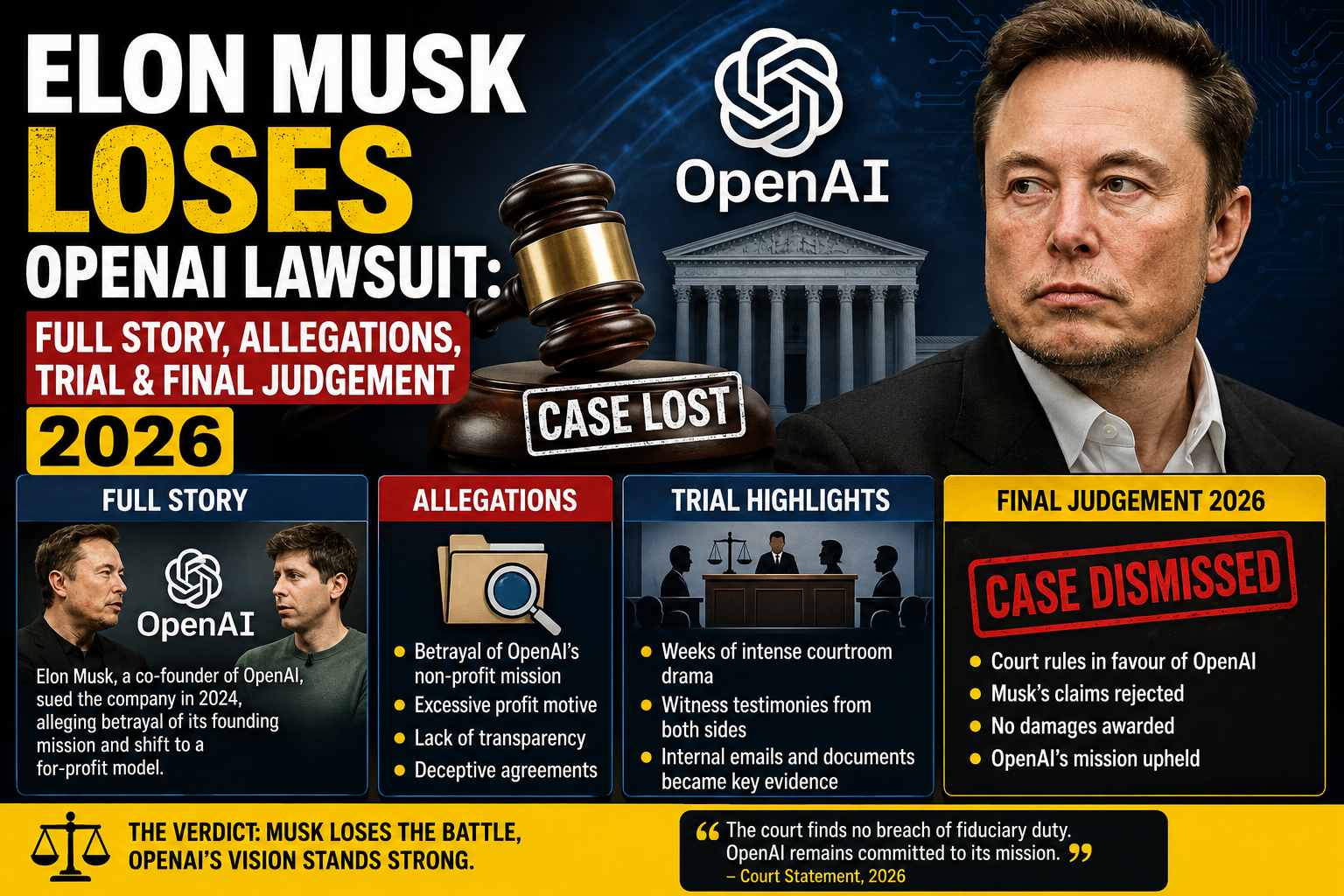
Elon Musk Loses OpenAI Lawsuit: Full Story, Allegations, Trial & Final Judgement 2026
Elon Musk vs OpenAI Lawsuit: Full Story, Key Allegations, Trial Highlights, and the Final Judgement (May 2026)
In one of the most high-profile legal battles in Silicon Valley history, Elon Musk suffered a decisive defeat against OpenAI, Sam Altman, and Greg Brockman on May 18, 2026. A federal jury in Oakland, California, unanimously ruled against Musk, dismissing his claims on the grounds that he had filed the lawsuit too late — beyond the statute of limitations. The verdict, reached in under two hours, clears a major obstacle for OpenAI’s path toward a potential IPO valued at nearly $1 trillion.
This blog provides a complete, detailed, and balanced account of the case — from its origins to the dramatic courtroom showdown and its far-reaching implications.
Origins of the Feud: From Co-Founders to Bitter Rivals
Elon Musk and Sam Altman co-founded OpenAI in December 2015 as a nonprofit organization. The stated mission was ambitious and idealistic: to develop artificial general intelligence (AGI) that would benefit all of humanity rather than serve private commercial interests. Musk donated approximately $38–50 million in the early years and played a significant role in shaping its initial direction.
Musk left OpenAI in 2018, citing potential conflicts with Tesla’s AI work. Tensions escalated in 2023 when OpenAI transitioned toward a for-profit model (capped-profit structure) to attract massive investment, including billions from Microsoft. Musk publicly criticized the move, accusing OpenAI of betraying its founding principles. He launched xAI in 2023 as a direct competitor, positioning it as a “maximum truth-seeking” alternative.
In February/March 2024, Musk filed a lawsuit in California federal court against OpenAI, Altman, Brockman, and related entities. He later amended the complaint, seeking massive remedies including:
- Forcing OpenAI back to nonprofit status
- Returning billions in profits
- Removing Altman and Brockman from leadership
- Up to $150 billion in damages (including claims of unjust enrichment)
Musk’s Core Allegations
Musk’s legal team argued that:
- OpenAI was founded as a nonprofit with a binding commitment to open-source development and humanity-first principles.
- Altman and others breached fiduciary duties and the founding agreement by pursuing aggressive commercialization.
- Musk was misled and his early donations were exploited.
- OpenAI’s partnership with Microsoft created conflicts of interest.
Musk’s lawyers portrayed the case as a fight to protect the original charitable mission from corporate greed.
OpenAI’s Defense
OpenAI countered that:
- There was no enforceable contract binding the company to remain a pure nonprofit forever.
- Musk himself had proposed for-profit elements in early discussions.
- Musk waited years after knowing about the changes (as early as 2019) before suing — violating California’s three-year statute of limitations for such claims.
- The lawsuit was a strategic move by a business competitor (xAI) to slow down a rival.
OpenAI emphasized that the shift to a for-profit arm was necessary to raise capital for the enormous compute and talent costs of building advanced AI.
The Trial: Key Moments (April–May 2026)
The trial, held in U.S. District Court in Oakland before Judge Yvonne Gonzalez Rogers, featured dramatic testimony from both sides. Witnesses included Musk, Altman, and several early OpenAI employees.
Key highlights:
- Musk took the stand and sparred with attorneys over emails and early conversations.
- Internal documents revealed heated debates among founders about OpenAI’s direction.
- OpenAI’s lawyers presented evidence showing Musk was aware of structural changes years before filing suit.
- The jury heard arguments about whether OpenAI had truly abandoned its mission or had adapted responsibly to compete in a high-stakes AI race.
After weeks of testimony and closing arguments, the case went to the nine-member jury.
The Judgement: May 18, 2026
On Monday, May 18, 2026, the jury delivered a swift and unanimous verdict:
- All claims against OpenAI, Sam Altman, Greg Brockman, and related entities were dismissed.
- The jury found that Elon Musk’s lawsuit was barred by the statute of limitations.
- Judge Yvonne Gonzalez Rogers immediately adopted the advisory jury’s verdict and dismissed the case.
The court did not rule on the substantive merits of Musk’s accusations (breach of contract, fiduciary duty, etc.). The decision rested purely on the procedural ground that Musk had waited too long to sue after becoming aware of OpenAI’s direction.
Musk’s Reaction Musk called the verdict a “calendar technicality” and a “terrible precedent.” He immediately announced plans to appeal to the 9th U.S. Circuit Court of Appeals.
OpenAI’s Reaction The company hailed the verdict as a major victory, clearing the path for future funding rounds and a potential public listing. Sam Altman expressed relief and reaffirmed OpenAI’s commitment to safe and beneficial AI development.
Implications of the Ruling
For OpenAI:
- Removes a major legal cloud hanging over the company.
- Boosts confidence for investors and employees.
- Strengthens its position in the global AI race.
For Elon Musk & xAI:
- A significant legal and reputational setback.
- Musk must now focus on building xAI as a competitor without court-mandated changes to OpenAI.
- May damage Musk’s image in some circles as using litigation against rivals.
For the AI Industry:
- Signals that courts may be reluctant to intervene in fast-moving corporate governance of AI companies.
- Reinforces the reality that massive capital requirements are driving commercialization of AI research.
Broader Significance: The case highlighted deep philosophical divides in the AI community — “open vs closed,” nonprofit idealism vs commercial necessity, and questions about who should control humanity’s most powerful technology.
What Happens Next?
Musk’s team has confirmed an appeal. However, overturning a statute of limitations dismissal is generally difficult. The case could drag on for months or years in appellate courts.
Meanwhile, OpenAI continues its rapid growth, with reports suggesting preparations for one of the largest IPOs in tech history.
Final Thoughts
The Musk vs OpenAI saga was never just about contracts or money — it was a very public clash of visions, egos, and ambitions at the frontier of artificial intelligence. While Musk lost this round on a technicality, the deeper questions he raised about AI safety, governance, and profit motives will continue to shape the industry for years to come.
The verdict on May 18, 2026, marks the end of one chapter — but the story of AI’s future remains far from over.
Related Articles
Microsoft AI CEO Mustafa Suleyman की बड़ी चेतावनी — AI का भविष्य सुरक्षित या ख़तरनाक? पूरी रिपोर्ट पढ़ें
READ MORE →
Modern India: Progress, Development & the Rise of a Global Power | 2024 Analysis
READ MORE →
NEET 2026 Paper Leak: How One Exam Can Destroy India’s Future
READ MORE →