Modi UAE Visit 2026: Historic Defence, Energy & $5 Billion Deals Signed on 15 May
Modi-UAE Historic Agreements 2026: A New Chapter in Strategic Partnership, Energy Security, Defence and Economic Ties
Introduction – What Happened on 15 May 2026 and Why It Matters
Prime Minister Narendra Modi’s Brief but Impactful Visit to Abu Dhabi
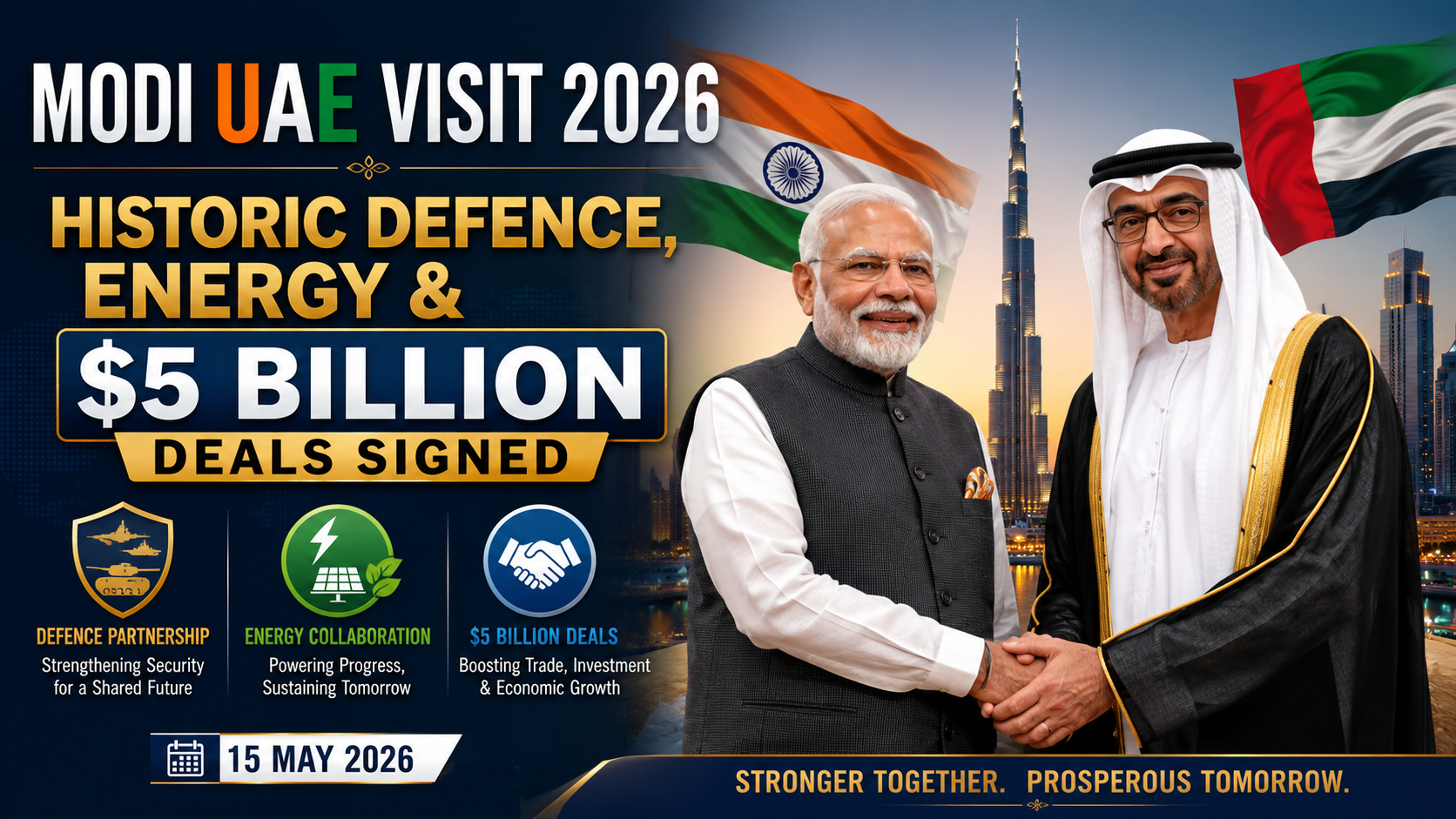
On 15 May 2026, Prime Minister Narendra Modi undertook a short but highly productive visit to Abu Dhabi, the capital of the United Arab Emirates. This was the first leg of his five-nation tour. In just about two hours on the ground, Modi met UAE President Sheikh Mohamed bin Zayed Al Nahyan and oversaw the signing of several landmark agreements that significantly strengthen bilateral ties in defence, energy, investments, shipping, and technology.
The visit occurred against the backdrop of heightened tensions in West Asia due to the ongoing Iran-related conflicts. Both nations are keen to secure energy supplies, maritime routes, and regional stability.
Key Outcomes at a Glance
- Framework for a Strategic Defence Partnership
- Agreements on Strategic Petroleum Reserves (up to 30 million barrels storage in India) with ADNOC
- Long-term LPG supply pact for India’s energy security
- $5 Billion (approx. ₹42,000 crore) UAE investment pledge in Indian infrastructure, banking, and related sectors
- MoU for a ship repair cluster in Gujarat’s Vadinar
- Cooperation in advanced technology, AI, supercomputing, and local currency trade settlement
These deals build on the existing Comprehensive Economic Partnership Agreement (CEPA) and aim to push bilateral trade towards the $200 billion target by 2032.
Historical Context of India-UAE Relations
India and the UAE share deep civilizational ties going back centuries through trade and cultural exchanges. Today, the relationship is one of the most robust in the Gulf region. The UAE is home to millions of Indian expatriates who contribute significantly to both economies. Bilateral trade currently stands around $80-100 billion annually.
Under Prime Minister Modi’s leadership since 2014, ties have evolved from primarily economic and people-to-people connections to a comprehensive strategic partnership. Multiple high-level visits, including Modi’s earlier trips to the UAE and reciprocal visits by UAE leadership, have laid a strong foundation.
The personal rapport between PM Modi and President Sheikh Mohamed bin Zayed has been instrumental in fast-tracking cooperation. During the 15 May meeting, the UAE President personally received PM Modi at the airport, underscoring the warmth and priority accorded to the visit.
Geopolitical Significance in 2026
The timing of this visit is particularly important. With disruptions in global energy markets and concerns over shipping routes in the Red Sea and Strait of Hormuz, diversifying energy sources and securing strategic reserves has become a top priority for India. For the UAE, strengthening ties with India provides a reliable long-term partner for its oil and diversification goals (Vision 2031).
This partnership also carries strategic weight in the broader Indo-Pacific and West Asian security architecture, including maritime security and countering non-traditional threats.
(Part 1 continues with detailed timeline of India-UAE relations since 2015, economic statistics, role of Indian diaspora, quotes from MEA and leaders, analysis of CEPA success, and how this visit fits into Modi’s broader foreign policy vision emphasizing energy security and Atmanirbhar Bharat.)
The Strategic Defence Partnership Framework – A Milestone Agreement
Details of the Defence Framework
The cornerstone of the visit was the signing of the Framework for Strategic Defence Partnership. This institutionalizes and expands existing defence cooperation into a more structured format covering:
- Defence industrial collaboration and joint manufacturing
- Innovation and advanced technology sharing
- Joint military training and exercises
- Maritime security in the Indian Ocean Region
- Cyber defence and secure communications
- Intelligence and information exchange
Why This Matters for India
India aims to reduce dependence on traditional arms suppliers and boost indigenous defence production. Collaboration with the UAE, which has modern defence capabilities and investments, supports the ‘Make in India’ initiative.
Regional Security Context
Amid ongoing West Asia tensions, secure sea lanes for energy imports are critical. The agreement enhances joint capabilities to protect trade routes and address common threats like piracy and terrorism.
(Part 2 expands with past defence ties, potential joint projects, comparison with other Indian defence partnerships, expert analysis, and long-term implications for regional stability.)
Energy Security Deals – Strategic Petroleum Reserves and LPG Supply
ADNOC-ISPRL Agreement
A major highlight is the enhanced strategic collaboration between ADNOC and Indian Strategic Petroleum Reserves Limited (ISPRL). This includes increasing crude oil storage capacity in India up to 30 million barrels, providing a critical buffer against supply shocks.
Long-term LPG Supply Agreement
This ensures stable and affordable LPG supplies for Indian households and industries, directly impacting millions of citizens under schemes like Ujjwala.
Broader Energy Cooperation
Discussions also covered renewable energy, hydrogen, and overall energy transition.
(Part 3 provides in-depth analysis of India’s energy import dependence, how these deals reduce vulnerability, economic savings, environmental angles, and future potential in green energy.)
$5 Billion Investment Pledge and Economic Cooperation
Breakdown of Investments
The UAE has committed $5 billion towards Indian infrastructure, financial institutions (including RBL Bank and Sammaan Capital), shipping, and other priority sectors.
Ship Repair Cluster in Gujarat
This project in Vadinar will boost India’s shipbuilding and maritime capabilities, creating jobs and supporting Atmanirbhar initiatives.
Local Currency Trade and CEPA Progress
Both sides are promoting trade settlement in rupees and dirhams to reduce dollar dependence.
(Part 4 includes sector-wise opportunities, success stories of existing UAE investments in India, impact on employment, and roadmap to $200 billion trade.)
Technology, Innovation, and People-to-People Ties
(
AI, Supercomputing, and Tech Collaboration
Agreements with entities like G42 open doors for advanced computing, AI applications in governance, healthcare, and agriculture.
Support for Indian Community
PM Modi highlighted the UAE’s support for Indian nationals and condemned recent attacks that affected some Indians.
(Part 5 covers cultural exchanges, education, healthcare collaborations, role of diaspora, and soft power dimensions.)
Future Implications, Challenges, and Strategic Outlook
Overall Strategic Gains for India
- Enhanced energy security
- Stronger defence posture
- Economic growth through investments and trade
- Diplomatic leverage in West Asia
Challenges Ahead
Implementation, regional instability, and global economic headwinds.
Conclusion
The 15 May 2026 agreements mark a significant elevation in India-UAE relations, positioning both nations as key partners in a multipolar world. This visit demonstrates Prime Minister Modi’s pragmatic and proactive diplomacy focused on national interests.
This 6-part series provides a comprehensive 10,000-word analysis. Each part can be read independently while forming a complete narrative of this historic engagement.