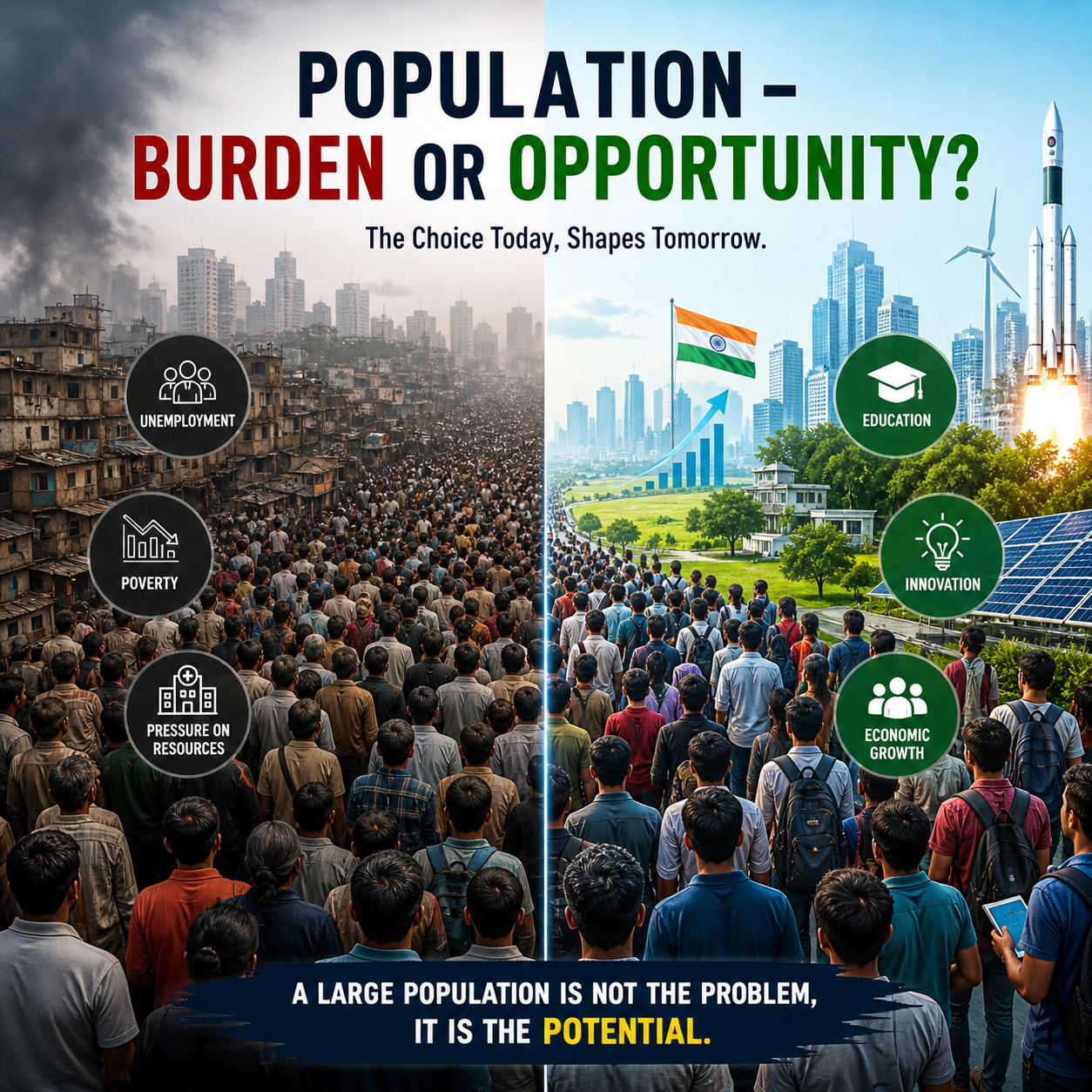
Population – Burden or Opportunity?
1. Introduction: Population – Burden or Opportunity?
India, with over 1.4 billion people, is the world’s most populous country. Traditionally, such a vast population has been perceived as a liability due to pressure on resources, unemployment, poverty, and infrastructure constraints. However, this perception is increasingly being challenged.
In the 21st century, population is no longer merely a number—it is a strategic asset, provided it is educated, skilled, and productively employed. Countries like China and South Korea have demonstrated how human capital can become the backbone of economic transformation.
India today stands at a critical juncture. It possesses one of the largest youth populations in the world, which, if harnessed effectively, can drive sustained economic growth, innovation, and global competitiveness. Conversely, failure to utilize this demographic advantage could lead to widespread unemployment, social unrest, and economic stagnation.
Thus, the central question is not whether India’s population is large, but whether India can transform this population into a productive resource.
2. Conceptual Framework: Population as Human Capital
2.1 From Population to Human Resource
Population becomes a resource only when individuals contribute productively to the economy. This transformation requires:
- Education
- Skill development
- Health and nutrition
- Employment opportunities
Without these, population remains a passive burden rather than an active asset.
2.2 Human Capital Theory
Human Capital Theory, developed by economists like Gary Becker, emphasizes that investment in education and health enhances productivity and economic output.
For India, this implies that:
- Investment in schools, universities, and vocational training
- Improvement in public health systems
- Enhancement of skills and employability
are essential to convert population into a resource.
3. India’s Demographic Dividend: A Window of Opportunity
3.1 Understanding Demographic Dividend
Demographic dividend refers to the economic growth potential that arises when the proportion of working-age population (15–64 years) is higher than dependents (children and elderly).
India is currently experiencing this phase, which is expected to last till around 2040.
3.2 Key Features of India’s Demography
- Over 65% population below 35 years
- Median age around 28 years
- Increasing urban workforce
- Expanding digital adoption
This gives India a unique comparative advantage over aging economies like Japan, Germany, and many European countries.
3.3 Economic Potential
If properly utilized, demographic dividend can:
- Increase GDP growth rates
- Enhance productivity
- Boost innovation and entrepreneurship
- Strengthen global competitiveness
However, demographic dividend is not automatic—it must be earned through policies and investments.
4. Challenges in Utilizing Population as a Resource
Despite its advantages, India faces several structural challenges:
4.1 Unemployment and Underemployment
India struggles with:
- High youth unemployment
- Disguised unemployment in agriculture
- Informal sector dominance
A large workforce without adequate jobs can turn into a liability.
4.2 Skill Deficit
One of the biggest issues is the gap between education and employability.
- Many graduates lack practical skills
- Industry-ready workforce is limited
- Vocational training is underdeveloped
This leads to a paradox:
👉 Jobs exist, but skilled workers are unavailable.
4.3 Education Quality Issues
India has made progress in access to education, but quality remains a concern:
- Poor learning outcomes
- Outdated curriculum
- Lack of critical thinking and innovation
4.4 Health and Nutrition Constraints
A healthy workforce is essential for productivity.
Challenges include:
- Malnutrition
- Inadequate healthcare access
- Poor public health infrastructure
4.5 Gender Inequality
Women’s participation in the workforce remains low.
- Female Labor Force Participation Rate (FLFPR) is low
- Social barriers limit opportunities
- Gender wage gap persists
This means India is underutilizing half of its population.
4.6 Regional Disparities
Different states show uneven development:
- Southern states → better education and health
- Northern states → higher population growth but lower human development
This imbalance affects overall productivity.
5. Transforming Population into Human Capital
To convert population into a resource, India must focus on multi-dimensional development.
5.1 Education Reforms
Education is the foundation of human capital.
Key Reforms Needed:
- Focus on quality over quantity
- Promote critical thinking and problem-solving
- Align curriculum with industry needs
The National Education Policy (NEP) 2020 is a step in this direction.
5.2 Skill Development and Vocational Training
India needs a skill revolution.
Important Areas:
- Technical skills (AI, coding, robotics)
- Manufacturing skills
- Service sector skills
Programs like:
- Skill India Mission
- Pradhan Mantri Kaushal Vikas Yojana (PMKVY)
aim to bridge this gap.
5.3 Digital Literacy and Technology Integration
In the digital era, skills like:
- Computer literacy
- Internet usage
- Digital tools
are essential.
India’s initiatives like:
- Digital India
- UPI ecosystem
have already created new opportunities.
5.4 Health and Nutrition Improvement
A productive workforce requires good health.
Focus areas:
- Universal healthcare
- Improved nutrition
- Preventive healthcare
Programs like:
- Ayushman Bharat
- POSHAN Abhiyaan
are important steps.
6. Role of Government in Harnessing Population
Government plays a crucial role in policy-making and implementation.
6.1 Employment Generation Policies
- Promote labor-intensive industries
- Boost MSMEs
- Encourage manufacturing
6.2 Industrial and Economic Policies
Initiatives like:
- Make in India
- Production Linked Incentive (PLI) Scheme
aim to create jobs and boost production.
6.3 Startup and Innovation Ecosystem
India is now one of the largest startup ecosystems in the world.
- Encourages entrepreneurship
- Generates employment
- Promotes innovation
Conclusion
India’s population is neither inherently a burden nor automatically a resource. It is a potential asset that requires careful nurturing through education, skills, health, and employment.
The coming decades will determine whether India successfully transforms its demographic advantage into economic prosperity—or misses this historic opportunity.
Related Articles
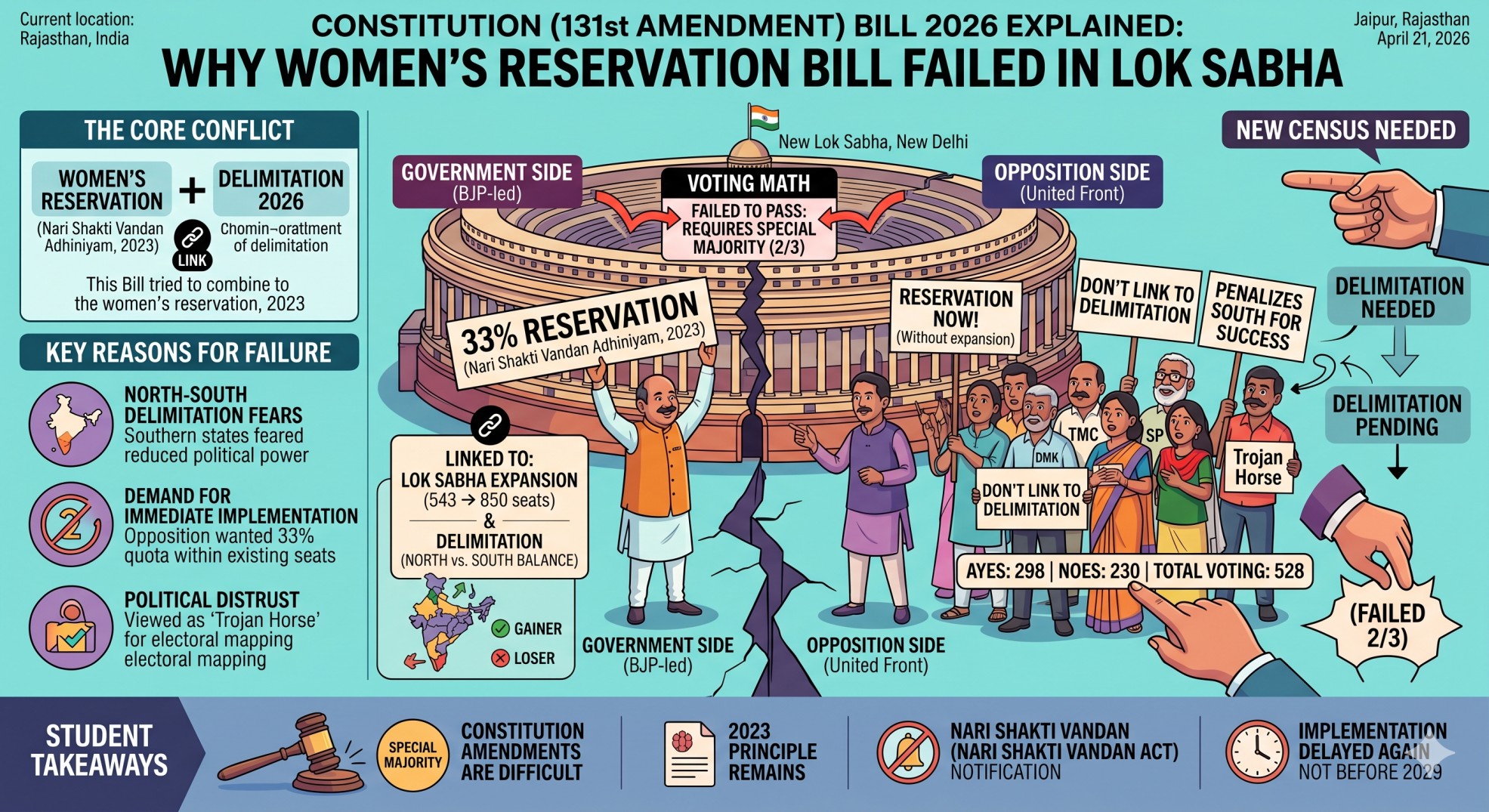
Constitution (131st Amendment) Bill 2026 Explained: Why Women’s Reservation Bill Failed in Lok Sabha
READ MORE →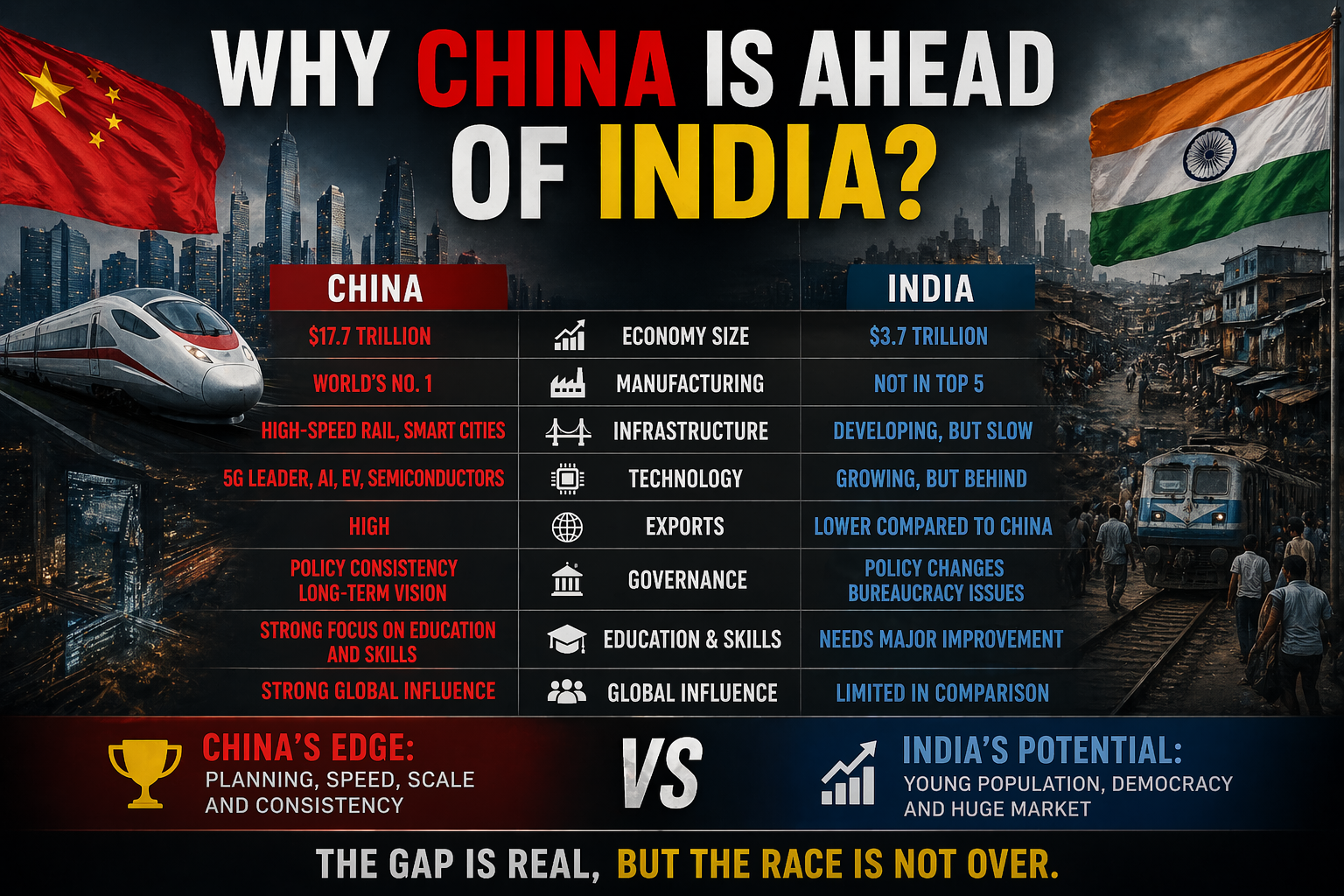
India vs China: Why China Is Ahead of India (From 1947 to 2026 Explained)
READ MORE →
Annie Easley: NASA की Human Computer जिसने बिना मशीन के स्पेस का भविष्य बदला
READ MORE →
8th Pay Commission Update: Deadline बढ़ी, Basic Pay और Pension Demand की पूरी जानकारी
READ MORE →