Exam Reform Bill 2026 Passed in Lok Sabha
Public Examinations Amendment Bill 2026: Will India Finally Stop Paper Leaks?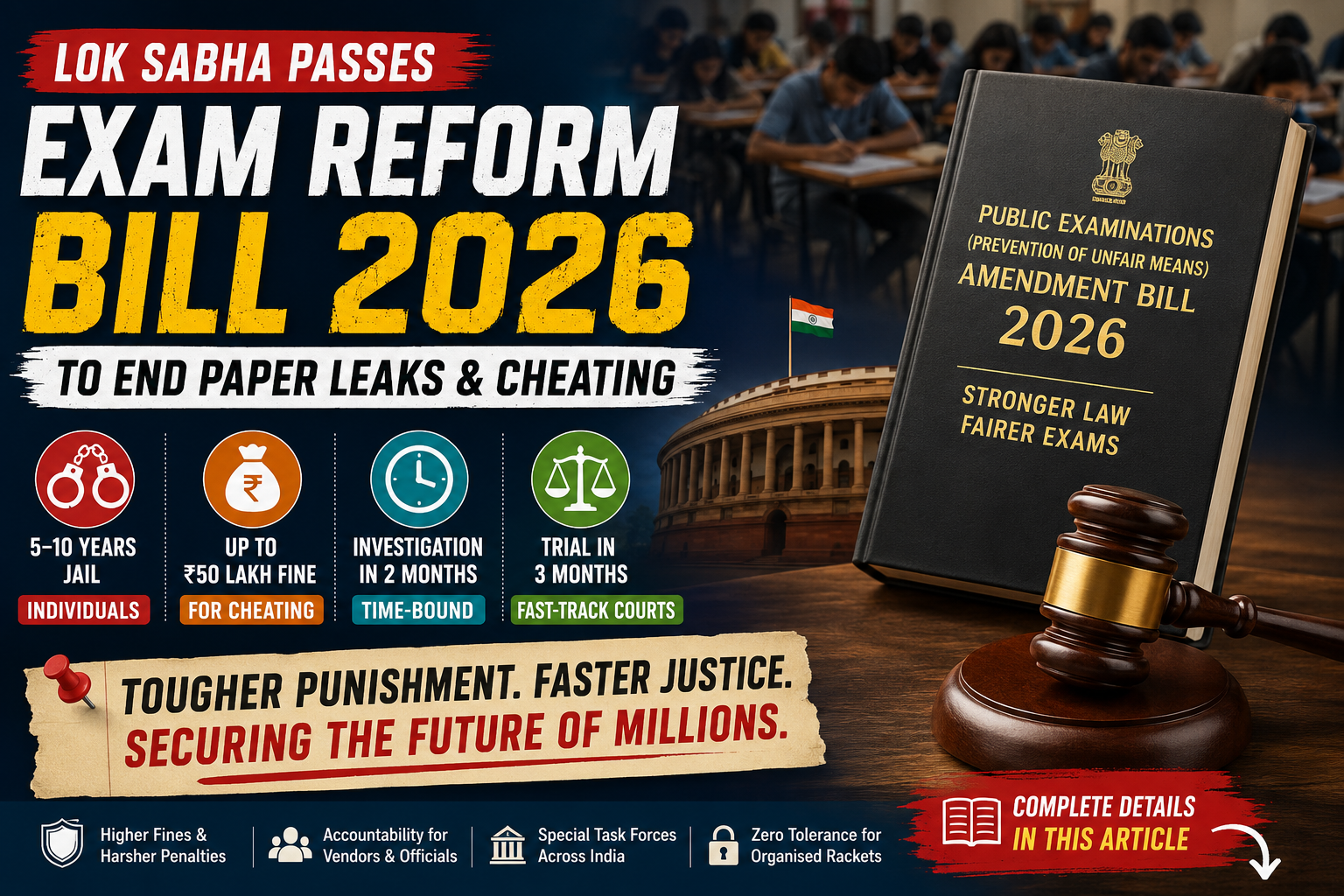
Post Date: July 31, 2026 Category: Education / Parliament / Exam Reforms
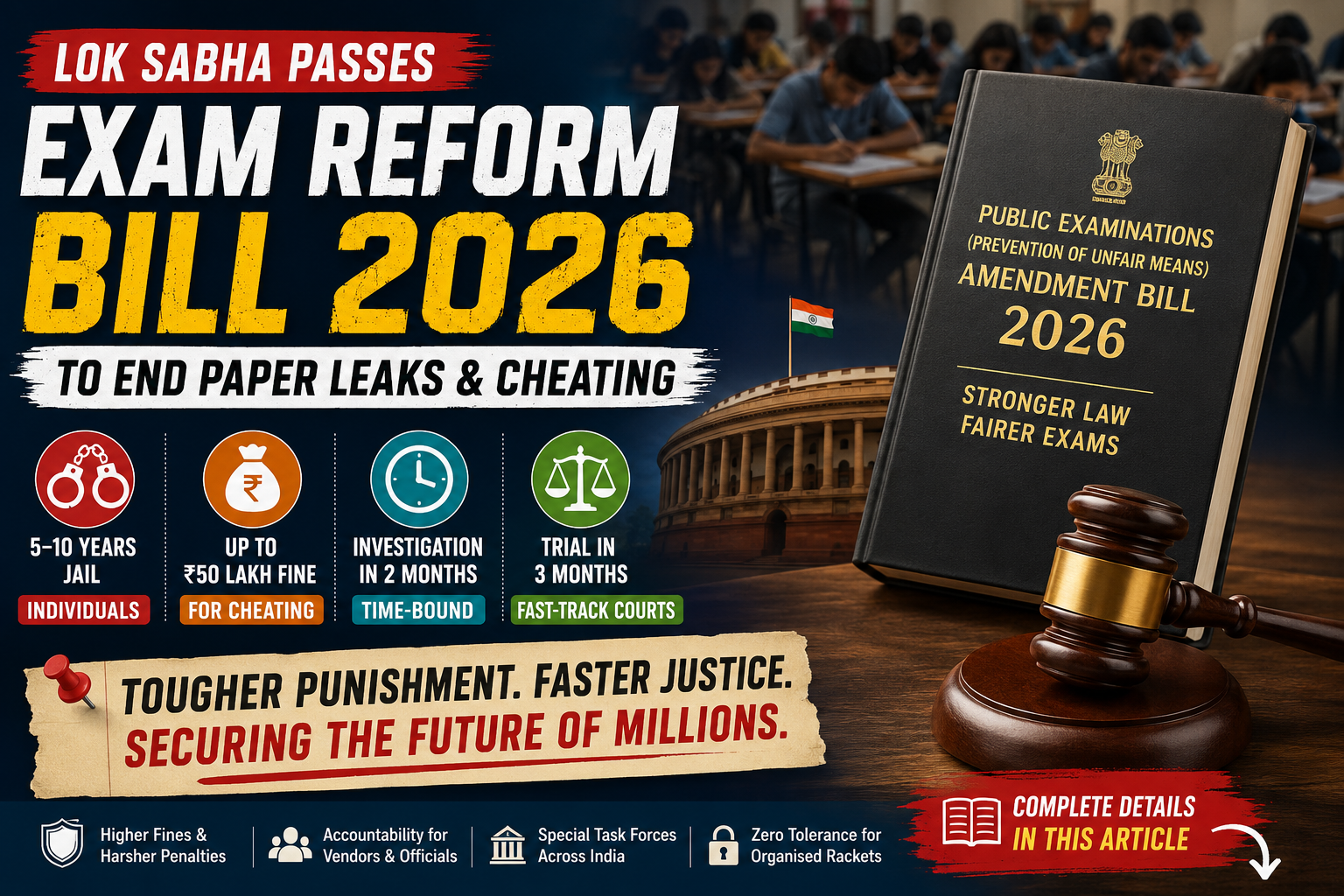
India has taken a major legislative step to curb paper leaks, organised cheating, and recruitment exam fraud. The Lok Sabha has passed the Public Examinations (Prevention of Unfair Means) Amendment Bill, 2026 by voice vote. The bill strengthens the anti-paper-leak framework created under the 2024 law by introducing stricter punishments, fixed investigation timelines, and fast-track courts for exam fraud cases.
The bill now moves through the remaining constitutional process before becoming law.
Background: What Was the 2024 Act?
The Public Examinations (Prevention of Unfair Means) Act, 2024 came into force to criminalise paper leaks, cheating, impersonation, and electronic malpractice in major public examinations conducted by agencies such as UPSC, SSC, NTA, RRB, and IBPS.
However, repeated allegations of exam leaks and organised cheating networks led the government to argue that stronger deterrence and faster prosecution were necessary. The 2026 Amendment Bill was introduced to address these concerns.
What Happened in the Lok Sabha?
The Lok Sabha passed the amendment bill on 30 July 2026. During the debate, the government said the bill was aimed at dismantling organised paper-leak syndicates and restoring confidence in public examinations. Opposition members raised concerns about broader reforms in the examination system, but the bill was ultimately passed by voice vote.
The Biggest Change: Harsher Punishments
The amendment significantly increases both imprisonment terms and financial penalties.
2024 vs 2026
Key punitive changes
| Offence | 2024 Act | 2026 Amendment |
|---|---|---|
| Individual cheating / paper leak involvement | 3–5 years imprisonment + fine up to ₹10 lakh | 5–10 years imprisonment + fine up to ₹50 lakh |
| Exam centre / IT / logistics service provider default | Fine up to ₹1 crore + 4-year debarment | Fine up to ₹5 crore + 8-year debarment |
| Collusion by officials / management | 3–10 years imprisonment + ₹1 crore fine | Minimum 5 years imprisonment + fine up to ₹5 crore |
| Organised cheating syndicates | 5–10 years imprisonment + fine up to ₹1 crore | Up to 10 years imprisonment + fine up to ₹10 crore + property attachment |
Based on the amendment bill introduced in Parliament and PRS Legislative Research analysis.
The focus is not only on individual candidates but on the entire organised cheating ecosystem.
Time-Bound Investigation: No More Endless Probes?
One of the most important reforms is the introduction of fixed timelines.
-
Investigation must be completed within 2 months of registration of the FIR.
-
The charge sheet must also be filed within this period.
-
States and central agencies may create Special Task Forces (STFs) for complex or inter-state paper leak cases.
This provision is intended to prevent cases from remaining unresolved for years while students' careers remain uncertain.
Fast-Track Courts for Exam Fraud
The bill requires every State and Union Territory to designate Special Fast-Track Courts (STCs) for public examination offences.
Key Features
-
Day-to-day hearings
-
Trial to be completed within 3 months from filing of the charge sheet
-
Appointment of Special Public Prosecutors
-
Appeals to be heard by a designated Division Bench of the High Court
The objective is to create a dedicated judicial mechanism instead of allowing exam fraud cases to be absorbed into the already overburdened regular criminal court system.
Which Exams Are Covered?
The law applies to specified public examinations conducted by central authorities, including:
-
Union Public Service Commission (UPSC)
-
Staff Selection Commission (SSC)
-
National Testing Agency (NTA) – including NEET, JEE, and CUET
-
Railway Recruitment Boards (RRBs)
-
Institute of Banking Personnel Selection (IBPS)
-
Examinations conducted by central ministries, departments, and notified statutory bodies
Does This Mean Students Will Be Jailed for Every Irregularity?
Not necessarily.
The primary targets of the legislation are:
-
Paper leak operators
-
Question paper sellers
-
Organised cheating gangs
-
Impersonation networks
-
Compromised service providers and officials acting in collusion
The government has maintained that the law is intended to protect honest candidates while punishing those who deliberately undermine the examination process.
Why Are Service Providers Being Punished So Harshly?
Many recent controversies have involved allegations related to:
-
Weak exam-centre security
-
Unauthorised server access
-
Compromised logistics chains
-
Printing and distribution leaks
As a result, the amendment imposes substantial liability on IT vendors, logistics contractors, printing agencies, and examination management companies.
Will This Completely Stop Paper Leaks?
Probably not by itself.
Legal experts generally argue that stronger punishment is only one part of the solution. Effective prevention also requires:
-
Encrypted digital paper delivery
-
Last-minute question paper generation
-
Geo-fenced access controls
-
Biometric verification
-
AI-based anomaly detection
-
Independent cybersecurity and logistics audits
Without administrative and technological reforms, criminal law alone may not eliminate all forms of examination fraud.
What Does This Mean for Aspirants?
Possible Benefits
Greater credibility of public examinations
Faster investigation and court proceedings
Higher accountability for exam centres and vendors
Stronger financial pressure on organised leak networks
Challenges
Uneven implementation across states
Need for additional judicial and investigative resources
Requirement for stronger cybersecurity capacity
Ensuring protection against wrongful implication
The Larger Context
The amendment comes amid a nationwide debate on examination transparency and recruitment integrity. Large-scale protests and public concern over paper leaks have increased pressure on the government to demonstrate a tougher and faster response to organised exam fraud.
What Happens Next?
The legislative process is:
-
Lok Sabha passed the bill ✔️
-
Rajya Sabha consideration ✔️ / pending formal completion depending on the latest parliamentary stage
-
Presidential assent ⏳
-
Notification and enforcement ⏳
(Readers should check the latest official parliamentary updates for the final status.)
Final Verdict: A Stronger Law, But Implementation Is the Real Test
The Public Examinations (Prevention of Unfair Means) Amendment Bill, 2026 is unquestionably a much stronger legal framework than the 2024 Act. It does not merely increase jail terms; it attempts to create a time-bound chain of investigation, prosecution, and trial.
Whether it becomes a historic reform will depend on implementation:
-
Will STFs and Fast-Track Courts be created quickly?
-
Will cybersecurity systems actually improve?
-
Will vendors and exam centres be audited independently?
-
Will innocent candidates be protected while organised syndicates are prosecuted effectively?
For the millions of students preparing for UPSC, SSC, NEET, JEE, RRB, IBPS, and other competitive examinations, the message is clear: India is moving toward a much tougher anti-paper-leak regime, but the credibility of the system will ultimately be judged not by the law on paper, but by how effectively it is enforced on the ground.