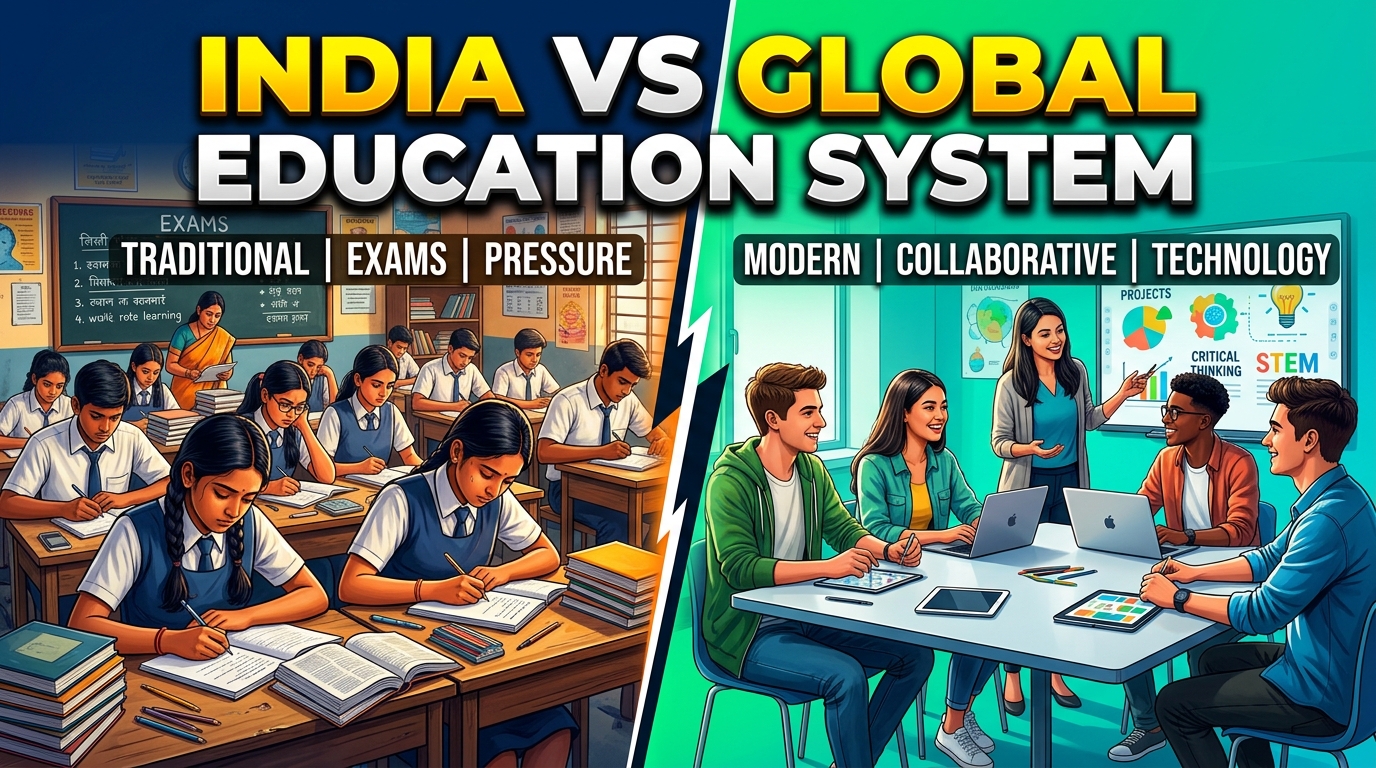
Indian vs Global Education System: Key Differences
Indian vs Other Countries Education System (Part 1)
1. Introduction to Education Systems
Education plays a crucial role in shaping the future of individuals and nations. Every country follows its own education system based on its culture, economic needs, and development goals.
The Indian education system is known for its strong theoretical foundation and large-scale structure. On the other hand, many foreign education systems focus more on creativity, practical learning, and skill development.
Understanding these differences helps students make better decisions about their careers and higher education choices.
2. Structure of Indian Education System
The Indian education system follows a structured format of primary, secondary, and higher education. Students typically study in a 10+2 system before entering college or university.
It is regulated by national boards and institutions, ensuring standardization across the country. The system emphasizes subjects like mathematics, science, and theory-based learning.
However, due to its large population, the system often faces challenges such as high competition, limited seats in top institutions, and pressure on students.
3. Structure of Foreign Education Systems
Education systems in countries like the USA, UK, and others are generally more flexible. Students are allowed to choose subjects based on their interests from an early stage.
These systems focus on credit-based learning, where students can select courses and progress at their own pace. This flexibility encourages independent thinking and specialization.
Additionally, foreign education systems often provide better infrastructure, research opportunities, and student support services.
4. Teaching Methods in India
Teaching in India is mostly teacher-centered. Teachers explain concepts, and students are expected to listen, memorize, and reproduce the information in exams.
This method helps build strong theoretical knowledge but may limit creativity and critical thinking in students.
5. Teaching Methods in Other Countries
Foreign education systems focus more on student-centered learning. Students are encouraged to participate in discussions, ask questions, and express their ideas freely.
Interactive teaching methods such as group projects, presentations, and case studies are commonly used.
6. Practical vs Theoretical Learning
India focuses more on theoretical knowledge, while many developed countries emphasize practical learning.
Students abroad often gain hands-on experience through labs, internships, and real-world projects, which helps them develop job-ready skills.
7. Examination System Comparison
India has a highly competitive exam system where marks play a crucial role in determining a student’s future.
In contrast, foreign systems use continuous assessment methods such as assignments, projects, and class participation.
8. Role of Technology in Education
Technology is growing in India, but many developed countries are already advanced in digital education systems.
Online learning platforms, smart classrooms, and AI-based tools are widely used abroad.
9. Student Skills Development
Foreign systems focus heavily on developing soft skills like communication, leadership, and problem-solving.
In India, the focus is gradually shifting toward skill-based education, but it still needs improvement.
Indian vs Other Countries Education System (Conclusion)
10. Cost of Education
Education in India is generally more affordable compared to foreign countries. However, top private institutions can still be expensive.
Studying abroad involves higher costs, including tuition fees, living expenses, and travel.
11. Career Opportunities
Foreign education often provides better global exposure and job opportunities. Students gain access to international job markets.
India is also growing rapidly, offering strong career opportunities, especially in technology and services.
12. Conclusion
Both systems have their strengths and weaknesses. India offers affordability and strong theoretical knowledge, while foreign systems provide flexibility, practical learning, and global exposure.
The best choice depends on a student’s goals, interests, and financial situation.
Related Articles
Constitution (131st Amendment) Bill 2026 Explained: Why Women’s Reservation Bill Failed in Lok Sabha
READ MORE →
CBSE 12th Result Live 2026: आज खत्म होगा सीबीएसई 12वीं के रिजल्ट का सस्पेंस? पढ़ें लेटेस्ट अपडेट
READ MORE →
12वीं के बाद क्या करें? Science, Commerce, Arts के लिए Best Courses और Career Options 2026
READ MORE →