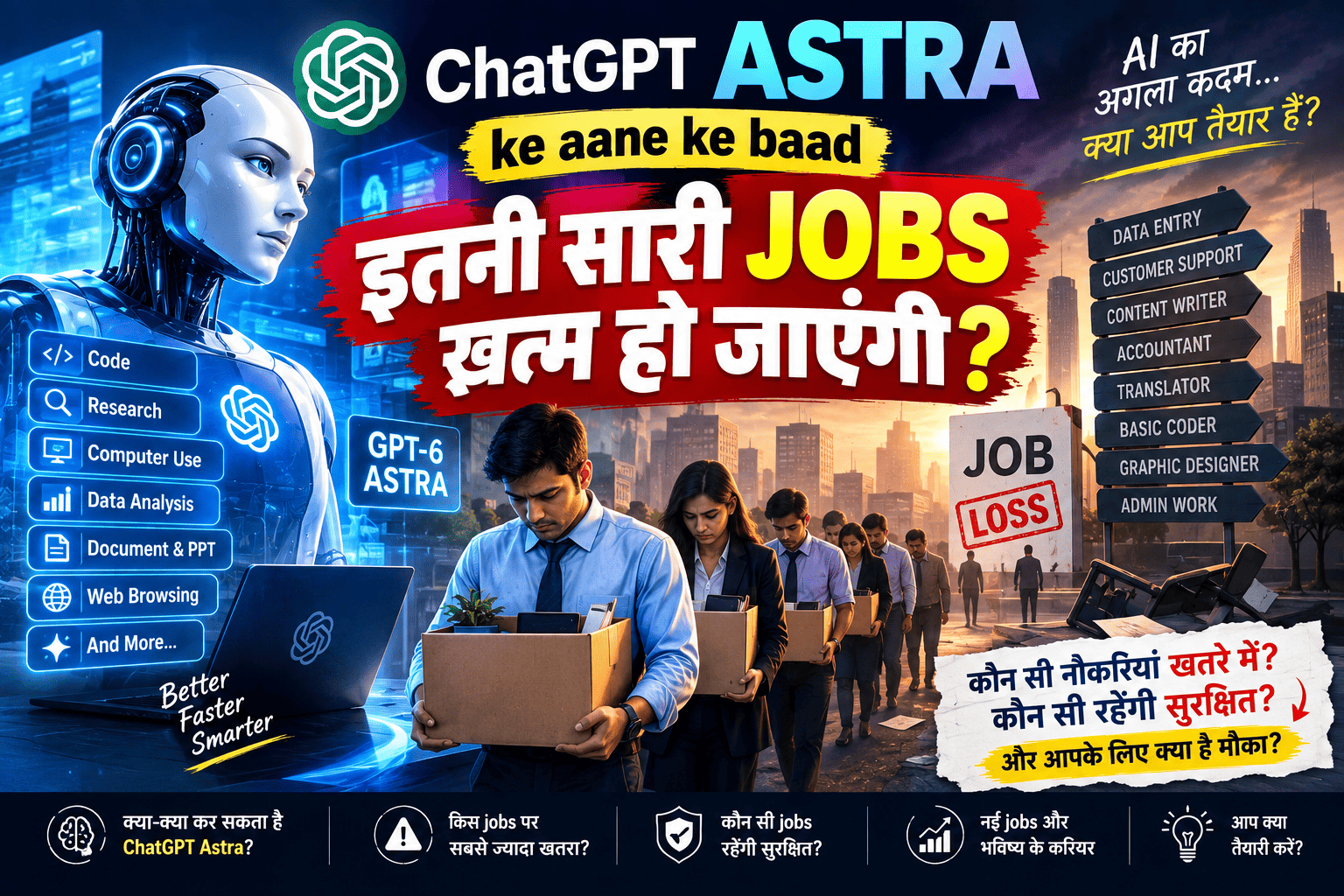
GPT-6 Astra: Features, Jobs and Future of AI
GPT-6 Astra: What Can It Do, and Will AI Take Your Job?
GPT-6 Astra is a major new AI model from OpenAI designed not only to answer questions but also to reason, browse the web, use computers, write code, analyze data, conduct research, and complete complex multi-step professional tasks.
OpenAI describes GPT-6 Astra as its most capable model, with state-of-the-art performance across computer use, browsing, software engineering, cybersecurity, science and professional work. (OpenAI)
The launch also raises an important question for students, employees and businesses:
Will AI take people's jobs, or will it create a new generation of jobs?
The answer is more complicated than simply saying that AI will replace humans. The bigger change may be that AI changes what people do at work.
What Is GPT-6 Astra?
GPT-6 Astra is OpenAI's latest frontier AI model, introduced on September 3, 2026.
Unlike traditional chatbots that mainly generate text in response to prompts, Astra is designed for end-to-end work.
It can combine reasoning with tools and computer interaction to complete a workflow from the initial instruction to a finished result.
OpenAI says Astra can work across areas including:
-
Computer use
-
Web browsing
-
Software engineering
-
Coding
-
Scientific research
-
Data analysis
-
Cybersecurity
-
Documents
-
Presentations
-
Spreadsheets
-
Professional workflows
It can also adapt when requirements change during a task instead of simply treating every new instruction as an entirely separate request. (OpenAI)
1. GPT-6 Astra Can Use a Computer
One of the biggest differences is its ability to work with computer interfaces.
Astra can perform tasks such as:
-
Filling online forms
-
Updating CRM records
-
Organizing calendars
-
Working with documents
-
Researching information online
-
Troubleshooting problems on screen
-
Testing software
-
Performing frontend quality checks
-
Working with business applications
This moves AI closer to an AI agent that can perform actions rather than simply telling a person what to do.
OpenAI reports that Astra achieved stronger computer-use performance than GPT-5.6 Sol in its OSWorld 2.0 latency comparison while completing tasks in substantially less simulated time. (OpenAI)
2. Advanced Coding and Software Development
GPT-6 Astra is also designed for difficult software-engineering work.
It can help with:
-
Writing code
-
Understanding large codebases
-
Debugging
-
Testing
-
Building websites
-
Building web applications
-
Creating prototypes
-
Improving existing software
-
Performing frontend QA
-
Troubleshooting technical problems
This does not mean software developers suddenly become unnecessary.
Instead, the role of a developer could shift from writing every line manually toward:
Planning → directing AI → reviewing → testing → making technical decisions
Astra can also work with computer environments and software tools, making it more useful for end-to-end development workflows. (OpenAI)
3. It Can Build and Test Websites
Website development is another area where the impact could be significant.
Astra can create websites and perform frontend quality checks to verify that features work correctly. (OpenAI)
For example, a business owner could potentially ask an AI agent to:
-
Create a website structure.
-
Build the pages.
-
Add content.
-
Test the interface.
-
Find problems.
-
Make corrections.
-
Prepare the final website.
This could make website development much more accessible to small businesses and individuals.
4. Documents, Presentations and Spreadsheets
Astra is designed for professional knowledge work, including the creation of:
-
Reports
-
Documents
-
Presentations
-
Spreadsheets
-
Data analyses
One important capability is its ability to follow existing templates, instructions and visual styles.
That means businesses could provide an existing presentation template and ask AI to prepare new material while maintaining the established structure and style. (OpenAI)
This could significantly reduce repetitive office work.
5. Data Analysis
Astra can also assist with data-heavy tasks.
For example, an employee could provide a large spreadsheet and ask the AI to:
-
Find patterns
-
Identify unusual values
-
Analyze trends
-
Create charts
-
Summarize results
-
Prepare a management report
-
Turn the analysis into a presentation
This means some routine analytical tasks that previously required a separate specialist could increasingly be performed by people using AI tools.
However, human verification remains important, particularly when decisions have financial, legal, medical or operational consequences.
6. Research and Information Processing
Research is another major application.
GPT-6 Astra can browse and gather information, analyze relevant material and produce structured outputs.
This can help with:
-
Market research
-
Academic research
-
Business research
-
Technical research
-
Competitor analysis
-
Literature review
-
Data interpretation
-
Research reports
OpenAI's latest research also emphasizes that increasingly capable AI is making more complex forms of work practical, potentially enabling new businesses and new areas of economic activity. (OpenAI)
7. Scientific and Engineering Work
Astra is designed for scientific and technical tasks as well.
OpenAI reports state-of-the-art results across several scientific and technical evaluations and highlights applications involving scientific data and engineering workflows. (OpenAI)
For engineers, AI can increasingly become a powerful assistant for:
-
Data analysis
-
Calculations
-
Technical documentation
-
Research
-
Design exploration
-
Code and simulation workflows
-
Report preparation
But engineers will still need to understand the underlying principles and verify AI-generated results.
8. Cybersecurity
Cybersecurity is one of the most powerful—and sensitive—areas for GPT-6 Astra.
OpenAI says Astra is its first model to reach the Critical level of cybersecurity capability under its Preparedness Framework.
According to OpenAI, with appropriate tools and access, Astra can identify previously unknown security vulnerabilities and develop ways to exploit them across highly protected systems without a person guiding every individual step. (OpenAI)
Because of this capability, OpenAI has implemented additional safeguards and monitoring around Astra.
This is a good example of why more capable AI requires not only better performance but also stronger safety systems.
Will GPT-6 Astra Take People's Jobs?
This is the question that concerns most people.
The honest answer is:
Some jobs will be affected.
But saying “AI will eliminate all jobs” is not supported by the evidence.
A more realistic possibility is:
AI will automate some tasks, reorganize many jobs and create demand for new types of work.
OpenAI's own research on AI and employment emphasizes that the ability of AI to perform tasks does not automatically mean the entire occupation disappears. Human interaction, accountability, physical presence and judgment can remain essential. (OpenAI)
Which Jobs Could Face Higher Automation Risk?
Jobs with highly repetitive, predictable and computer-based tasks are likely to face more pressure.
Examples include:
Data Entry
Data entry involves structured and repetitive computer tasks, making it particularly suitable for automation.
Basic Administrative Work
AI agents can increasingly handle scheduling, forms, document processing and routine information management.
Basic Customer Support
Simple questions and predictable customer requests can increasingly be handled by AI systems.
Routine Bookkeeping
Some repetitive financial-record tasks can be automated, although professional accounting and financial responsibility still require human oversight.
Basic Content Production
Simple, repetitive articles, descriptions and routine marketing copy can increasingly be generated by AI.
Basic Translation
AI translation can handle many routine language tasks, although specialist translation still requires human expertise.
Basic Website Development
Simple websites can increasingly be created with AI-assisted development tools.
Jobs That Are More Likely to Change Rather Than Disappear
Many professions are unlikely to simply vanish. Instead, the job description itself may change.
Software Developers
Instead of manually writing every component, developers may increasingly:
-
Design systems
-
Review AI-generated code
-
Manage AI coding agents
-
Test applications
-
Make architecture decisions
Lawyers
AI can help with:
-
Document review
-
Legal research
-
Contract analysis
-
Drafting
But lawyers still provide judgment, strategy, negotiation, client communication and professional responsibility.
Accountants
AI can automate calculations and routine document processing.
Accountants can increasingly focus on:
-
Advisory work
-
Tax strategy
-
Compliance
-
Business decisions
-
Client relationships
Teachers
AI can create:
-
Lesson plans
-
Quizzes
-
Study material
-
Personalized explanations
But teachers provide something different: human interaction, motivation, classroom management and understanding of individual students.
What About Civil Engineering Jobs?
For civil engineering, AI is more likely to become a powerful assistant than an immediate replacement for engineers.
AI can assist with:
-
Quantity calculations
-
BOQ preparation
-
Estimation
-
Project documentation
-
Scheduling
-
Data analysis
-
Technical reports
-
Drawing analysis
-
Site-report processing
-
Design workflows
But construction involves the real physical world.
Civil engineers still need to deal with:
-
Site conditions
-
Contractors
-
Labour
-
Safety
-
Material quality
-
Inspections
-
Government regulations
-
Clients
-
Construction decisions
-
Unexpected site problems
Therefore, the future civil engineer may be:
Civil Engineering + AI + Software + Project Management
rather than simply traditional civil engineering.
Which Jobs Are Less Easily Automated?
No job can honestly be called completely “AI-proof.”
However, jobs requiring significant combinations of physical presence, human trust, judgment, responsibility and interpersonal skills are harder to automate completely.
Examples include:
-
Doctors
-
Nurses
-
Surgeons
-
Physiotherapists
-
Electricians
-
Plumbers
-
Mechanics
-
Skilled construction workers
-
Emergency responders
-
Therapists
-
Managers
-
Negotiators
-
Entrepreneurs
AI can assist these professionals, but replacing the entire human role is much more difficult.
Will AI Create New Jobs?
Yes.
As AI becomes more capable, companies will need people who understand how to build, deploy, supervise and manage AI systems.
Potential growth areas include:
AI Automation Specialist
Designing automated business workflows using AI agents.
AI Integration Specialist
Connecting AI systems with existing business software.
AI Product Manager
Managing AI-powered products and services.
AI Safety Specialist
Developing and monitoring safeguards for advanced AI systems.
AI Auditor
Checking whether AI systems produce reliable and compliant results.
AI Agent Manager
Supervising AI agents working across business processes.
AI Cybersecurity Specialist
Combining AI expertise with cybersecurity knowledge.
Human-AI Workflow Designer
Designing workflows that determine which tasks should be handled by humans and which should be delegated to AI.
AI Could Also Create New Businesses
This may be one of the biggest economic effects.
A person who previously needed:
5 employees + expensive software + specialist knowledge
may increasingly be able to start a small business with:
1 person + AI agents + cloud software.
That could lower the cost of launching businesses.
OpenAI's recent work argues that increasingly capable AI can make previously impractical ideas economically feasible and open opportunities for new businesses and markets. (OpenAI)
AI vs Humans: What Will the Future Look Like?
The future is unlikely to be simply:
AI vs Humans
A more realistic model is:
Humans + AI
Consider two employees.
Employee A
Does everything manually.
Employee B
Uses AI to:
-
Research
-
Analyze data
-
Draft documents
-
Automate repetitive tasks
-
Write code
-
Prepare presentations
Even if both employees have similar basic skills, Employee B could potentially produce much more output.
This means the biggest competitive advantage may not be “knowing AI” alone.
It will be knowing how to combine AI with your existing profession.
What Skills Should Students Learn?
The rise of GPT-6 Astra makes traditional skills more valuable when combined with AI.
Students should focus on:
1. AI Literacy
Understand what AI can and cannot do.
2. Critical Thinking
Never blindly trust AI-generated information.
3. Communication
Good communication remains valuable because humans still need to explain ideas, negotiate and work with others.
4. Domain Expertise
An AI user with strong subject knowledge can often use AI much more effectively than someone who only knows prompting.
5. Problem Solving
Learn to break large problems into smaller tasks that AI can help solve.
6. Digital Tools
Learn tools such as:
-
Excel
-
Data-analysis software
-
CAD/BIM tools
-
Programming
-
AI agents
-
Project-management software
7. Human Skills
Leadership, creativity, negotiation, decision-making and empathy will remain important.
The Biggest Change May Be Job Reorganization
OpenAI's economic research provides an interesting perspective.
In an analysis of more than 800,000 messages from U.S. ChatGPT users, OpenAI reported that 43.5% of occupation-specific work-related messages involved tasks associated with another occupation.
In simple terms, AI allows people to perform work that traditionally belonged to another profession. (OpenAI)
For example:
A small-business owner can use AI for basic financial analysis.
A marketer can troubleshoot a website.
A salesperson can analyze customer data.
A manager can prepare a presentation without waiting for a specialist.
This means the boundaries between professions could become increasingly flexible.
What Does OpenAI's Jobs Research Say?
OpenAI's April 2026 analysis of 921 occupations covering approximately 148 million U.S. jobs categorized occupations into different potential transition patterns.
It estimated:
-
18% of jobs had relatively high automation risk
-
24% were likely to reorganize
-
12% could grow with AI
-
46% showed less immediate change
Importantly, OpenAI explicitly states that these percentages are not predictions that these jobs will disappear. They are a framework for understanding where different kinds of change may emerge. (OpenAI)
That distinction is extremely important.
Should You Be Afraid of GPT-6 Astra?
For most people, the better response is not fear.
It is preparation.
If your work contains many repetitive tasks, learn how AI can automate them.
If you are a student, learn AI alongside your main subject.
If you are a developer, learn AI-assisted development.
If you are a designer, learn AI design workflows.
If you are an engineer, learn AI-assisted engineering and data tools.
If you are a business owner, learn AI automation.
The goal should be:
Don't compete with AI at tasks AI is good at. Learn how to use AI to become better at the work humans are still responsible for.
GPT-6 Astra: The Bottom Line
GPT-6 Astra represents a significant shift from AI that answers questions to AI that can increasingly perform workflows.
It can reason through complex tasks, use computers, browse information, write software, analyze data, create professional documents and presentations, assist with scientific work and operate across multiple steps. (OpenAI)
Will it eliminate some jobs?
Yes, some repetitive tasks and certain roles are likely to face significant automation pressure.
Will it eliminate all jobs?
No.
Many jobs will instead be redesigned around AI.
And at the same time, new opportunities will emerge around:
AI development + AI automation + AI safety + AI management + domain expertise.
The most valuable worker of the future may not be the person who can compete against AI.
It may be the person who knows how to make AI work for them.
Frequently Asked Questions
Is GPT-6 Astra better than GPT-5.6?
GPT-6 Astra is designed as a more capable model for difficult end-to-end work, particularly computer use, coding, research and professional workflows. OpenAI positions it as its most capable model. (OpenAI)
Can GPT-6 Astra use a computer?
Yes. OpenAI says Astra can perform computer-based tasks such as filling forms, updating CRM records, organizing calendars, conducting research and testing software. (OpenAI)
Will GPT-6 Astra replace programmers?
It can automate parts of software development, especially repetitive coding and testing. However, software engineering also involves architecture, requirements, security, product decisions and responsibility. The profession is more likely to change than simply disappear.
Which jobs are most vulnerable to AI?
Repetitive and predictable digital tasks such as data entry, some administrative work, basic customer support, routine bookkeeping and certain forms of basic content production are more exposed to automation.
Which skills should students learn?
Students should combine AI literacy with their core field, while developing critical thinking, communication, problem-solving, digital skills and domain expertise.
Is GPT-6 Astra available to everyone?
OpenAI says Astra is being rolled out in phases. Its availability depends on the ChatGPT plan, organization and rollout status. It is also available through the OpenAI API and selected cloud platforms. (OpenAI)
Related Articles
1 जनवरी 2026 से बदल जाएंगे ये 5 बड़े नियम: UPI, क्रेडिट स्कोर और Income Tax पर होगा सीधा असर
READ MORE →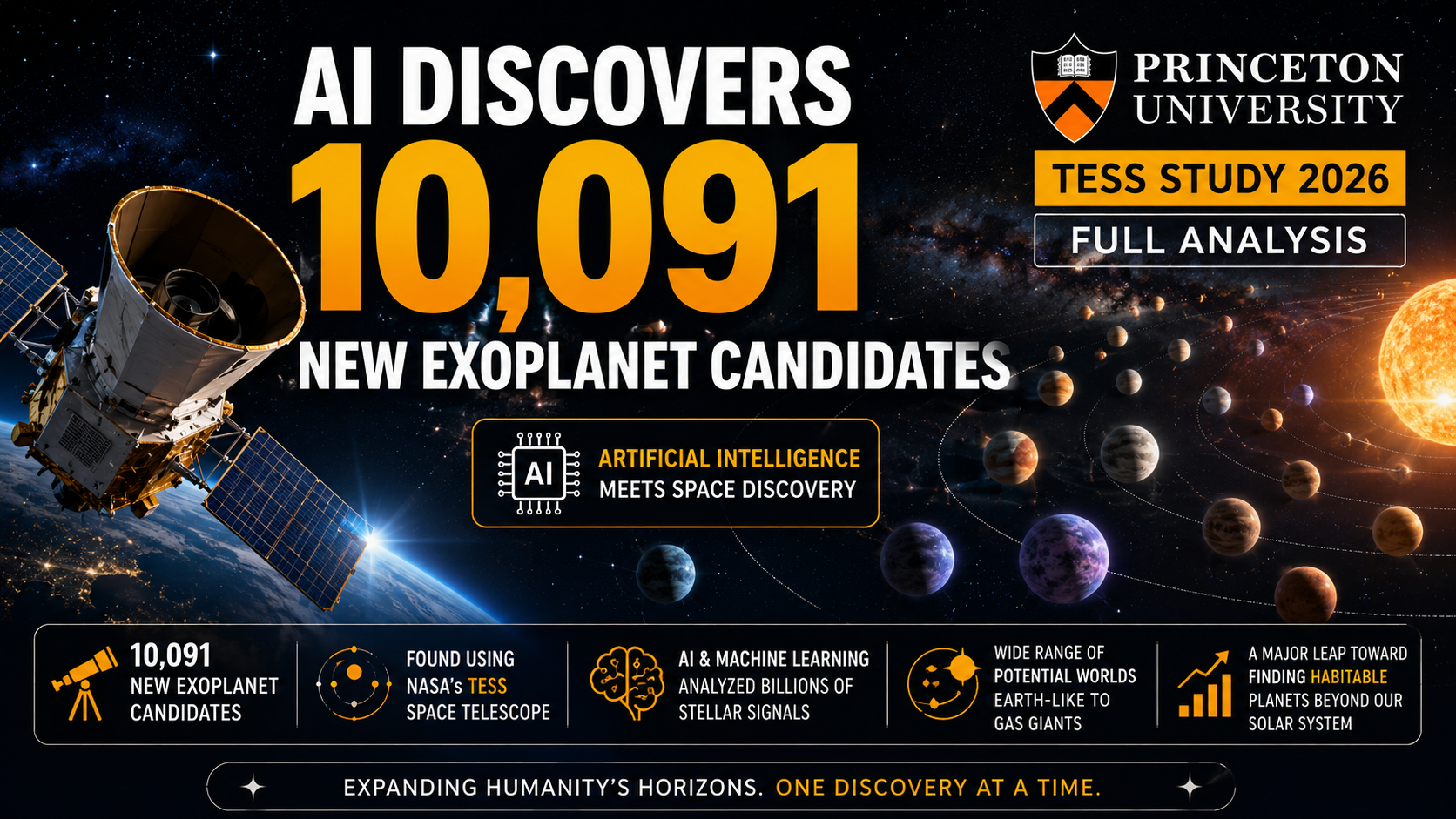
AI Discovers 10,091 New Exoplanet Candidates | Princeton University TESS Study 2026 Full Analysis
READ MORE →
CAG Railway Audit: E. Coli Found in Station Drinking Water
READ MORE →
BRICS Youth and Sports Ministers Meeting 2026
READ MORE →