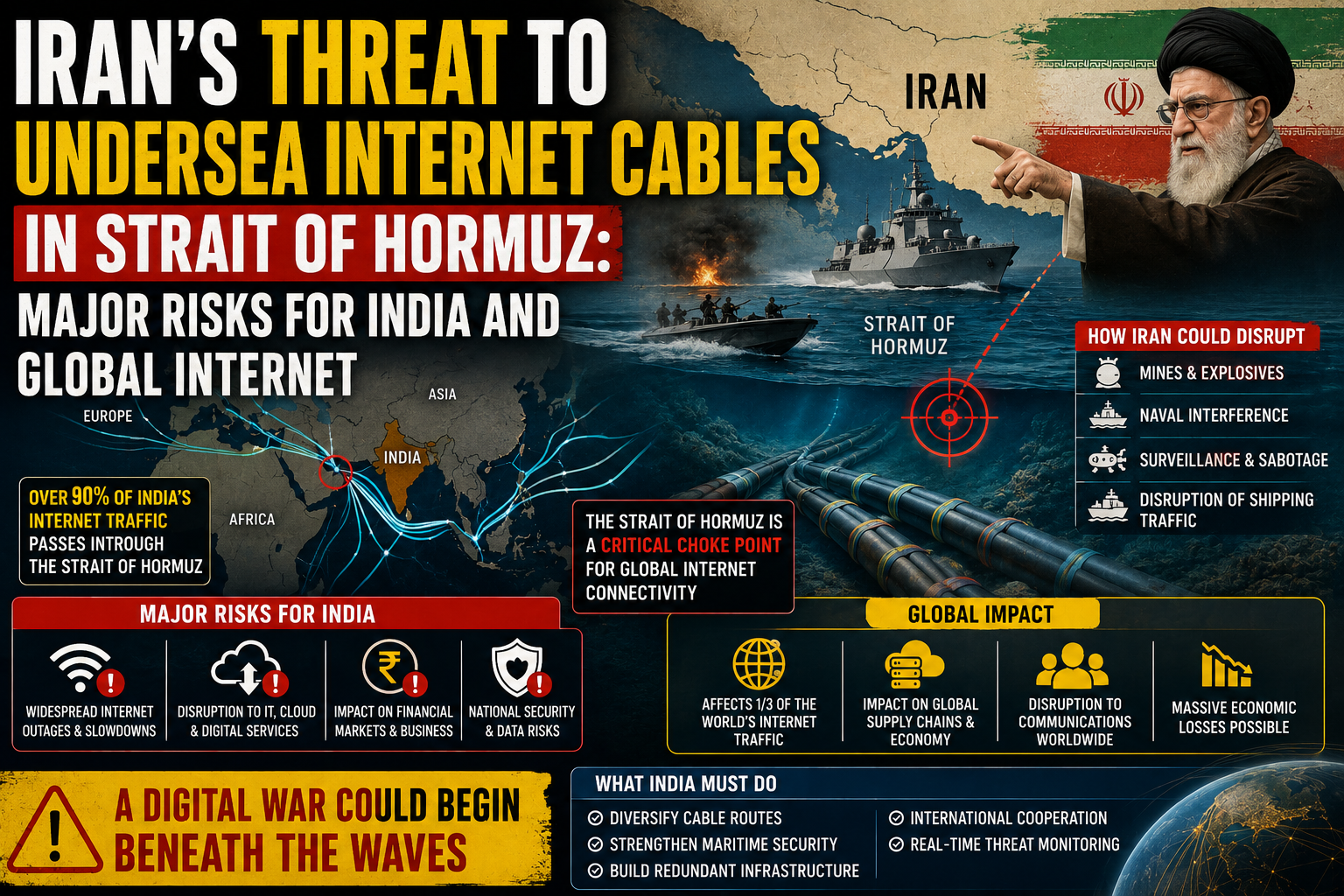
Iran’s Threat to Undersea Internet Cables in Strait of Hormuz: Major Risks for India and Global Internet
Iran’s Threat to Undersea Internet Cables in the Strait of Hormuz: India’s Vulnerabilities and Global Ripple Effects
In a dramatic escalation of hybrid warfare tactics, Iran has signaled its willingness to target or control one of the most critical yet invisible infrastructures of the modern world: the vast network of undersea fiber-optic cables that carry nearly 95-99% of global internet traffic. As tensions in the Persian Gulf reached new heights in May 2026, Iranian state-linked media and military spokespersons openly discussed imposing fees on submarine cables passing through the Strait of Hormuz, with veiled threats of disruption if international tech companies refuse to comply.
This development marks a dangerous shift from traditional oil chokepoints to “digital chokepoints.” For India, one of the world’s largest and fastest-growing digital economies, the implications are profound. For the rest of the world, any sustained disruption could trigger cascading failures across finance, communication, trade, and national security systems.
The Invisible Backbone of the Global Internet
Undersea cables are the true arteries of the digital age. Stretching over 1.4 million kilometers across the ocean floor, these thin yet incredibly sophisticated fiber-optic lines transmit trillions of dollars in daily financial transactions, enable cloud computing, power streaming services, facilitate international calls, and support everything from stock market trades to military communications.
Unlike satellites, which handle only a tiny fraction of global data with higher latency and cost, submarine cables provide the speed, capacity, and reliability that modern economies demand. A single major cable can carry terabits of data per second — enough to stream millions of HD videos simultaneously.
The Strait of Hormuz, already one of the world’s most critical energy chokepoints responsible for roughly 20% of global oil trade, has now emerged as a digital vulnerability. Multiple high-capacity cables traverse this narrow waterway, connecting Europe, the Middle East, Asia, and beyond. Iran’s strategic location gives it potential leverage over this critical corridor.
Iran’s Strategy: From Oil to Digital Leverage
Iran’s latest moves are not isolated provocations but part of a calculated hybrid strategy. State-linked outlets like Tasnim and Fars have published detailed maps of cable routes and explicitly discussed charging licensing fees to major tech giants such as Google, Microsoft, Meta, and Amazon. Iranian officials have further suggested that cable repair and maintenance rights should be monopolized by Iranian entities.
This approach serves multiple purposes:
- Generating new revenue streams amid heavy sanctions
- Demonstrating asymmetric warfare capabilities
- Creating deterrence against potential military actions
- Shifting global attention from kinetic conflict to infrastructure warfare
While outright cutting cables remains operationally challenging and would invite severe international retaliation, even the threat of disruption, delayed repairs, or selective interference creates significant uncertainty in global markets.
India’s Exposure: A Digital Economy at Risk
India stands particularly vulnerable in this scenario. With over 900 million internet users and a booming digital economy valued at hundreds of billions of dollars, the country relies heavily on submarine cables for international connectivity.
Major cable landing stations in Mumbai, Chennai, Kochi, Tuticorin, and other coastal cities serve as gateways for India’s global data traffic. A significant portion of India’s westward connectivity — crucial for services exports, IT-BPM sector, and financial transactions — passes through routes vulnerable to disruptions in the Arabian Sea, Persian Gulf, and Red Sea corridors.
Potential Impacts on India:
1. IT and BPO Sector India’s $250+ billion IT services industry, which employs millions and drives a large chunk of services exports, depends on low-latency, high-bandwidth international links. Even partial disruptions could lead to delayed project deliveries, client dissatisfaction, and revenue losses.
2. Digital Payments and Fintech UPI, digital banking, stock trading platforms, and fintech apps could face severe latency or outages, affecting daily transactions for hundreds of millions of users.
3. E-commerce and Consumer Internet Platforms like Amazon, Flipkart, Netflix, and YouTube could experience slowdowns, directly impacting consumer experience and business revenues.
4. Data Centers and Cloud Services India’s ambition to become a global data center hub could suffer major setbacks if international connectivity becomes unreliable.
5. National Security and Communications Critical government, defense, and emergency communication systems that rely on these cables could be compromised, forcing expensive and less efficient satellite backups.
Past incidents, such as the 2025 Red Sea cable cuts, already demonstrated how disruptions can cause noticeable slowdowns across India and Pakistan. A more sustained or targeted threat in the Strait of Hormuz would amplify these effects dramatically.
Global Consequences: A Digital Catastrophe in the Making
The effects of any major disruption in the Strait of Hormuz would not remain regional. Because of how interconnected global cable networks are, damage in one chokepoint creates rerouting pressure on others, leading to widespread congestion and cascading failures.
Financial Markets Daily financial transactions worth over $10 trillion flow through these cables. Disruptions could freeze trading systems, delay settlements, and trigger panic in stock markets worldwide.
Supply Chains and Global Trade Modern just-in-time supply chains depend on real-time data exchange. Shipping companies, manufacturers, and retailers could face operational chaos.
Cloud Computing and AI Major cloud providers and AI training systems rely on seamless global connectivity. Interruptions could slow innovation and increase costs.
Communication Blackouts International calls, video conferencing, email, and messaging services could become unreliable, affecting businesses, families, and diplomatic channels.
Geopolitical Escalation Attacking or interfering with critical infrastructure could be seen as an act of war, potentially drawing in major powers and expanding the conflict beyond the Middle East.
Why Repairing Damaged Cables is Extremely Difficult in Conflict Zones
One often-overlooked aspect is the challenge of repairs. Cable repair ships require safe access to conflict zones. In a heightened security environment, insurance costs skyrocket, crews face risks, and operations can be delayed for weeks or months. This means even accidental damage could remain unrepaired for extended periods, prolonging outages.
Mitigation Strategies and the Road Ahead
Countries and companies are already exploring alternatives:
- Diversifying cable routes through safer corridors
- Investing in new Arctic and Pacific routes
- Developing more robust satellite constellations (though insufficient as a full replacement)
- Enhancing cable protection through international agreements and naval patrols
- Building greater domestic data resilience and edge computing capabilities
For India specifically, accelerating projects like the India-Europe Economic Corridor’s digital components, investing in eastern routes, and strengthening naval capabilities for maritime domain awareness have become urgent priorities.
Conclusion: The New Frontier of Hybrid Warfare
Iran’s threats against undersea cables in the Strait of Hormuz represent more than a regional dispute — they signal the emergence of a new era where digital infrastructure has become a primary battlefield. The invisible cables lying on the ocean floor are now as strategically important as oil tankers and military bases.
For India, this moment serves as a stark reminder of the need to reduce critical dependencies and build resilient digital infrastructure. For the world, it underscores the fragility of our hyper-connected global system. In an age where data flows are as vital as oil flows, securing the seabed may prove as important as securing the seas.
As tensions continue in the Middle East, the world watches anxiously. The next few weeks could determine whether this remains a war of words and economic pressure — or escalates into something far more disruptive to the digital foundation of modern civilization.
The cables may be silent, but their potential silence could echo loudly across the globe.
Related Articles

8th Pay Commission Update: Deadline बढ़ी, Basic Pay और Pension Demand की पूरी जानकारी
READ MORE →
BRICS Meeting 2026 Ends Without Joint Statement Over Iran War | Deep Divisions Between Iran & UAE Exposed
READ MORE →
AI Discovers 10,091 New Exoplanet Candidates | Princeton University TESS Study 2026 Full Analysis
READ MORE →