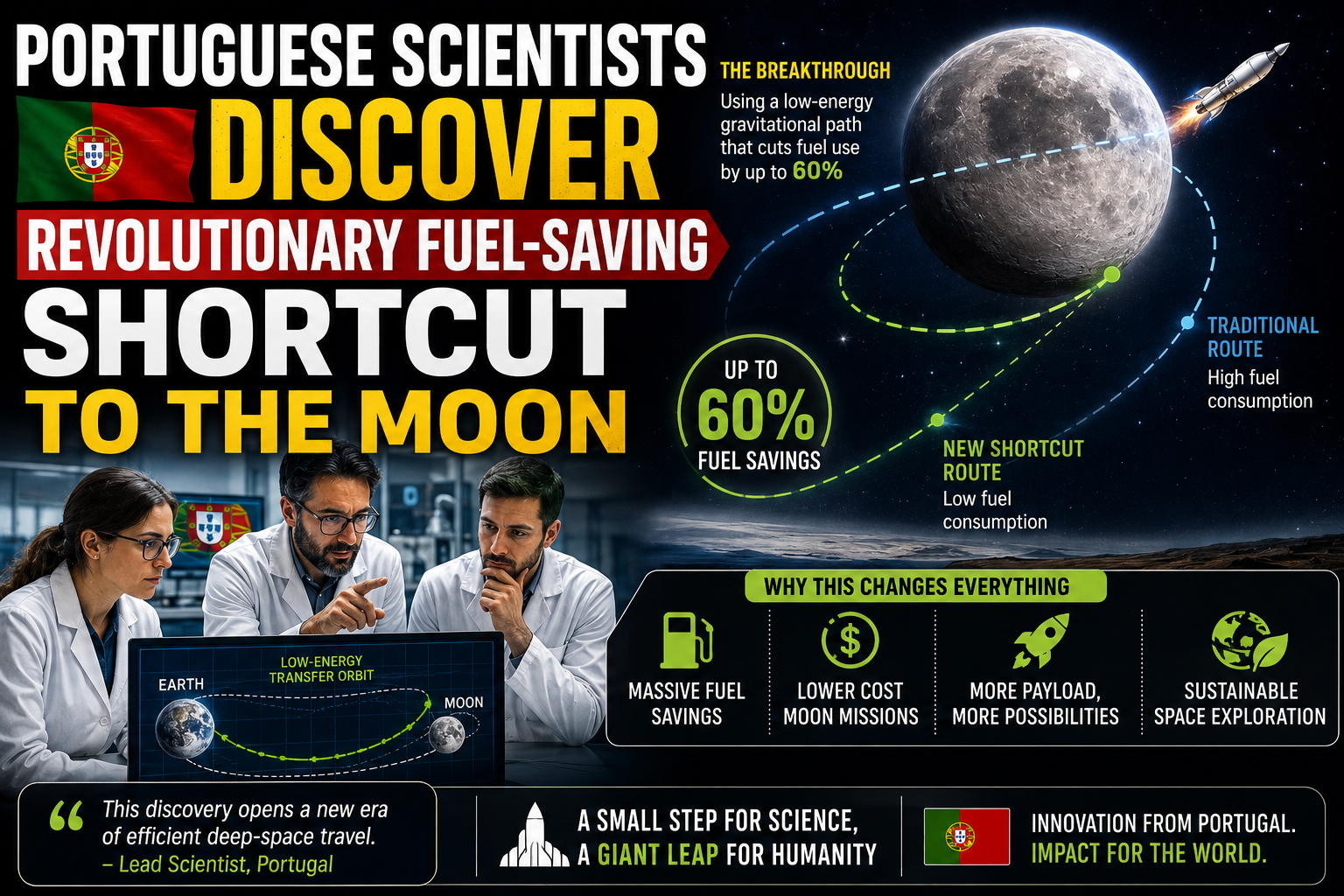
Portuguese Scientists Discover Revolutionary Fuel-Saving Shortcut to the Moon
Portuguese Scientists Discover Fuel-Saving Shortcut to the Moon: A Game-Changing Breakthrough in Space Exploration
In a remarkable scientific achievement that could reshape future lunar missions, a team of Portuguese researchers has identified a significantly more efficient route to the Moon. Led by Dr. Allan Kardec de Almeida Júnior from the University of Coimbra, the international collaboration simulated nearly 30 million different trajectories and discovered a path that saves 58.8 meters per second in velocity change (delta-v) compared to previously known most efficient routes.
While 58.8 m/s may sound small, in space travel it translates into substantial fuel savings, reduced mission costs, and the potential to carry more payload or extend mission capabilities. Published in the journal Astrodynamics, this breakthrough comes at a crucial time as NASA, China, and private companies race to establish a permanent presence on the Moon.
The Research Team and Methodology
The study was a truly international effort involving researchers from:
- University of Coimbra (Portugal) – lead institution
- University of Porto and University of Évora (Portugal)
- Paris Observatory (France)
- University of Pernambuco (UPE) and University of São Paulo (USP), Brazil
The team applied an advanced mathematical technique called the Theory of Functional Connections. This innovative approach dramatically reduces computational costs, allowing them to run an unprecedented 30 million simulations — far more than traditional methods that typically handle only a few hundred thousand trajectories.
By systematically exploring vast numbers of possible paths, the researchers mapped a more economical transfer from Earth’s orbit to the Moon’s orbit via the L1 Lagrange Point — a gravitational sweet spot between Earth and the Moon where the pulls of both bodies nearly cancel each other out.
Understanding the New Lunar Shortcut
Traditional lunar transfer orbits, such as the Hohmann transfer used in many missions, follow predictable elliptical paths. The Portuguese team’s approach challenges conventional wisdom about how to best approach the L1 point.
Previous models assumed it was most efficient to enter the natural trajectory (variate) toward L1 from the side closest to Earth. However, the simulations revealed that approaching from the side closer to the Moon is actually more fuel-efficient. This counterintuitive finding emerged only because the team could test millions of variations systematically.
The new route is divided into two main segments:
- Transfer from Earth orbit to a stable orbit around the Earth-Moon L1 Lagrange Point.
- Transition from L1 to lunar orbit.
Spacecraft can loiter at L1 for extended periods (in 13-day cycles) with minimal fuel, acting as a natural “way station” in space.
Key Advantages of the New Route
1. Fuel Efficiency The 58.8 m/s saving might seem minor against the total delta-v requirement of around 3,343 m/s, but it represents meaningful cost reduction. For heavy spacecraft like SpaceX’s Starship (capable of carrying 100+ tonnes), this saving translates into significantly more payload capacity or reduced propellant mass.
2. Continuous Communication Unlike trajectories that pass behind the Moon (causing communication blackouts, as experienced in some Artemis missions), this L1-based route maintains constant line-of-sight with Earth. This is critical for real-time operations, crew safety, and scientific data transmission.
3. Commercial and Strategic Potential The L1 point could evolve into a future space hub for:
- Lunar tourism (offering stunning views of both Earth and Moon)
- Refueling depots
- Mining operations support
- Staging point for deeper space missions
4. Cost Reduction NASA’s Space Launch System (SLS) currently consumes over two million litres of propellant per launch at enormous cost. Even modest efficiency gains can save billions over multiple missions.
Implications for Global Space Programs
This discovery arrives as humanity prepares for a new era of lunar exploration:
- NASA’s Artemis program aims to return humans to the Moon and establish a sustainable presence.
- China is advancing its own lunar ambitions with the International Lunar Research Station.
- Private companies like SpaceX, Blue Origin, and ispace are developing lunar landers and habitats.
A more efficient transfer route could lower barriers to entry, enabling more frequent missions and accelerating the development of a cislunar economy (the economic zone between Earth and the Moon).
Technical Deep Dive: Lagrange Points and Orbital Mechanics
Lagrange Points are five positions in the Earth-Moon system where gravitational forces create stable or semi-stable orbital environments. L1 lies directly between Earth and the Moon, making it ideal for transfers.
The Portuguese team’s use of functional connections theory represents a significant advancement in astrodynamics. Traditional optimization methods struggle with the immense complexity of multi-body gravitational interactions. By reformulating the problem mathematically, the researchers achieved both higher precision and vastly greater computational efficiency.
Challenges and Limitations
The current study considered only Earth and Moon gravity. Including the Sun’s influence could yield even greater savings but would make launch windows more restrictive, as trajectories would be valid only for specific dates.
Future work will need to incorporate:
- Solar gravity
- Solar radiation pressure
- Non-spherical gravity fields of Earth and Moon
- Real spacecraft parameters (mass, propulsion systems)
Future Outlook: From Theory to Practice
While this is currently a theoretical advancement, the practical applications could materialize within the next decade. Space agencies and private companies are already exploring L1 as a strategic waypoint.
The breakthrough also highlights Europe’s (particularly Portugal’s) growing role in space science, despite not having the massive budgets of NASA or CNSA. Collaborative international research like this proves that innovation in orbital mechanics can come from smaller nations with smart methodologies.
Broader Significance for Humanity’s Space Future
This discovery symbolizes humanity’s increasing mastery over the complex dynamics of space travel. As we move from sporadic exploration missions to sustainable lunar operations, every efficiency gain compounds into major strategic and economic advantages.
For Portugal, a country with a proud maritime exploration history, this modern “shortcut to the Moon” represents a continuation of its legacy of discovery — this time extending into the final frontier.
The road to the Moon just became a little shorter, a little cheaper, and a lot more promising.
Related Articles

BTS Concert 2026 World Tour Tickets: Dates, Price, Booking & India Update
READ MORE →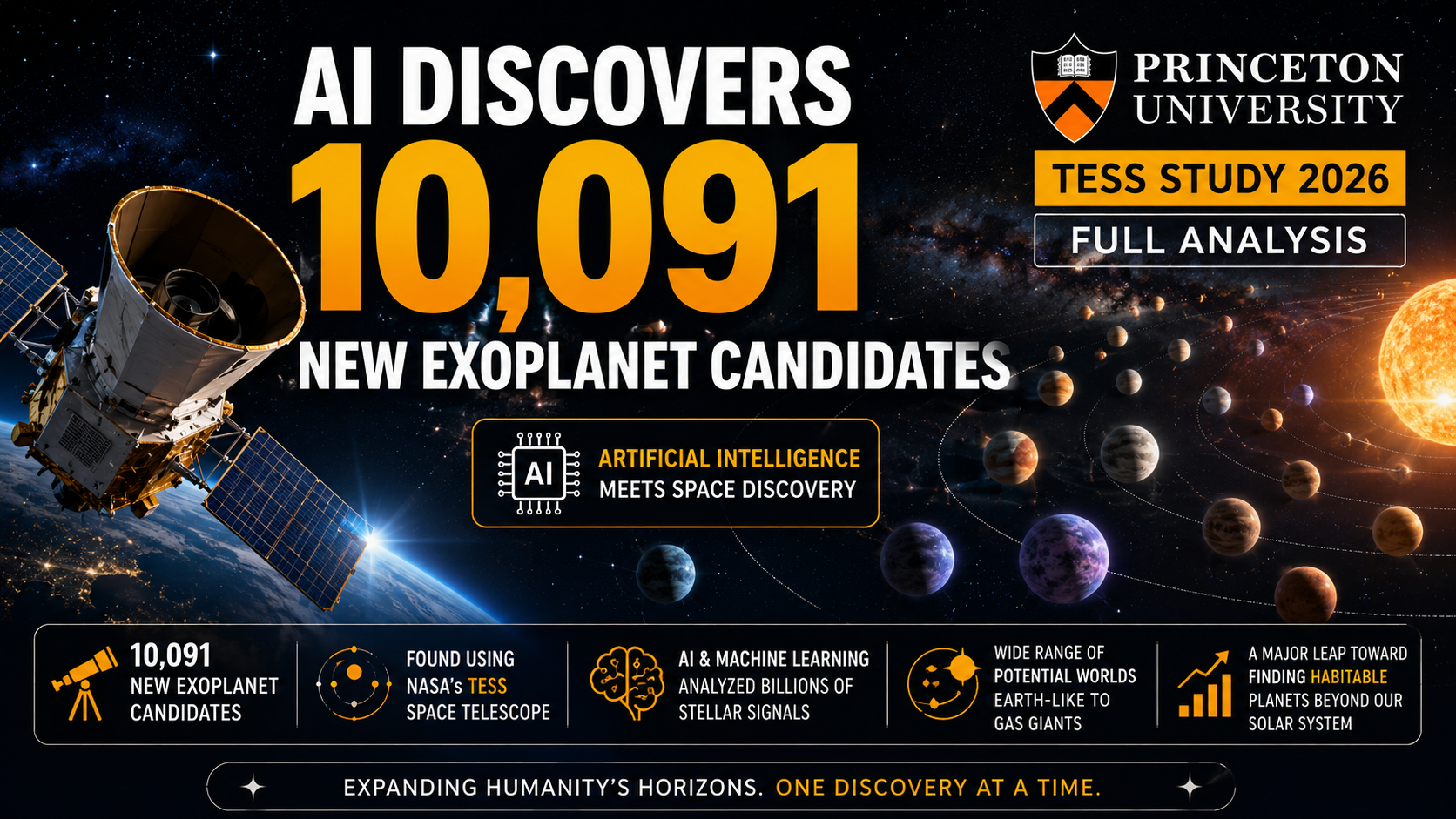
AI Discovers 10,091 New Exoplanet Candidates | Princeton University TESS Study 2026 Full Analysis
READ MORE →
Canada में मिला पहला Hantavirus केस, स्वास्थ्य विभाग अलर्ट पर
READ MORE →