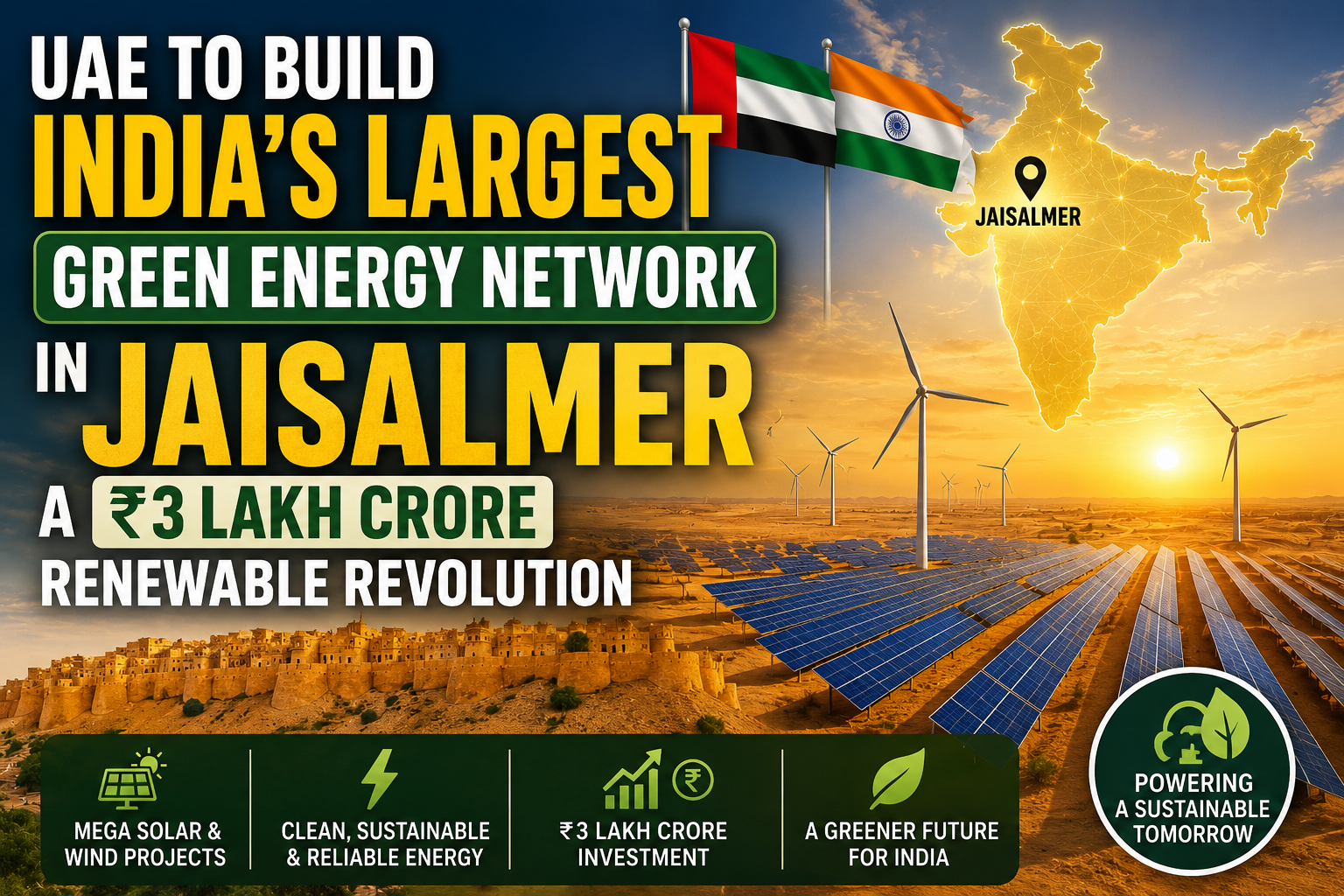
UAE to Build India’s Largest Green Energy Network in Jaisalmer: A ₹3 Lakh Crore Renewable Revolution
UAE to Build India’s Largest Green Energy Network in Jaisalmer: A Game-Changing Renewable Energy Revolution
Jaisalmer, the golden city of Rajasthan, famous for its majestic forts, sweeping sand dunes, and rich cultural heritage, is on the cusp of a remarkable transformation. What was once seen primarily as a tourist destination and a land of harsh deserts is now poised to become one of the world’s most significant green energy powerhouses. In a landmark development, the United Arab Emirates (UAE) has signed a major investment memorandum with the Rajasthan government to develop a massive renewable energy network, with Jaisalmer and surrounding western districts at its core. This ambitious project, targeting around 60 GW of solar, wind, and hybrid capacity with an estimated investment of ₹3 lakh crore (approximately $36 billion), promises to be one of India’s largest green energy initiatives.
This is not just another solar park announcement. It represents a strategic convergence of two nations committed to energy transition — the UAE, a global leader in clean energy innovation, and India, one of the fastest-growing renewable markets. The project could reshape India’s energy landscape, create thousands of jobs, boost the local economy, and significantly contribute to global climate goals.
The Foundation: Why Jaisalmer and Western Rajasthan?
Western Rajasthan, encompassing Jaisalmer, Barmer, and parts of Jodhpur, offers near-perfect conditions for large-scale renewable energy development. The region receives over 300 sunny days annually, with some of the highest solar radiation levels in India. Vast stretches of barren desert land minimize competition with agriculture, while consistent wind patterns in the Thar Desert make it ideal for wind power projects.
Jaisalmer already hosts several pioneering renewable initiatives. Adani Green Energy has developed one of the world’s largest wind-solar hybrid clusters here, including projects of 600 MW and more, supplying clean power to hundreds of thousands of homes. Other developers have commissioned hundreds of MW in solar capacity in areas like Bhimsar, Dwada, Nokh, and Pokhran. These existing projects serve as a strong foundation for the much larger UAE-backed network.
The scale of the proposed UAE project dwarfs previous efforts. A 60 GW capacity would be transformative — equivalent to powering millions of households and offsetting enormous carbon emissions. For context, India’s total renewable capacity crossed 200 GW recently, and this single initiative in one region could add a substantial portion toward national targets.
Details of the UAE-Rajasthan Green Energy Partnership
The investment memorandum was signed in Jaipur in the presence of Rajasthan Chief Minister Bhajan Lal Sharma and UAE Minister of Investment HE Mohamed Hassan Alsuwaidi. The agreement focuses on solar, wind, and hybrid energy projects in western Rajasthan. The UAE will appoint a suitable developer (likely involving Masdar or other UAE entities with global expertise) to execute the project in collaboration with Indian authorities.
Key highlights include:
- Capacity Target: Approximately 60 GW of renewable energy (mix of solar PV, wind, and hybrid systems).
- Investment: Around ₹3 lakh crore, making it one of the largest foreign commitments in India’s renewable sector.
- Components: Large-scale solar parks, wind farms, battery energy storage systems (BESS) for round-the-clock supply, and potentially green hydrogen production facilities.
- Timeline: Still in the exploration and feasibility stage, with detailed project reports, land acquisition, and regulatory clearances to follow. Full realization could span several years, with phased implementation.
- Location Focus: Primarily Jaisalmer and adjacent districts, leveraging existing transmission infrastructure and vast available land.
This partnership builds on broader India-UAE ties in clean energy and aligns with India’s National Green Hydrogen Mission and the UAE’s ambitious net-zero targets by 2050.
Technological Marvels: What the Network Will Look Like
The proposed green energy network will not rely on standalone solar or wind farms. Instead, it will emphasize hybrid systems that combine solar during the day with wind (often stronger at night) for more consistent output. Advanced battery storage will help store excess energy and supply power during non-generation periods, moving closer to 24/7 renewable supply.
Key Technologies Expected:
- Ultra-large solar photovoltaic arrays using high-efficiency bifacial modules.
- Modern wind turbines suited for desert conditions (low wind cut-in speeds, sand-resistant designs).
- Gigawatt-scale battery storage to manage intermittency.
- Smart grid integration and digital monitoring systems.
- Potential green hydrogen electrolyzers powered by dedicated renewable capacity.
UAE companies like Masdar bring world-class expertise. Masdar has developed some of the largest solar projects globally, including the 2 GW Al Dhafra plant, and is expanding into green hydrogen and international markets. Their involvement could introduce cutting-edge efficiency, financing models, and operational excellence to Jaisalmer.
Economic Impact on Jaisalmer and Rajasthan
This project could be a economic lifeline for the region. Jaisalmer has limited industrial activity, and many locals rely on tourism, agriculture (where possible), and traditional occupations. The green energy network is expected to generate thousands of direct and indirect jobs — from construction and installation to operations, maintenance, logistics, and skilled technical roles.
Local communities could benefit through:
- Land leasing revenue for farmers and landowners.
- Skill development programs in solar and wind technology.
- Improved infrastructure — better roads, transmission lines, water management, and digital connectivity.
- Ancillary industries like module manufacturing, component supply, and hospitality for project personnel.
Rajasthan aims to reach 90 GW renewable capacity by 2030, and this project would provide a massive boost. At the national level, it supports India’s goal of 500 GW non-fossil fuel capacity and net-zero by 2070.
Environmental Benefits and Sustainability
The environmental gains are enormous. A 60 GW renewable project could offset tens of millions of tons of CO2 emissions annually, equivalent to removing millions of cars from roads. It promotes desert greening through careful land management practices, such as agrivoltaics (combining solar with limited farming) or biodiversity corridors.
However, large projects in sensitive desert ecosystems require careful planning to minimize impact on local flora, fauna (including endangered species like the Great Indian Bustard), and traditional grazing lands. Sustainable development practices — wildlife-friendly fencing, habitat restoration, and community consultation — will be critical.
Challenges on the Path to Realization
While the vision is inspiring, execution will face hurdles:
- Land Acquisition: Coordinating vast tracts of land while respecting community and environmental concerns.
- Transmission Infrastructure: Evacuating gigawatts of power to load centers requires massive grid upgrades.
- Water Scarcity: Desert regions need innovative solutions for panel cleaning and construction.
- Regulatory and Policy Clarity: Fast-tracking approvals without compromising standards.
- Intermittency and Storage: High costs of battery storage remain a challenge, though prices are falling.
- Local Acceptance: Ensuring benefits reach grassroots level to avoid disputes.
Past projects in Rajasthan have seen delays due to these issues, but stronger India-UAE collaboration and central government support could accelerate progress.
Global Context: UAE’s Clean Energy Ambitions
The UAE is not new to renewables. It hosts some of the world’s largest solar plants and aims for 50% renewable energy in its mix by 2050. Through Masdar and other entities, the UAE is investing billions internationally. This Rajasthan project fits perfectly into its strategy of exporting expertise while securing long-term energy partnerships.
For India, it strengthens energy security, attracts foreign capital, and positions the country as a green energy leader in the Global South.
The Road Ahead: Timeline and Expectations
As of 2026, the project remains in the planning phase. Next steps include detailed feasibility studies, developer selection, environmental clearances, and power purchase agreements. Phased commissioning could begin within 3–5 years for initial capacities, with full scale potentially by the early 2030s.
Success will depend on collaboration between governments, developers, local communities, and financiers. If executed well, Jaisalmer could host one of the largest concentrated renewable energy zones on the planet — a shining example of desert turning into a green powerhouse.
Conclusion: A New Dawn for the Golden City
The UAE’s vision to build India’s largest green energy network in Jaisalmer marks more than an infrastructure project. It symbolizes hope, innovation, and international partnership in the fight against climate change. For the people of Jaisalmer, it offers economic opportunity without sacrificing their desert heritage. For India and the UAE, it strengthens bonds and advances shared sustainability goals.
As the sun continues to blaze over the Thar Desert and winds sweep across the dunes, Jaisalmer is ready to harness nature’s gifts like never before. The golden city is about to shine even brighter — not just with its forts and festivals, but with clean, green power that will light up millions of lives across India and beyond.
This is the beginning of a new chapter. The desert is no longer just a place of mirages — it is becoming a beacon of sustainable energy for the world.
Related Articles
Constitution (131st Amendment) Bill 2026 Explained: Why Women’s Reservation Bill Failed in Lok Sabha
READ MORE →
Census 2027 Self Enumeration: घर बैठे ऑनलाइन जनगणना फॉर्म कैसे भरें | पूरी प्रक्रिया हिंदी में
READ MORE →
8th Pay Commission Update: Deadline बढ़ी, Basic Pay और Pension Demand की पूरी जानकारी
READ MORE →
BTS Concert 2026 World Tour Tickets: Dates, Price, Booking & India Update
READ MORE →
BRICS Meeting 2026 Ends Without Joint Statement Over Iran War | Deep Divisions Between Iran & UAE Exposed
READ MORE →