India No Longer the 4th Largest Economy?
India’s Economy Falls to 6th Place? Understanding the Reality Behind the Ranking Shift
Introduction
For the last few years, India has been celebrated as one of the world's fastest-growing major economies. Headlines frequently highlighted India's rise toward becoming the third-largest economy globally. However, recent reports suggesting that India has slipped to the 6th position in global GDP rankings have created confusion among economists, policymakers, investors, and ordinary citizens.
Many people are asking:
- Has India's economy become weaker?
- Why did India lose its position?
- Is India no longer among the world's top economies?
- What does this mean for India's future growth story?
The truth is more nuanced than sensational headlines suggest.
India's movement in global GDP rankings does not necessarily indicate economic decline. Instead, it reflects a combination of currency movements, GDP measurement methods, global economic fluctuations, and statistical revisions.
This article provides a comprehensive analysis of India's shift to the sixth-largest economy position, examining the causes, implications, challenges, and future outlook.
Understanding GDP Rankings
Before discussing India's position, it is important to understand what GDP rankings actually measure.
GDP (Gross Domestic Product) represents the total monetary value of all goods and services produced within a country during a specific period.
There are two major ways to compare economies globally:
1. Nominal GDP
Nominal GDP measures economic output using current market exchange rates.
This is the ranking most media outlets refer to when they say:
"India is the 4th, 5th, or 6th largest economy."
Because calculations are converted into US dollars, exchange rate movements significantly impact rankings.
2. Purchasing Power Parity (PPP)
PPP adjusts GDP based on local purchasing power.
This method considers:
- Cost of living
- Domestic prices
- Real purchasing capacity
Under PPP measurements, India remains among the world's largest economies.
Current Global GDP Rankings
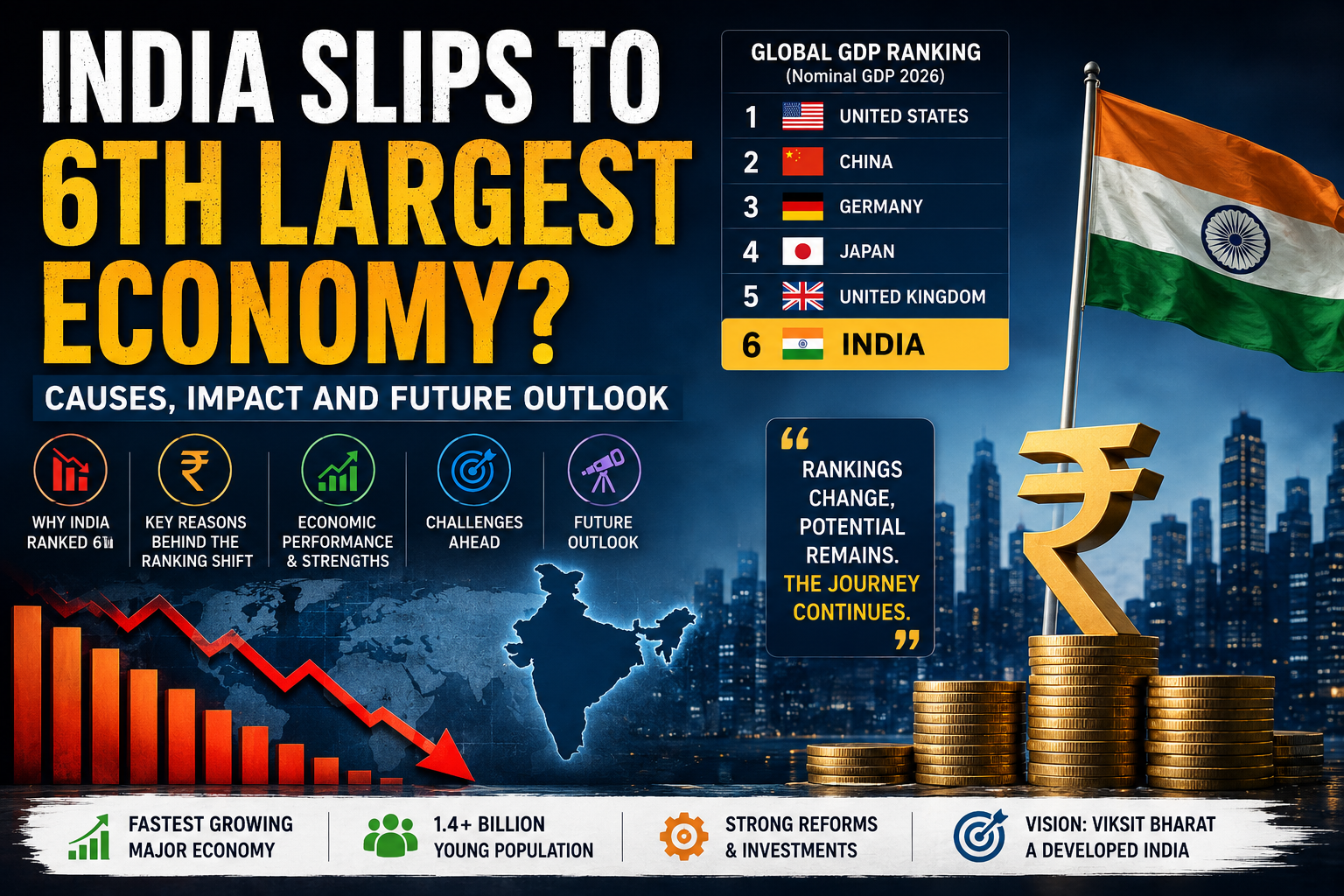
According to recent IMF estimates, the nominal GDP rankings approximately appear as follows:
| Rank | Country | GDP (Approx.) |
|---|---|---|
| 1 | United States | $30+ Trillion |
| 2 | China | $19+ Trillion |
| 3 | Germany | $5+ Trillion |
| 4 | Japan | $4+ Trillion |
| 5 | United Kingdom | $4+ Trillion |
| 6 | India | $4+ Trillion |
The difference between positions four, five, and six is relatively small.
Minor currency fluctuations can alter rankings significantly.
Why Did India Move to 6th Position?
Several interconnected factors contributed to this change.
1. Exchange Rate Depreciation
The most important reason is the depreciation of the Indian Rupee against the US Dollar.
Global GDP rankings use dollars.
Even if India's domestic production increases, a weaker rupee reduces GDP when converted into dollars.
Example
Suppose:
- India's GDP = ₹300 trillion
If:
- 1 USD = ₹75
GDP becomes:
$4 trillion
If:
- 1 USD = ₹85
The same economic output appears smaller in dollar terms.
No actual production is lost.
Only conversion changes.
This factor alone can shift rankings.
2. Stronger Performance of Other Economies
India's growth remained strong.
However:
- Japan stabilized
- UK performed better than expected
- Germany maintained industrial output
When other countries improve simultaneously, relative rankings change.
Economic rankings are comparative, not absolute.
3. Global Inflation Effects
Many developed countries experienced inflation.
Inflation increased nominal GDP values.
As a result:
- Dollar-denominated GDP expanded.
- Developed economies appeared larger.
This temporarily affected rankings.
4. GDP Revisions
International organizations periodically revise:
- Growth estimates
- Statistical methodologies
- Historical calculations
Such revisions can alter rankings even without dramatic economic changes.
Is India's Economy Actually Weakening?
The answer is largely no.
Several indicators continue showing strong performance.
Economic Growth Rate
India remains among the fastest-growing major economies.
Recent growth rates remain significantly higher than:
- United States
- Germany
- United Kingdom
- Japan
Many developed nations grow at:
1–2%
India often grows between:
6–8%
This growth differential remains one of India's biggest strengths.
Rising Domestic Consumption
India's population exceeds 1.4 billion.
A growing middle class drives demand for:
- Housing
- Smartphones
- Vehicles
- Education
- Healthcare
- Financial services
Consumption remains a powerful growth engine.
Manufacturing Expansion
Government initiatives such as:
Make in India
aim to increase manufacturing output.
Key sectors include:
- Electronics
- Mobile phones
- Automobiles
- Semiconductors
- Defence production
India has become one of the world's largest smartphone manufacturing hubs.
Infrastructure Boom
India is investing heavily in:
- Expressways
- Airports
- Railways
- Ports
- Metro networks
Infrastructure spending supports long-term productivity growth.
Major projects include:
- Dedicated Freight Corridors
- Bharatmala
- Sagarmala
- Vande Bharat expansion
Digital Economy Growth
India has built one of the world's most advanced digital public infrastructures.
Examples include:
- UPI
- Aadhaar
- DigiLocker
- FASTag
UPI transactions now process billions of payments monthly.
This digital transformation boosts efficiency and economic activity.
Foreign Direct Investment (FDI)
India continues attracting global investors.
Major multinational companies invest in:
- Technology
- Manufacturing
- Renewable energy
- E-commerce
Global corporations increasingly view India as an alternative manufacturing destination.
India's Biggest Strengths
Massive Population
India possesses the world's largest population.
This creates:
- Labor availability
- Consumer demand
- Entrepreneurial opportunities
Few countries possess both large markets and large workforces.
Young Workforce
India's median age remains significantly lower than:
- Japan
- Germany
- China
A younger population supports:
- Productivity
- Innovation
- Long-term growth
This demographic advantage may last decades.
Technology Sector
India's IT industry remains globally competitive.
Major strengths include:
- Software exports
- Artificial Intelligence
- Cloud computing
- Cybersecurity
- Business process outsourcing
Indian tech professionals are present across global technology firms.
Startup Ecosystem
India has become one of the world's largest startup hubs.
Key sectors:
- FinTech
- EdTech
- HealthTech
- SaaS
- AI
Thousands of startups continue emerging annually.
Challenges Facing India
Despite strong growth, several obstacles remain.
Unemployment
Job creation remains a major challenge.
India must create millions of jobs annually to absorb new workers entering the labor force.
Skill mismatch remains an issue.
Income Inequality
Economic growth is not evenly distributed.
Large differences exist between:
- Urban and rural areas
- Rich and poor households
Inclusive growth remains essential.
Agricultural Dependence
A significant population still depends on agriculture.
However:
- Agricultural productivity remains relatively low.
- Farm incomes require improvement.
Modernization is necessary.
Education Quality
India has expanded access to education.
However, challenges remain regarding:
- Learning outcomes
- Technical skills
- Employability
Human capital development will determine future competitiveness.
Healthcare Infrastructure
Although improvements continue, healthcare access remains uneven.
Investment is needed in:
- Hospitals
- Medical education
- Rural healthcare
Healthy populations support economic growth.
Why Rankings Alone Can Be Misleading
Rankings often create dramatic headlines.
However, they don't tell the complete story.
For example:
A country may rank higher because:
- Currency appreciated.
- Inflation increased.
- Statistical revisions occurred.
Meanwhile another country may:
- Produce more goods.
- Create more jobs.
- Grow faster.
Yet appear lower temporarily.
Therefore rankings should not be interpreted in isolation.
Nominal GDP vs PPP: The Real Difference
This distinction is crucial.
Nominal GDP
Measures international economic size.
Useful for:
- Global finance
- Debt markets
- International trade
PPP GDP
Measures domestic purchasing power.
Useful for:
- Living standards
- Economic capacity
- Real output comparison
Under PPP measurements, India remains among the world's largest economies and continues holding a much stronger position.
Can India Become the Third Largest Economy?
Most economists believe the answer is yes.
Several factors support this expectation.
Faster Growth Than Developed Economies
India's growth rates consistently exceed those of:
- Germany
- Japan
- United Kingdom
Over time, faster growth compounds significantly.
Expanding Manufacturing
India seeks to become a global manufacturing hub.
If successful, GDP could rise substantially.
Digital Transformation
Technology adoption is accelerating productivity.
AI, automation, digital payments, and e-governance can contribute significantly to growth.
Infrastructure Investments
Modern infrastructure reduces costs and improves efficiency.
This enhances competitiveness.
Demographic Dividend
A young workforce remains one of India's greatest advantages.
If properly skilled and employed, it can generate enormous economic gains.
The Role of Artificial Intelligence in India's Future Economy
AI may become a major growth driver.
Applications include:
- Agriculture
- Healthcare
- Education
- Manufacturing
- Financial services
AI can:
- Increase productivity
- Reduce costs
- Improve decision-making
India's large IT talent pool provides a strong foundation.
Global Economic Risks
Several external risks could affect India's trajectory.
Geopolitical Conflicts
Wars and tensions can disrupt:
- Energy markets
- Trade routes
- Supply chains
Oil Prices
India imports significant amounts of crude oil.
Higher oil prices increase:
- Inflation
- Import bills
Global Recession
Economic slowdowns in major markets affect exports.
Currency Volatility
Exchange rate fluctuations can influence GDP rankings.
What Should India Focus On?
To become a top-three economy sustainably, India should prioritize:
Job Creation
Generating employment opportunities at scale.
Manufacturing Expansion
Increasing industrial output.
Education Reform
Improving skills and productivity.
Infrastructure Development
Enhancing connectivity and logistics.
Innovation
Supporting research and technology.
Ease of Doing Business
Attracting domestic and foreign investment.
What This Means for Ordinary Indians
Most citizens should not worry about a temporary ranking change.
What matters more is:
- Income growth
- Employment opportunities
- Quality education
- Better healthcare
- Improved infrastructure
If these areas improve, economic progress continues regardless of short-term ranking movements.
Expert Perspective
Many economists view India's movement to the sixth position as largely statistical rather than structural.
Key observations include:
- Growth remains strong.
- Consumption remains robust.
- Investment continues increasing.
- Demographic advantages persist.
The long-term trajectory remains positive.
Conclusion
India's shift to the sixth-largest economy position in nominal GDP rankings does not indicate economic decline. The change primarily reflects currency fluctuations, comparative performance among major economies, inflation effects, and statistical revisions.
India continues to be one of the world's fastest-growing major economies, supported by a young population, expanding digital infrastructure, rising manufacturing capacity, and significant infrastructure investments.
While challenges such as unemployment, inequality, education quality, and healthcare remain, the country's long-term fundamentals remain strong.
Rather than focusing solely on rankings, the more important question is whether India can sustain high growth, create quality jobs, improve living standards, and build a globally competitive economy.
If current trends continue and reforms accelerate, India remains well-positioned to become one of the world's top three economies in the coming decades.
The real story is not that India fell to sixth place. The real story is whether India can convert its enormous potential into sustained economic leadership for the 21st century.
Related Articles
India’s Union Budget FY 2026-27: ₹53.47 Lakh Crore Detailed Overview, Sector-Wise Allocation & Impact
READ MORE →
India-Austria Relations 2026: A Strategic Partnership for Defense & Trade
READ MORE →
India vs China: Why China Is Ahead of India (From 1947 to 2026 Explained)
READ MORE →