Trump China Visit 2026 with Elon Musk Tim Cook Jensen Huang: Reasons, Deals & Analysis
Trump’s Historic China Visit 2026 with Elon Musk, Tim Cook, and Top CEOs: Reasons, Strategies, Outcomes, and Global Implications –
Part 1: Background and Strategic Context of Trump’s China Visit
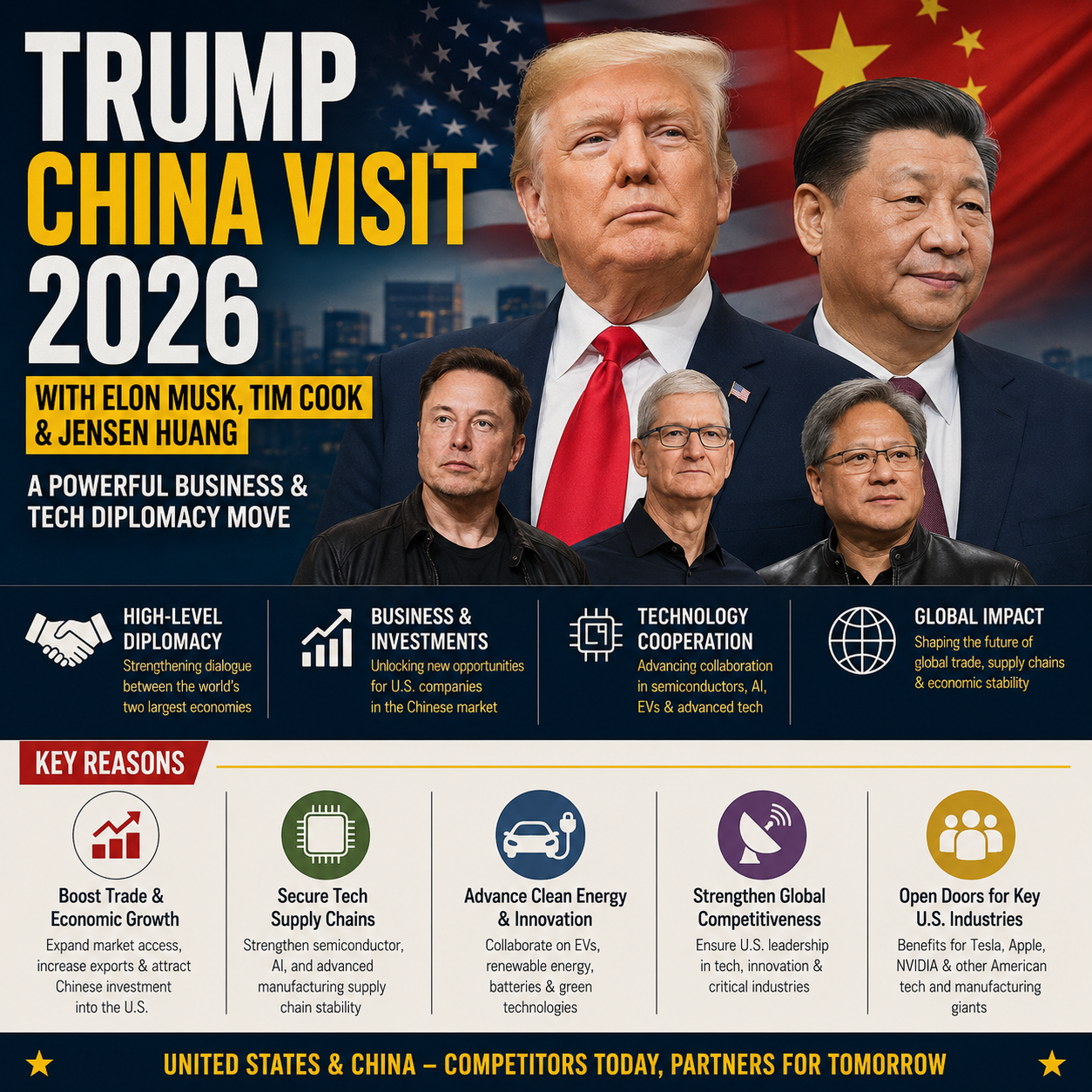
The High-Stakes Summit in Beijing In mid-May 2026, U.S. President Donald Trump undertook a significant state visit to Beijing, China, from May 13 to 15. This marked his first trip to China in nearly a decade since his previous presidential term. What made this visit particularly notable was the inclusion of a powerful delegation of American business leaders, prominently featuring Tesla and SpaceX CEO Elon Musk, Apple CEO Tim Cook, Nvidia CEO Jensen Huang, BlackRock’s Larry Fink, and executives from Boeing, Goldman Sachs, Cargill, and more — totaling around 16-17 top CEOs.
This was not a routine diplomatic trip. It occurred against a backdrop of ongoing U.S.-China strategic competition, trade tensions, technological rivalry in AI and semiconductors, and global disruptions caused by conflicts in West Asia affecting oil supplies through the Strait of Hormuz.
Why Trump Chose to Bring Business Leaders Trump’s decision to include Musk, Cook, Huang, and others was a calculated strategic move. By bringing America’s corporate heavyweights, Trump aimed to shift the narrative from pure government-to-government confrontation to pragmatic business engagement. He publicly stated his intention to ask President Xi Jinping to “open up” China so these executives could “work their magic.”
Key Reasons Behind the Visit
- Trade Rebalancing: Address persistent trade imbalances, tariffs, and market access issues.
- Technology and AI Cooperation/Competition Management: Discussions on semiconductors, export controls, and AI governance.
- Energy and Geopolitical Stability: Coordination on Iran-related disruptions and global oil prices.
- Investment and Market Access: Seeking better opportunities for U.S. companies in China while pushing for reciprocity.
- Domestic U.S. Economic Signaling: Demonstrating to American businesses and voters that the administration was actively creating opportunities abroad.
Historical Context of U.S.-China Relations Under Trump Trump’s first term (2017-2021) was defined by a trade war, tariffs on hundreds of billions of Chinese goods, and a tough stance on technology theft and intellectual property. The Phase One trade deal in 2020 provided some relief but left many issues unresolved. In his second term, Trump adopted a more transactional approach — combining pressure with deal-making, while leveraging personal rapport with Xi.
The Role of Key CEOs
- Elon Musk (Tesla/SpaceX): Tesla has a major Gigafactory in Shanghai. Musk’s presence highlighted interests in EV market access, battery technology, and broader SpaceX-related discussions.
- Tim Cook (Apple): Apple relies heavily on Chinese manufacturing and the Chinese consumer market. Cook’s participation underscored supply chain stability and market access.
- Jensen Huang (Nvidia): Central to AI chip discussions amid U.S. export restrictions.
- Others like Larry Fink (BlackRock) represented finance and investment flows.
This CEO-heavy delegation signaled a “whole-of-nation” approach, blending government diplomacy with corporate interests.
Global Timing The visit coincided with rising oil prices due to Middle East tensions, concerns over Taiwan, and domestic U.S. economic priorities. Trump positioned the trip as an opportunity to stabilize relations and deliver economic wins.
(Expanded section would include detailed timelines, previous Trump-Xi meetings, evolution of bilateral trade data from 2016-2026, expert analyses on decoupling vs. de-risking strategies, and geopolitical risk assessments.)
Detailed Reasons and Motivations
Economic Motivations U.S.-China bilateral trade exceeds $500-600 billion annually. The U.S. maintains a significant trade deficit. Trump aimed to secure commitments on agricultural purchases, manufacturing investments, and reduced non-tariff barriers.
Tech and AI Strategy With AI emerging as a critical domain, the U.S. seeks to manage competition without full decoupling. Bringing Nvidia’s Huang aimed at potential easing of chip restrictions in exchange for Chinese market openings or investment guarantees.
Corporate Lobbying and Interests Many U.S. firms have deep exposure to China: Apple’s supply chain, Tesla’s production, Boeing’s sales, and Wall Street’s asset management. CEOs joined to directly advocate for their companies and gain insights from high-level meetings.
Geopolitical and Security Angles Discussions covered Iran, the Strait of Hormuz, fentanyl precursors, and Taiwan. Shared interest in regional stability provided common ground despite rivalry.
Domestic Political Calculus Trump showcased “America First” through strong negotiation backed by business support, countering criticisms of being too confrontational or too soft.
China’s Perspective China, facing economic slowdown pressures and export challenges, welcomed the high-level engagement. Xi’s message of “opening wider” to U.S. businesses was a key outreach.
(Deep dive would cover statistics on U.S. FDI in China, Chinese FDI in U.S., sector-specific dependencies, impact of tariffs, supply chain vulnerabilities, and analyses from think tanks like CSIS, Brookings, etc.)
Strategies Employed by Trump Administration
The “Business Delegation” Leverage Strategy By including CEOs, Trump created a unique dynamic: Xi and Chinese leaders engaged directly with influential American business voices, potentially bypassing bureaucratic hurdles.
Personal Diplomacy Trump’s longstanding emphasis on personal relationships with Xi was evident. He praised Xi as a leader “respected by all” and introduced each CEO personally during the banquet.
Transactional Bargaining The approach mixed demands (market access, IP protection, reduced subsidies) with offers (potential tariff adjustments, tech cooperation frameworks).
Multilateral Backdrop While bilateral, the visit occurred amid broader U.S. alliances (QUAD, AUKUS, EU engagement) and India’s parallel diplomatic efforts, giving Trump additional leverage.
Public Communication Strategy Trump used Truth Social and media appearances to frame the visit positively, emphasizing “fantastic deals” and American strength.
Risk Management The delegation helped mitigate perceptions of weakness while avoiding over-reliance on government-only talks that often stall.
(Expanded with game theory perspectives, negotiation tactics, role of backchannel diplomacy, comparison with Biden-era strategies, and potential scenarios for outcomes.)
Key Events, Discussions, and Immediate Outcomes
Arrival and Ceremonial Aspects Trump arrived on Air Force One with the CEO delegation. Highlights included a state banquet at the Great Hall of the People, meetings with Premier Li Qiang, and a visit to the Temple of Heaven with Xi.
Bilateral Meetings Extended talks (over 2 hours) covered trade access, agricultural buys, technology, fentanyl, Iran, and Taiwan. No sweeping new trade deal was announced immediately, but both sides stressed cooperation and avoiding escalation.
CEO Engagements Separate meetings with Chinese Premier and business leaders. Xi assured that China would “open wider.” CEOs expressed commitment to the Chinese market.
Outcomes
- Renewed commitment to dialogue mechanisms.
- Potential sector-specific progress (EVs, chips, finance).
- Invitation for Xi to visit the U.S. later in 2026.
- Symbolic wins for business confidence.
Market Reactions Immediate impacts on stock prices for Tesla, Apple, Nvidia, etc., and broader market sentiment.
(Detailed timeline of the visit days, key quotes from Trump, Xi, Musk, Cook; analysis of speeches; expert commentary on what was achieved vs. expectations.)
Global Implications, Criticisms, and the Road Ahead
Broader Geopolitical Impact The visit helped stabilize the world’s most important bilateral relationship amid multiple global crises. It demonstrated pragmatic engagement over pure confrontation.
Implications for Global Supply Chains and Tech Potential easing of tensions could benefit multinational corporations but raise questions about U.S. strategic dependencies.
Criticisms
- Some viewed the CEO inclusion as corporate capture or weakness.
- Concerns over human rights, Taiwan, and technology security not being prioritized enough.
- Questions on long-term effectiveness without structural changes.
Future Outlook Expect follow-up working groups, possible mini-deals, and continued strategic competition alongside cooperation. The visit sets the tone for U.S.-China relations in the latter half of the 2020s.
Conclusion: A New Chapter in Great Power Diplomacy Trump’s 2026 China visit with Musk, Cook, Huang, and other CEOs represents a bold, business-centric approach to managing superpower rivalry. While deliverables were modest, the symbolism and direct engagement could pave the way for more predictable relations, benefiting global economic stability.
Related Articles
India’s Union Budget FY 2026-27: ₹53.47 Lakh Crore Detailed Overview, Sector-Wise Allocation & Impact
READ MORE →
India-Austria Relations 2026: A Strategic Partnership for Defense & Trade
READ MORE →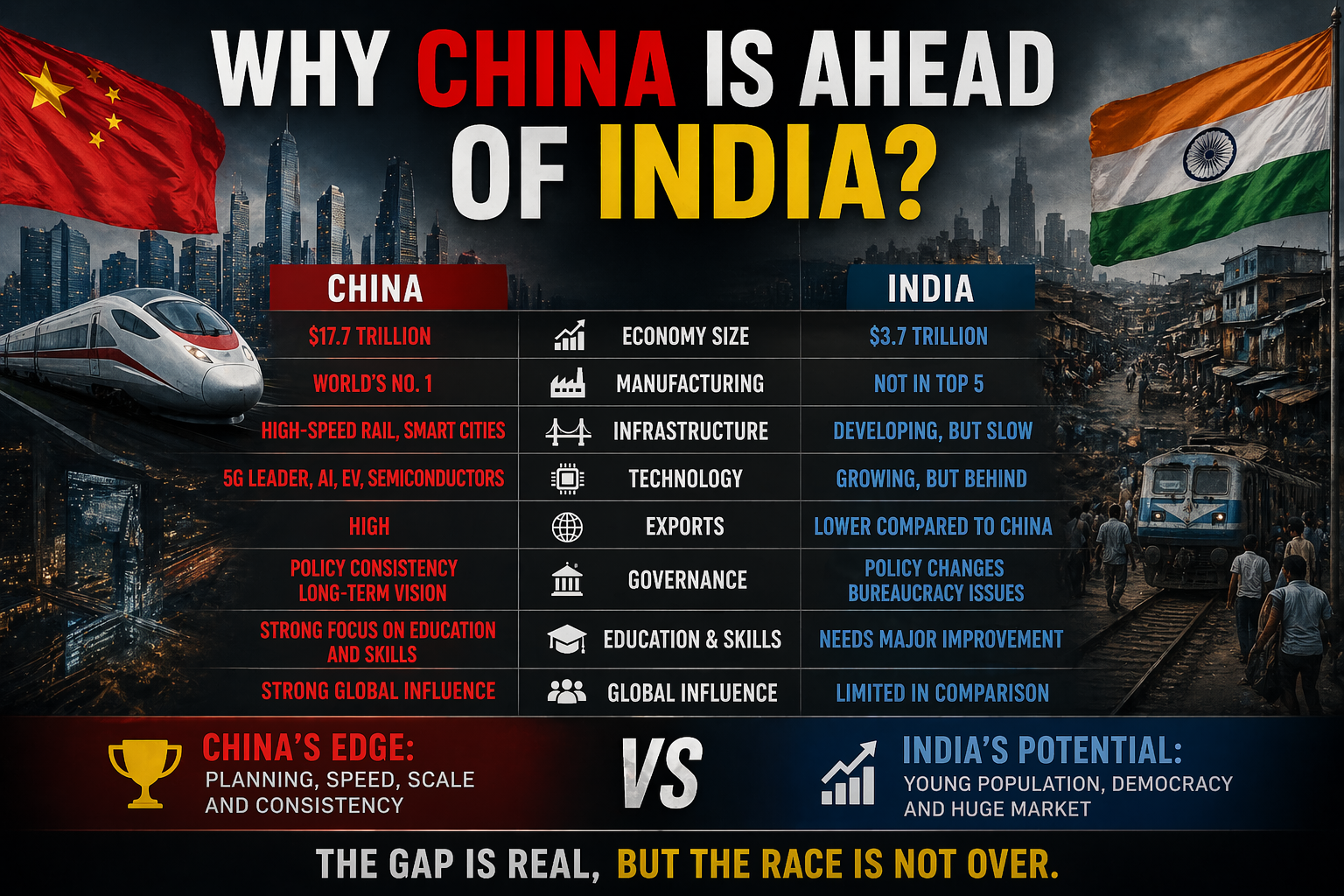
India vs China: Why China Is Ahead of India (From 1947 to 2026 Explained)
READ MORE →
Indian vs Global Education System: Key Differences
READ MORE →